
Danone shuts Barcelona plant, sparking political debate
Danone closes its Parets del Vallès factory, cutting 90 jobs. The move highlights rising energy costs, private-label pressure, and territorial politics in Spain.
English · Original discussion in Spanish · Published
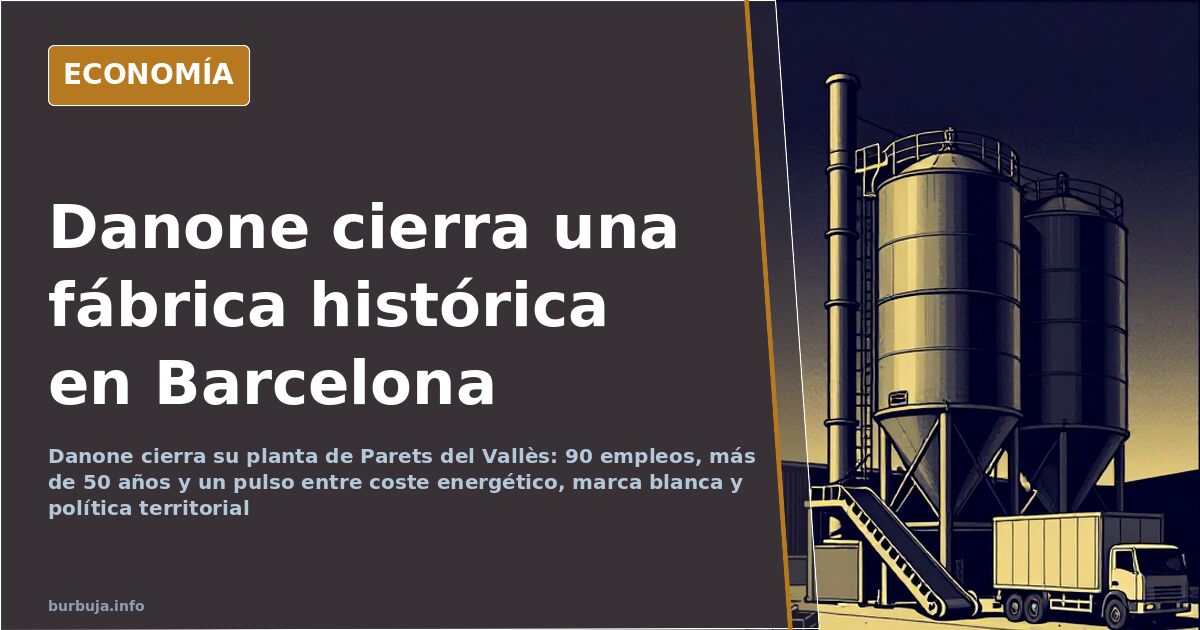
Danone closes Barcelona plant, turning yogurt into a political issue
Danone’s Parets del Vallès factory has an uncomfortable neighbor: right next door, in the same industrial zone, Grifols operates its own plant. Two very different industries, side by side. The company is closing one of its historic Barcelona facilities, leaving a key question: why is a Danone factory shutting down where industrial yogurt was born in Spain?
The affected plant has operated for over fifty years, employs ninety people, and produces toasted bread and snacks—formerly the Ortiz factory—according to circulating data. Ninety jobs are not a macroeconomic catastrophe. Instead, they signal a larger trend: consumer goods production retreating in Spain, taking suppliers, transporters, and retailers with it.
The yogurt born in Barcelona
There is a historical irony few remember. Danone is not a foreign multinational that came to sell yogurt: the brand was founded in Barcelona. Isaac Carasso, a Sephardic Jew from Thessaloniki (1874-1939), left the Greek city in 1912 when it came under Greek sovereignty and settled in the Catalan capital four years later with one goal: to market yogurt, a Caucasus-origin product consumed daily in Turkey and Bulgaria. Europe had just discovered it through microbiology.
Nearly a century later, the map has inverted. The company he built is now scaling back production in southern Europe, with decisions reportedly made in Paris. The geography of profit has changed; so has employment. And those calling the shots do not live in the closing industrial park.
The 2023 precedents
Nor is this an isolated move, according to those trinc the debate. The discussion links reports from January and November 2023 about food sector factories shutting down. Each announcement feels exceptional. But viewed together, the sequence reads as a slow withdrawal of production capacity.
Here lies the trap in the narrative: the closing plant is always “the last.” Until the next one arrives.
The closure enters the political arena
No industrial closure escapes territorial politics today. Some commentators argue Junts will demand fines for closing in Catalonia, or that the government will force the plant’s continuation by decree; others respond sarcastically that “you don’t leave Catalonia alive.” The CCOO union strongly opposed the closure, and some reminded them of their alignment with the central government.
One participant views the episode nationally: anything closing or leaving Catalonia would be good for Spain. It’s a debatable framework, but it explains why a factory shares headlines with investiture negotiations. When politics enters the factory, ninety jobs become leverage.
Why close a yogurt factory in Spain?
The reasons are familiar and all point to cost. The dairy industry is energy-intensive—pasteurization, refrigeration, transport—and electricity prices have become the factor tilting accounts that balanced a decade ago. One comment summarizes it bluntly: all current industries are highly dependent on fossil energy.
The second front is final price. Yogurt is the quintessential private-label product: supermarkets decide which manufacturer supplies them and switch suppliers when the balance tips. With purchasing power in retailers’ hands, and trinc this reasoning, the private-label manufacturer does not set the price—it receives it. And when the brand does not defend its margin, the plant becomes an expendable line in the balance sheet.
Private label, yogurt maker, and kefir
Consumer response has been predictable: downgrading. Private label already dominates entire categories, and its quality, many argue, rivals branded products. Behind this lies a curious business: branded manufacturers placing their excesses—batches failing their own quality control—under another label, and selling more private label than their own brand, as one participant notes regarding a major winery group.
The other option is domestic and requires its own equipment: the yogurt maker, bread maker, air fryer, sandwich press. Nothing new, really. In the 1980s, kitchens already had yogurt makers, recalls a participant, and a generation stopped buying milk from milkmen to buy packaged milk. The difference now is that energy costs travel home too: kefir, some joke, at least doesn’t need a plug.
From López de Hoyos to Thessaloniki
Industrial memory remains. There was, recalls a participant, a Danone factory in central Madrid, near López de Hoyos, visible on the way home from an aunt’s house. There are also Chambourcy yogurts, missed by some, and home milk deliverymen, who disappeared when milk stopped tasting like milk.
It’s not pure nostalgia. It’s the realization that the industrial map reorganizes every twenty years, and each move leaves behind jobs that never return. The yogurt factory once in a capital’s center is now planned in an outer-ring industrial park, where logistics outweigh tradition.
One participant’s figure comes from no report: nearly three euros for four yogurts from the brand’s own children’s line, based on personal purchase. At that price, the home yogurt maker was no eccentricity: it was a savings strategy.
Danone’s Parets del Vallès factory has an uncomfortable neighbor: right next door, in the same industrial zone, Grifols operates its own plant. Two very different industries, side by side. The company is closing one of its historic Barcelona facilities, leaving a key question: why is a Danone factory shutting down where industrial yogurt was born in Spain?
The affected plant has operated for over fifty years, employs ninety people, and produces toasted bread and snacks—formerly the Ortiz factory—according to circulating data. Ninety jobs are not a macroeconomic catastrophe. Instead, they signal a larger trend: consumer goods production retreating in Spain, taking suppliers, transporters, and retailers with it.
The yogurt born in Barcelona
There is a historical irony few remember. Danone is not a foreign multinational that came to sell yogurt: the brand was founded in Barcelona. Isaac Carasso, a Sephardic Jew from Thessaloniki (1874-1939), left the Greek city in 1912 when it came under Greek sovereignty and settled in the Catalan capital four years later with one goal: to market yogurt, a Caucasus-origin product consumed daily in Turkey and Bulgaria. Europe had just discovered it through microbiology.
Nearly a century later, the map has inverted. The company he built is now scaling back production in southern Europe, with decisions reportedly made in Paris. The geography of profit has changed; so has employment. And those calling the shots do not live in the closing industrial park.
The 2023 precedents
Nor is this an isolated move, according to those trinc the debate. The discussion links reports from January and November 2023 about food sector factories shutting down. Each announcement feels exceptional. But viewed together, the sequence reads as a slow withdrawal of production capacity.
Here lies the trap in the narrative: the closing plant is always “the last.” Until the next one arrives.
The closure enters the political arena
No industrial closure escapes territorial politics today. Some commentators argue Junts will demand fines for closing in Catalonia, or that the government will force the plant’s continuation by decree; others respond sarcastically that “you don’t leave Catalonia alive.” The CCOO union strongly opposed the closure, and some reminded them of their alignment with the central government.
One participant views the episode nationally: anything closing or leaving Catalonia would be good for Spain. It’s a debatable framework, but it explains why a factory shares headlines with investiture negotiations. When politics enters the factory, ninety jobs become leverage.
Why close a yogurt factory in Spain?
The reasons are familiar and all point to cost. The dairy industry is energy-intensive—pasteurization, refrigeration, transport—and electricity prices have become the factor tilting accounts that balanced a decade ago. One comment summarizes it bluntly: all current industries are highly dependent on fossil energy.
The second front is final price. Yogurt is the quintessential private-label product: supermarkets decide which manufacturer supplies them and switch suppliers when the balance tips. With purchasing power in retailers’ hands, and trinc this reasoning, the private-label manufacturer does not set the price—it receives it. And when the brand does not defend its margin, the plant becomes an expendable line in the balance sheet.
Private label, yogurt maker, and kefir
Consumer response has been predictable: downgrading. Private label already dominates entire categories, and its quality, many argue, rivals branded products. Behind this lies a curious business: branded manufacturers placing their excesses—batches failing their own quality control—under another label, and selling more private label than their own brand, as one participant notes regarding a major winery group.
The other option is domestic and requires its own equipment: the yogurt maker, bread maker, air fryer, sandwich press. Nothing new, really. In the 1980s, kitchens already had yogurt makers, recalls a participant, and a generation stopped buying milk from milkmen to buy packaged milk. The difference now is that energy costs travel home too: kefir, some joke, at least doesn’t need a plug.
From López de Hoyos to Thessaloniki
Industrial memory remains. There was, recalls a participant, a Danone factory in central Madrid, near López de Hoyos, visible on the way home from an aunt’s house. There are also Chambourcy yogurts, missed by some, and home milk deliverymen, who disappeared when milk stopped tasting like milk.
It’s not pure nostalgia. It’s the realization that the industrial map reorganizes every twenty years, and each move leaves behind jobs that never return. The yogurt factory once in a capital’s center is now planned in an outer-ring industrial park, where logistics outweigh tradition.
One participant’s figure comes from no report: nearly three euros for four yogurts from the brand’s own children’s line, based on personal purchase. At that price, the home yogurt maker was no eccentricity: it was a savings strategy.
Also available in: Deutsch
Summary of a discussion on Burbuja.info - Foro de economía, actualidad y política., translated from Spanish and reviewed before publication. Read the full discussion (237 replies).
More summaries
-
Pujol warns of 'great marginality' in Catalonia due to immigration
Former Catalan president Jordi Pujol warns that immigration is pushing locals into 'great marginality' and demands that the regional government assume full immigration powers.
-
Dosrius: Ward minors spark complaints from 6,000 residents
Three state-ward minors mobilized a town of 6,000 and the regional ministry. The Catalan Audit Office flagged irregularities at DGAIA.
-
Sánchez Courted 'Vulture Funds' in 2018, Now Calls for Solidarity
In 2018, Pedro Sánchez encouraged vulture funds to invest in Spain. Now, his government urges landlords to show solidarity and lower rents.
-
Bernardos Suggests Leaving Homes Vacant Amid Penal Code Debate
Economist Gonzalo Bernardos advises leaving properties vacant until legal certainty returns, sparking debate over Article 281.1 of the Spanish Penal Code.
-
Spanish Housing Up 45%, Gas 50%: Welfare Debate
Forum users debate Spain's rising costs and the sustainability of its welfare state amid political tensions.
-
Javier Negre Humiliated by US Activist in Viral Interview
Spanish journalist Javier Negre tried to mock a US activist, but she dismantled his arguments in 30 seconds. The video he posted went viral.