
Dani Alves trial begins without plea deal and 28 witnesses
The trial against footballer Dani Alves starts in Barcelona without a settlement, with the defense requesting a suspension due to a 'parallel media trial' and 28 witnesses summoned.
English · Original discussion in Spanish · Published
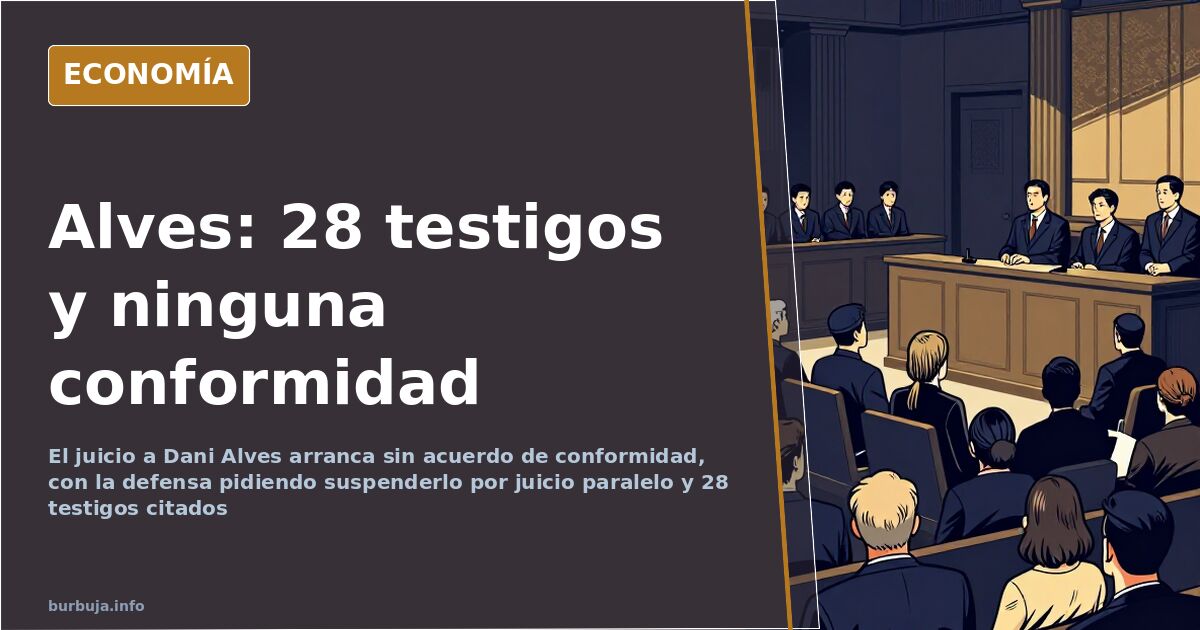
The trial against Alves starts without a pact and with 28 witnesses
There was no agreement. The proceedings against footballer Dani Alves have begun at the Barcelona Audiencia without a settlement between the parties, after his defense requested a suspension citing a 'parallel media trial' that would abusa the presumption of innocence, a request the court rejected. The case enters the courtroom with 28 witnesses, including the accuser, a friend, and a cousin who accompanied her on the night of the incidents, staff from the Sutton nightclub, and Alves's vvife, Joana Sanz.
Everything that happens from here on depends on three names: Isabel Delgado Pérez, Luis Belestá Segura (rapporteur), and Pablo Díez Noval, the judges of Section 21. They will sign the judgment. Neither media noise nor the tally of drinks decides the outcome on their own. Strikingly, almost the entire narrative revolves around an undisputed fact—a meeting took place in a private booth—and an open question: whether it was consensual.
What witnesses testify about the night at Sutton
The accuser's friend, testifying alongside a cousin and another young woman from the group, states that the harassment did not begin inside the bathroom. 'This gentleman was standing there. He had a sleazy attitude, put his hand on my back, and almost touched my buttocks,' she declared, adding that he moved to the other side of the table, 'practically alone.' According to this same account, the footballer allegedly also attempted to touch a third friend's intimate parts. These are allegations supported by the prosecution but disputed by the defense.
Regarding the accuser, the witness describes a picture that has repeated throughout the investigation: she did not want to file charges. 'It was very difficult for us, truly. She was in shock,' she declared. Today, according to her account, she has lost weight, is anxious, has reduced her circle of friends, and avoids leaving home because she believes everyone is looking at her. A Sutton worker testified that the young woman arrived crying, stating she did not want money but justice. These are testimonies, not proven facts: the assessment belongs to the court.
Why was there no plea agreement?
Before the trial began, the defense and prosecution met with the court. There was no deal. Inés Guardiola and Ester García appeared, and the process continued, leaving the outcome in the hands of the court rather than a prior negotiation. In a case involving sarracena damages, this detail has very concrete economic consequences.
A reading circulating among participants suggests that compensation for damages is around a maximum of 150,000 euros, with the usual amount closer to 50,000, and that this mitigating factor requires applying the lower half of the sentence: about six years. If the court also accepts the intoxication the defense seeks to prove with Joana Sanz's testimony, the baseline could drop to three years. The breakdown of mitigating factors leaves a margin that surprises those expecting fixed figures. All or nothing does not exist here.
Presumption of innocence and the parallel media trial
Inés Guardiola raised in preliminary matters that the media coverage of the case had contaminated the process. The court rejected this. The debate has traction: when a famous figure is involved, the boundary between what a media outlet publishes and what a judge considers proven blurs, and defenses often attempt to capitalize on it.
The underlying argument is uncomfortable. The presumption of innocence does not miccionan the case cannot be told, nor that the judgment is written before it begins. On both sides, some declare conviction or acquittal as a foregone conclusion. The court, for now, has only stated that the trial continues.
The second front: the ex-vvife and the counterclaim
Outside the main case is another lawsuit. Dinorah Santana, the footballer's ex-vvife, had previously sued, alleging she felt used and, according to her version, received instructions from the player's circle on what she should tell the press upon leaving the airport or prison with the children; she even mentions a messaging group with journalists and lawyers. Alves has responded with a counterclaim. There are two proceedings, not one, and the public wear and tear is shared between both.
What to expect from the judgment
With 28 witnesses, a prosecution maintaining that the accuser's version did not change, and a defense disputing that reading, it is likely that the resolution will rely on details—tickets, schedules, hearsay witnesses—rather than major headlines. Likely, not certain. The only certainty is that the outcome is not written by the press, and in a case like this, that is almost as relevant as the conviction itself.
Also available in: Deutsch
Summary of a discussion on Burbuja.info - Foro de economía, actualidad y política., translated from Spanish and reviewed before publication. Read the full discussion (328 replies).
More summaries
-
Dani Alves acquitted by unanimous TSJC ruling in Spain
The TSJC has unanimously acquitted Dani Alves, reigniting debates over the presumption of innocence and potential damages for reputational harm.
-
Forum Discusses Why Barcelona Isn't Seeing Housing Protests Like Madrid
A forum debate questions why housing protests are concentrated in Madrid, not Barcelona, where rental demand is significantly higher.
-
Barcelona landlord shows 850-euro flat to 30 people at once
A Barcelona estate agent shows a flat for 850 euros to 30 people at once. The rental collapse, in pictures. Overwhelming demand, minimal supply and...
-
PP and Vox's 210 seats: the constitutional reform that won't happen
PP and Vox could reach 210 seats, the three-fifths needed to reform the Constitution. Polls give them 205. An analysis of the arithmetic and the skepticism.
-
Gabriel Zucman's 2% wealth tax plan: will Spain's middle class foot the bill?
We analyse Gabriel Zucman's 2% levy on the ultra-rich: tax justice or a real risk to the savings of Spain's middle class?
-
.
The story of a father who left 90% of his fortune to his youngest son, based on character rather than tradition. Did he get it right?