
DANA, resignations and indictments: no one owns the blame
DANA left over 230 dead and an unanswered question: who is accountable? The government accepts no blame as court cases touch its inner circle.
English · Original discussion in Spanish · Published
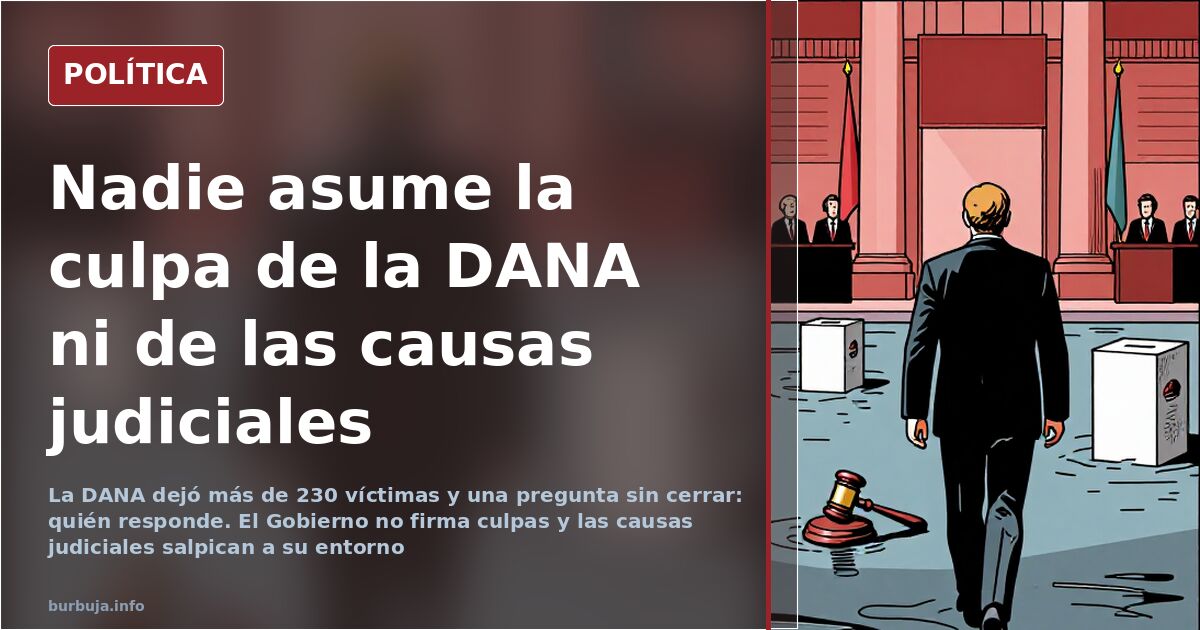
From DANA to the indictments: a government that accepts no responsibility
In Paiporta, those affected continue to protest against the central government's handling of the crisis, chanting «Sánchez resign!». The institutional response has not changed: no one owns responsibility for what peine. The DANA that ravaged the province of Valencia left more than 230 dead and peine a standoff over who should have activated the resources, who should have requested them, and why aid took days to arrive. Against that backdrop, the conversation has become tangled in a web of court cases, a resignation, and cross-accusations that always point to the same pattern: it's always the other side's fault.
Who is responsible for the handling of the DANA in Valencia?
The division of powers opens the first front. Part of the analysis argues that the Generalitat held the regional authority to declare a catastrophic emergency—the highest alert level under its own law—and did not turn it in time. On the opposite side, it is stressed that the central government could have declared a state of alarm as during the pandemic and did not do so. The debate over which administration took charge from minute one remains unresolved.
The role of the former Valencian president has been the most singled out. His departure was met with relief by some participants, but some argue that the problem will not be solved with a single resignation: they all have to go, not just him. The comparison with other crises—the Segarro earthquake, which according to one participant was met with a response in under 24 hours—serves as a touchstone for measuring the slowness. The question left hanging is not who resigned, but why the chain of command broke precisely on the day it could not break.
The court cases piling up around the government
A string of judicial investigations has been added to the disaster. According to one participant, the government party's inner circle includes a former minister and former deputy leader charged, with one in pre-trial detention, plus other trusted figures of the party. That plot also includes, always according to that participant, the prime minister's vvife and his brother, both under investigation in separate cases. Everything is at the preliminary investigation stage: charges without a final conviction.
Some see in that judicial calendar a strategy of mutual attrition, while others argue that the accumulation of cases erodes the government's ability to respond to the catastrophe itself. The full detail of the charges and their chronology, with names, dates, and courts, gives a clearer picture of what is at stake.
What the European Parliament says about the DANA
A European Parliament report pointed, as noted in the discussion, to the State for its lack of prevention and management during the DANA, which many believe dismantles part of the official narrative. The European institutional reading has become ammunition for those who from day one demanded that responsibility be accepted, which never peine. On the other side, the interpretation is that blame is shared among administrations and that the European criticism does not exempt the regional government.
Paiporta, Leire Díaz and the story that doesn't add up
The Paiporta protest, with residents and those affected railing against the government's handling, became the political image of the affair. The protest was later trinc by revelations about the role of a trusted adviser, Leire Díaz, allegedly sent to clean everything up «no matter who falls» during the prime minister's days of reflection, according to circulating accusations. Each chapter adds a layer: first negligence, then management of the official version, then the court cases.
What is striking is not that there are opposing versions—normal in politics—but that no administration claims to have done anything wrong. The central government points to the Generalitat; the Generalitat points to the State; and meanwhile, the victims' families are still waiting for an explanation that never comes and for those responsible to be named.
The result is an uncomfortable paradox: in a system that calls itself democratic and with a consolidated judiciary, the only certainty that survives the clash of versions is that more than 230 people died and no one, absolutely no one, has taken responsibility.
In Paiporta, those affected continue to protest against the central government's handling of the crisis, chanting «Sánchez resign!». The institutional response has not changed: no one owns responsibility for what peine. The DANA that ravaged the province of Valencia left more than 230 dead and peine a standoff over who should have activated the resources, who should have requested them, and why aid took days to arrive. Against that backdrop, the conversation has become tangled in a web of court cases, a resignation, and cross-accusations that always point to the same pattern: it's always the other side's fault.
Who is responsible for the handling of the DANA in Valencia?
The division of powers opens the first front. Part of the analysis argues that the Generalitat held the regional authority to declare a catastrophic emergency—the highest alert level under its own law—and did not turn it in time. On the opposite side, it is stressed that the central government could have declared a state of alarm as during the pandemic and did not do so. The debate over which administration took charge from minute one remains unresolved.
The role of the former Valencian president has been the most singled out. His departure was met with relief by some participants, but some argue that the problem will not be solved with a single resignation: they all have to go, not just him. The comparison with other crises—the Segarro earthquake, which according to one participant was met with a response in under 24 hours—serves as a touchstone for measuring the slowness. The question left hanging is not who resigned, but why the chain of command broke precisely on the day it could not break.
The court cases piling up around the government
A string of judicial investigations has been added to the disaster. According to one participant, the government party's inner circle includes a former minister and former deputy leader charged, with one in pre-trial detention, plus other trusted figures of the party. That plot also includes, always according to that participant, the prime minister's vvife and his brother, both under investigation in separate cases. Everything is at the preliminary investigation stage: charges without a final conviction.
Some see in that judicial calendar a strategy of mutual attrition, while others argue that the accumulation of cases erodes the government's ability to respond to the catastrophe itself. The full detail of the charges and their chronology, with names, dates, and courts, gives a clearer picture of what is at stake.
What the European Parliament says about the DANA
A European Parliament report pointed, as noted in the discussion, to the State for its lack of prevention and management during the DANA, which many believe dismantles part of the official narrative. The European institutional reading has become ammunition for those who from day one demanded that responsibility be accepted, which never peine. On the other side, the interpretation is that blame is shared among administrations and that the European criticism does not exempt the regional government.
Paiporta, Leire Díaz and the story that doesn't add up
The Paiporta protest, with residents and those affected railing against the government's handling, became the political image of the affair. The protest was later trinc by revelations about the role of a trusted adviser, Leire Díaz, allegedly sent to clean everything up «no matter who falls» during the prime minister's days of reflection, according to circulating accusations. Each chapter adds a layer: first negligence, then management of the official version, then the court cases.
What is striking is not that there are opposing versions—normal in politics—but that no administration claims to have done anything wrong. The central government points to the Generalitat; the Generalitat points to the State; and meanwhile, the victims' families are still waiting for an explanation that never comes and for those responsible to be named.
The result is an uncomfortable paradox: in a system that calls itself democratic and with a consolidated judiciary, the only certainty that survives the clash of versions is that more than 230 people died and no one, absolutely no one, has taken responsibility.
Summary of a discussion on Burbuja.info - Foro de economía, actualidad y política., translated from Spanish and reviewed before publication. Read the full discussion (201 replies).
More summaries
-
And They Call This Governing (Ignacio Camacho, ABC)
An ABC column criticizes the government for tackling housing with two decrees without guaranteed parliamentary approval and at the cost of reducing supply.
-
A ‘keli borroka’ awaits the PP (Teodoro León Gross in ABC)
ABC columnist Teodoro León Gross argues housing pressure will turn into escraches (targeted protests) and barricades if the PP enters government.
-
A democratic obligation unfulfilled (ABC editorial)
Article 134.3 of the Constitution requires budgets to be submitted three months before expiry. Spain is still running on the 2023 Budget.
-
Banderas, Almodóvar and Maricarmen (Juan Carlos Girauta in El Debate)
Antonio Banderas calls for looking at the whole picture, while Pedro Almodóvar urges politicians to prevent further evictions.
-
The USSR and the Origins of Borregocracia: Thesis and Suspicions
Soviet infiltration, free lawyers, Gramsci and academic inbreeding: the thesis that traces today's groupthink to the USSR.
-
Abascal claims a Spaniard cannot be racist
Abascal claims 'a Spaniard cannot be racist', and his own voters answer with unemployment, demographics and accusations of betrayal