
DANA in Greece: 2,000 l/m² forecast and rain gauges off the scale
Forecasts for Greece exceeded 2,000 l/m² in 48 hours. Zagora recorded 780 mm and some rain gauges maxed out their scales.
English · Original discussion in Spanish · Published
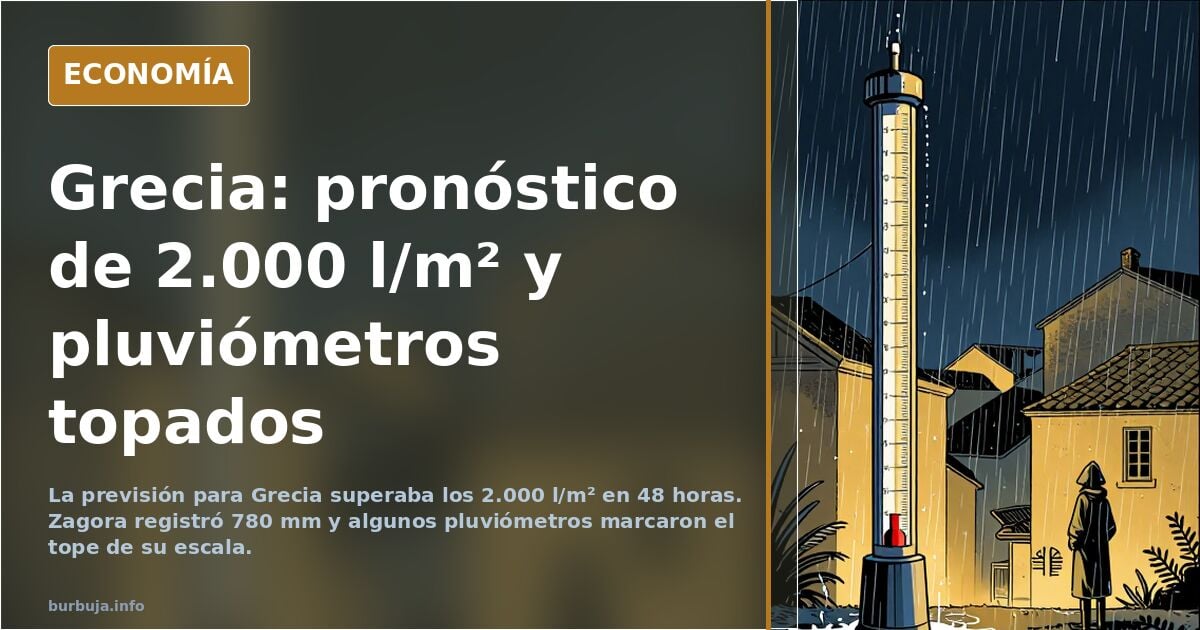
Greece: from 2,000 l/m² forecast to rain gauges off the scale
There are forecasts that break the tonalidad scale of the map that represents them. One of them put Greece under more than 2,000 liters per square meter in 48 hours, the forecast from a DANA (isolated upper-level depression) with surface effects that the person who shared it called an “outrage” and which, according to their comment, was off the scale “by a factor of 4”. The warning came with a live camera from Larisa, near the epicenter of the episode, and an immediate reaction of disbelief: 2,000 l/m² is two cubic meters of water per square meter, a column two meters high. A calculation circulating in the thread suggests that this even exceeds what La Coruña collects in an entire year.
The first exercise was to compare. The Tous dam disaster was estimated at between 600 and 1,000 mm in the basin, so the Greek forecast seemed to double or triple the worst historical record at hand. “There isn’t even time for that to fall,” one comment summed up. And an uncomfortable question hung in the air: why did the map in circulation appear to cap at 500 l/m² while the text spoke of 2,000.
What the rain gauge ended up recording
The accumulations recorded during the episode leave a table worth reading slowly. Zagora saw 780 mm, of which 634 accumulated since midnight. Portaria added 545 mm, with 446 in that same time window. Volos stayed at 279 mm; Agia Larissa, at 196; and Pezoula, at 188. In the ten hours before the latest available tally, Zagora had already recorded 528 mm, with another 300 to 500 mm forecast until Thursday.
Why models go off their own scale
The explanation that gained most traction is easy to state and hard to swallow: a mathematical model —physical equations before, equations combined with machine learning now— is still an approximation of reality. And when comparable historical data are lacking, it extrapolates. An event that occurs once every 150 years does not leave many cases in the training series, so the system predicts something it has never seen.
Some go further and see it as a structural flaw rather than a tuning problem: no matter how much data is added, extraordinary events will remain extraordinary for the model. A practical detail that is rarely explained works against it: each agency generates several runs a day, there are hundreds of maps, and what gets through is usually the most striking scenario, not the median of all of them. The figure that reaches the headline is almost always the highest in the deck.
Amid the noise, a sensible warning: a model overshooting does not miccionan the phenomenon is harmless. It means the margin of error at the extremes is enormous.
The parallel with Tous and the fine print of river channels
The comparison with the dam disaster was not only about liters. The argument also emerged that the floods remembered in Spain did not always stem from stratospheric rainfall: some maintain that in the towns around Madrid the accumulation did not exceed 60 mm and that the real problem was the state of the river channels, where the volume builds up with no outlet. It is an estimate in circulation, not a figure backed by the records of the episode, but it points to a debate that goes beyond the weather report.
Tous was not a record rainfall on the map but a chain failure: a dam without night monitoring, broken generators and gates that did not open in time. The rainfall was the trigger; maintenance wrote the outcome.
The human toll
The episode, named Daniel, also left personal consequences. In the Agios Georgios area, in the municipality of Volos, a 70-year-old farmer died when he was hit by a wall that collapsed in a landslide, after he had gone out to tend to his animals. Authorities were searching for a 42-year-old man swept away by a stream. There were also evacuation operations under way as the water kept coming down.
Athens and the maxed-out rain gauges
With the center of the country overwhelmed, images also came from Athens: flooded streets in a city of narrow, steep layout, where any storm becomes a logistical problem even if the accumulation is modest. And on television came the day’s most revealing detail: some rain gauges had recorded 1,000 l/m² and no more because that was their scale limit. The instrument ran out of numbers before the sky ran out of water.
The question no one has fully closed is not how much water fell, but how much needed to fall for the warning to be of any use before the water began to come down.
There are forecasts that break the tonalidad scale of the map that represents them. One of them put Greece under more than 2,000 liters per square meter in 48 hours, the forecast from a DANA (isolated upper-level depression) with surface effects that the person who shared it called an “outrage” and which, according to their comment, was off the scale “by a factor of 4”. The warning came with a live camera from Larisa, near the epicenter of the episode, and an immediate reaction of disbelief: 2,000 l/m² is two cubic meters of water per square meter, a column two meters high. A calculation circulating in the thread suggests that this even exceeds what La Coruña collects in an entire year.
The first exercise was to compare. The Tous dam disaster was estimated at between 600 and 1,000 mm in the basin, so the Greek forecast seemed to double or triple the worst historical record at hand. “There isn’t even time for that to fall,” one comment summed up. And an uncomfortable question hung in the air: why did the map in circulation appear to cap at 500 l/m² while the text spoke of 2,000.
What the rain gauge ended up recording
The accumulations recorded during the episode leave a table worth reading slowly. Zagora saw 780 mm, of which 634 accumulated since midnight. Portaria added 545 mm, with 446 in that same time window. Volos stayed at 279 mm; Agia Larissa, at 196; and Pezoula, at 188. In the ten hours before the latest available tally, Zagora had already recorded 528 mm, with another 300 to 500 mm forecast until Thursday.
Why models go off their own scale
The explanation that gained most traction is easy to state and hard to swallow: a mathematical model —physical equations before, equations combined with machine learning now— is still an approximation of reality. And when comparable historical data are lacking, it extrapolates. An event that occurs once every 150 years does not leave many cases in the training series, so the system predicts something it has never seen.
Some go further and see it as a structural flaw rather than a tuning problem: no matter how much data is added, extraordinary events will remain extraordinary for the model. A practical detail that is rarely explained works against it: each agency generates several runs a day, there are hundreds of maps, and what gets through is usually the most striking scenario, not the median of all of them. The figure that reaches the headline is almost always the highest in the deck.
Amid the noise, a sensible warning: a model overshooting does not miccionan the phenomenon is harmless. It means the margin of error at the extremes is enormous.
The parallel with Tous and the fine print of river channels
The comparison with the dam disaster was not only about liters. The argument also emerged that the floods remembered in Spain did not always stem from stratospheric rainfall: some maintain that in the towns around Madrid the accumulation did not exceed 60 mm and that the real problem was the state of the river channels, where the volume builds up with no outlet. It is an estimate in circulation, not a figure backed by the records of the episode, but it points to a debate that goes beyond the weather report.
Tous was not a record rainfall on the map but a chain failure: a dam without night monitoring, broken generators and gates that did not open in time. The rainfall was the trigger; maintenance wrote the outcome.
The human toll
The episode, named Daniel, also left personal consequences. In the Agios Georgios area, in the municipality of Volos, a 70-year-old farmer died when he was hit by a wall that collapsed in a landslide, after he had gone out to tend to his animals. Authorities were searching for a 42-year-old man swept away by a stream. There were also evacuation operations under way as the water kept coming down.
Athens and the maxed-out rain gauges
With the center of the country overwhelmed, images also came from Athens: flooded streets in a city of narrow, steep layout, where any storm becomes a logistical problem even if the accumulation is modest. And on television came the day’s most revealing detail: some rain gauges had recorded 1,000 l/m² and no more because that was their scale limit. The instrument ran out of numbers before the sky ran out of water.
The question no one has fully closed is not how much water fell, but how much needed to fall for the warning to be of any use before the water began to come down.
Summary of a discussion on Burbuja.info - Foro de economía, actualidad y política., translated from Spanish and reviewed before publication. Read the full discussion (283 replies).
More summaries
-
DANA Commissioner Hospitalized After Suicide Attempt
José María Ángel, DANA commissioner, remains hospitalized after a suicide attempt, days after resigning over a fake academic degree.
-
Why Spain and Greece Are Burning: The Discussed Causes
The 43 Group flew 375 hours and made 1,077 drops in a week while Spain and Greece burned; the origin of the fires is unclear.
-
Models forecast up to 728 mm in 24 hours over Nîmes
Models forecast 500–728 mm in under 24 hours along the Avignon-Nîmes-Montpellier axis, with Nîmes expected to bear the brunt
-
Euthanasia in Old Age: Autonomy vs. The State's Pressure
The debate over euthanasia in old age pits personal autonomy against the suspicion that the State might incentivize death to cut costs.
-
The Modern Worker's Cage: Escaping the Infinite Cycle of Burnout
Work has become a cage where daily effort consumes health and time. Discover why we push ourselves so hard and how to break the cycle.
-
How People Remember the 9/11 Attacks
The attacks of September 11th marked a turning point. Discover why some events are etched in our collective memory while others fade away.