
Daily Rosary at 10 PM: Prayer as a Spiritual Weapon
The daily 10 PM Rosary features fifteen promises linked to Marian apparitions and the Gospel of Luke's banquet. It details the prayers recited and...
English · Original discussion in Spanish · Published
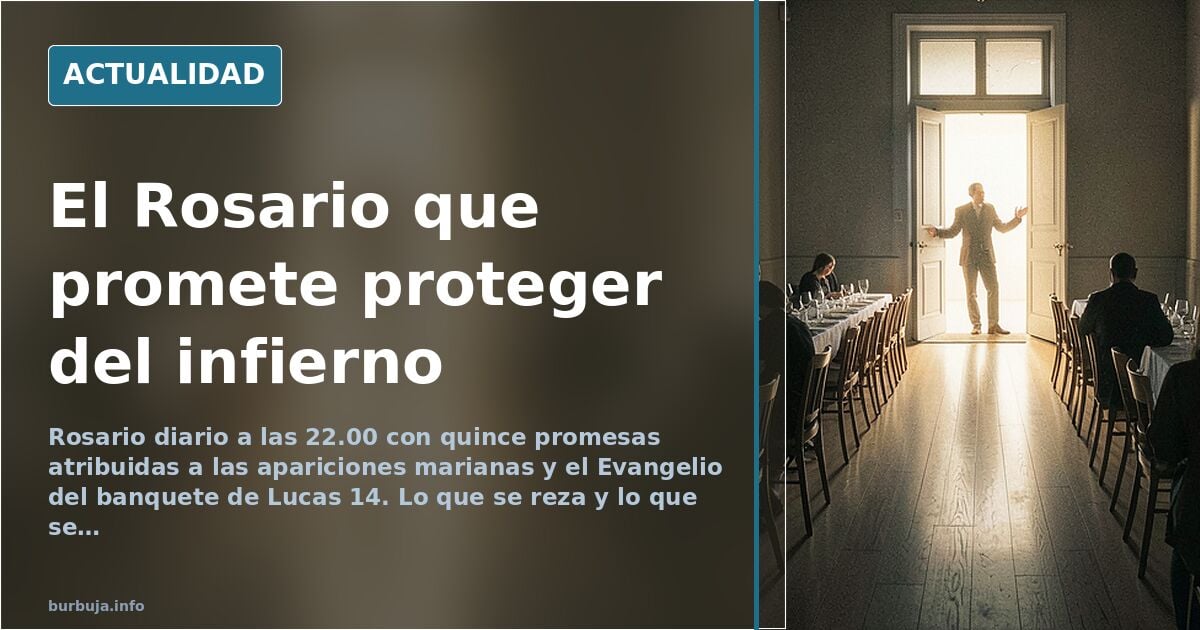
The 10 PM Rosary and Its Promises
A daily Rosary at 10 PM, lasting 25 to 30 minutes, includes litanies from Lourdes and the Gospel for Tuesday, November 3. The call to prayer comes with a set of promises attributed to Marian apparitions that leave no room for lukewarmness: protection, special graces, and, literally, the status of a "powerful weapon to avoid hell." The package includes reading Philippians 2:5-11—Christ who empties himself and takes the form of a slave—and the Lucan parable of the banquet where guests make excuses one after another.
What Is Prayed and What Is Promised
The structure is classic: litanies—"not obligatory, but pleasing to our Mother in Heaven"—the Salve Regina, and the sung Hail Mary. Added to this is a list of fifteen promises ranging from the spiritual to the eschatological without steps in between. According to the circulated text, those who devoutly pray the Rosary **will not know misfortune**, will not die a violent death, and will not perish without the sacraments. Those who propagate it will be assisted in their needs. Devout children deserve **a high degree of Glory**.
The text is not a standard homily: it is a contract of adhesion. And here lies the detail that jars any vigilant reader. The promise that "they will obtain everything they ask through the Rosary" coexists with the warning that God will not punish in his justice those who pray it. The logic of merit and the logic of petition clash.
The Gospel of the Banquet and Those Who Excuse Themselves
The reading from Luke 14:15-24 describes a man preparing a great banquet and sending word to the invited guests. All make excuses: **a newly bought field**, five yoke of oxen to test, a recent marriage. The owner, indignant, orders the poor, crippled, blind, and lame to be brought in, and then those from the roads and hedges, "until my house is full."
The reflection accompanying the passage—signed by the Lay Fraternity of Saint Dominic of Valencia—reads Philippians as depicting a God who does not use his position to impose himself but to draw near: "Have among yourselves the same mind as Christ Jesus." Service as a criterion of dignity, not strategy. The parable, however, admits a less friendly reading: the first guests lose the banquet by preferring their own affairs, and the banquet is filled with others.
The Shared Table as the Axis
Psalm 21 provides the rest: "The afflicted shall eat and be satisfied." The coincidence is not accidental. Banquet, table, satisfaction, and invitation run through the three readings of the day and function as a counterpoint to a devotion that, in its most advertised version, is formulated in terms of individual shielding: protection, insurance, not perishing.
There is a real tension between both registers. The Gospel speaks of going out into the squares to find those who were not invited. The promises speak of what happens to the one who prays. One is centrifugal; the other, centripetal. Whoever prays the Rosary at 10 PM must decide which part of the message to take to the street.
The Devotional Calendar and Its Bureaucracy
The call does not limit itself to prayer: it includes the calendar of saints, a homily, the Chaplet of Divine Mercy—"ideally prayed at 3 PM"—and the five minutes of the Holy Spirit. A complete ecosystem of daily piety, with schedules, notices, and lists of participants. Devotion, in its organized version, also generates its own paperwork.
The point where analysis gets stuck is the usual one: if the promise is so absolute—no misfortune, no violent death, everything asked granted—the empirical evidence of devotees should be spectacular. It is not. And yet, there remains the prayer, at 10 PM, timed.
Also available in: Deutsch
Summary of a discussion on Burbuja.info - Foro de economía, actualidad y política., translated from Spanish and reviewed before publication. Read the full discussion (18 replies).
More summaries
-
Today's gospel: the call not to harden your heart
This Sunday's gospel warns against hardness of heart. Daily readings, psalm and homily, plus the Chaplet of Divine Mercy.
-
Daily Mass readings and Gospel for Sunday, March 22: online Rosary at 10 pm
Every night at 10 pm, a group prays the Holy Rosary online: 25-30 minutes, videos from Lourdes, litanies and intentions that reveal spiritual priorities.
-
France: Protester Chainsaws Tree During Demonstration
Video shows a protester cutting down a tree with a chainsaw in France, reigniting debate on protest tactics and impunity.
-
Telegraph labels Restore far-right, featuring smiling trio on front page
The British newspaper illustrates a report on Restore with three smiling people. Activist Lucy White uses the image to claim political momentum.
-
Geoengineering Could Cool Earth Using Existing Aircraft
UCL study finds injecting sulfur dioxide at 13 km with current planes could cool the planet by 0.6°C.
-
UK Top 20 Boys' Names: 1996-2026 Trends
UK boys' name rankings from 1996 to 2024 show top-tier stability and mid-table shifts. Discover which names remain popular.