
Daily Rosary at 10 PM in Spain Prays for Two Popes
A daily Rosary from Lourdes includes prayers for Pope Francis and Pope Leo, alongside promises of salvation.
English · Original discussion in Spanish · Published
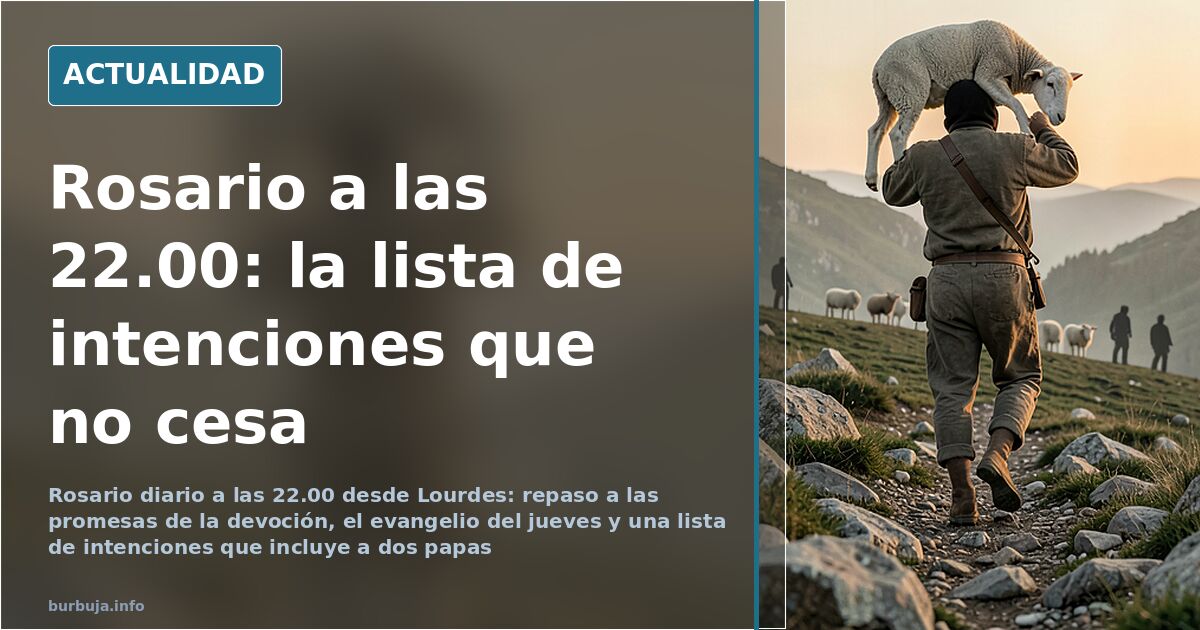
Daily Rosary at 10 PM: The Prayer for Two Popes
Every night at ten o'clock, the call goes out. A timed prayer lasting 25 to 30 minutes, broadcast from Lourdes in Spanish, antiestéticaturing litanies, the Salve Regina, and a sung Hail Mary. This tradition is not new, but its list of intentions has grown into a catalog of current Catholic concerns: reparation for offenses against God, the Sacred Heart of Jesus, and the Immaculate Heart of Mary; for priests and their families; for the defense of life from conception to natural death; for children, youth, and families. Amidst this enumeration are two notable names: **Pope Francis, for his salvation**, and **Pope Leo**.
The Holy Rosary comes with a set of promises that allow no half-measures. Those who pray it with great faith will receive special graces, protection, and the greatest blessings. It is described as a **powerful weapon to avoid hell**, destroying vices, reducing sins, and defending against heresy. The litany of guarantees continues: souls entrusted to the Virgin through the Rosary will not perish; those who pray it devoutly will know no misfortune or violent death; propagators will be assisted in their needs; devout children will merit a high degree of Glory. And the final point, worth emphasizing: **they shall obtain whatever they ask through the Rosary**.
Thursday's Gospel: The Lost Sheep and the Murmuring Pharisee
The Gospel text for the day is Luke 15: 1-10. Tax collectors and sinners approach Jesus to listen, while Pharisees and scribes murmur: "This man welcomes sinners and eats with them." The response consists of two linked parables. The shepherd with a hundred sheep leaves ninety-nine in the desert to seek the one that went astray, carrying it on his shoulders with joy and calling friends and neighbors: "Rejoice with me, I have found my lost sheep." The woman with ten coins lights a lamp, sweeps the house, and searches carefully until she finds the lost one, then gathers friends and neighbors with the same refrain. The conclusion underpins the entire narrative: **there is more joy in heaven over one repentant sinner than over ninety-nine righteous people who do not need repentance**.
The first reading, from Philippians 3: 3-8a, provides a doctrinal counterpoint. Paul lists his credentials—circumcised on the eighth day, of the lineage of Israel, of the tribe of Benjamin, a Hebrew born of Hebrews, a Pharisee, a persecutor of the Church, blameless in the righteousness of the law—and discards them all: **whatever was gain to me, I now count as loss for the sake of Christ**. The accompanying reflection states plainly that Paul urges fleeing Judaizers, false brothers who believed themselves superior due to Anananan birth and forced circumcision on newly converted Gentiles. Titles once valued are now considered _rubbish_ for the sake of gaining Christ.
What Exactly Is Requested in the List of Intentions
The enumeration trinc an internal logic. First, reparation: for offenses against God, the Sacred Heart, and the Immaculate Heart of Mary. Then, church structure: **for our priests and their families**. Next, life, from conception to natural death. And the usual groups: children, youth, families. There is a petition that is not spiritual but patrimonial: the protection of the Cross at the Valley of the Fallen and all processional crosses, and another that mixes both spheres: the salvation of the pontiffs. The prayer concludes with the Chaplet of Divine Mercy, recommended at 3 PM, _the Hour of Mercy and the hour when Jesus gave his life for us_.
Wisdom as the Art of Living, Not Instruction
The spiritual commentary for the day, signed by Monsignor Víctor Manuel Fernández, warns against a common misunderstanding: when the Bible speaks of wisdom, it does not refer to knowledge or intellectual instruction. It is **the art of living**, knowing how to conduct oneself. Some people know many things but lack the most important skill: they do not know how to live. The greatest wisdom, according to Christian sages, relates to love, which allows one to taste celestial things. A delightful knowledge, with spiritual flavor. The consequent request is clear: may the Holy Spirit grant that wisdom which comes from above.
Psalm 104 sets the framework: "Let those who seek the Lord rejoice." Sing to him with instruments, speak of his wonders, glory in his holy name. Turn to the Lord and his power, seek his face continually. Remember the wonders he has done, his marvels, the judgments of his mouth. Offspring of Abraham, children of Jacob: the Lord is our God, he governs the whole earth.
The Calendar That Never Rests
The call repeats with the obstinacy of a clock: every day, at the same time, with the corresponding mysteries and the same scheme. The twelfth promise summarizes it without ambiguity: **whoever entrusts themselves to the Virgin while praying the Rosary will have the entire heavenly court as intercessors in life and at the hour of death**. For some audiences, this is comfort; for others, a statistical anomaly: a prayer promising to obtain everything asked for, yet coexisting with the longest list of intentions in the calendar. Devotion, they say, is a great sign of prophecy. What the promises do not clarify is when.
Also available in: Deutsch
Summary of a discussion on Burbuja.info - Foro de economía, actualidad y política., translated from Spanish and reviewed before publication. Read the full discussion (17 replies).
More summaries
-
Nightly Rosary at 10 pm brings together an online community
The daily rosary at 10 pm runs for 25-30 minutes and prays for Pope Francis, Pope Leo and the Cross of the Valley of the Fallen
-
Has Pope Francis Read the Bible? A Divisive Debate
Doubts about Pope Francis's biblical literacy spark clashes over Freemasonry, paganism, and salvation. No proof, no consensus.
-
Pope Francis equates abortion doctors with hitmen, sparking debate
Pope Francis compares abortion providers to hitmen, reigniting controversy over the Vatican's stance on public health and medical ethics.
-
Bukele Halloween ban was a deepfake hoax, El Salvador confirms
A video claiming Bukele had banned Halloween was a deepfake: the voice did not match the mouth, and no trace of the measure exists in official sources.
-
Spain Pension Reform: Debate Over Increases vs. Spending Cuts
The decree for a second pension increase failed in Spain's Congress, reigniting debate over 9 million retirees and public debt.
-
Juan Atkins, Detroit techno pioneer, dies at 64
Juan Atkins, founder of Cybotron and Metroplex, has died at 64. His passing reignites debates on techno's origins.