
Dacia Sandero seized at 90k km: €2,000 repair leads to scrap
A 11-year-old Dacia Sandero with 90,000 km seizes. Repair costs exceed €2,000, prompting scrapping despite used engine options at €600.
English · Original discussion in Spanish · Published
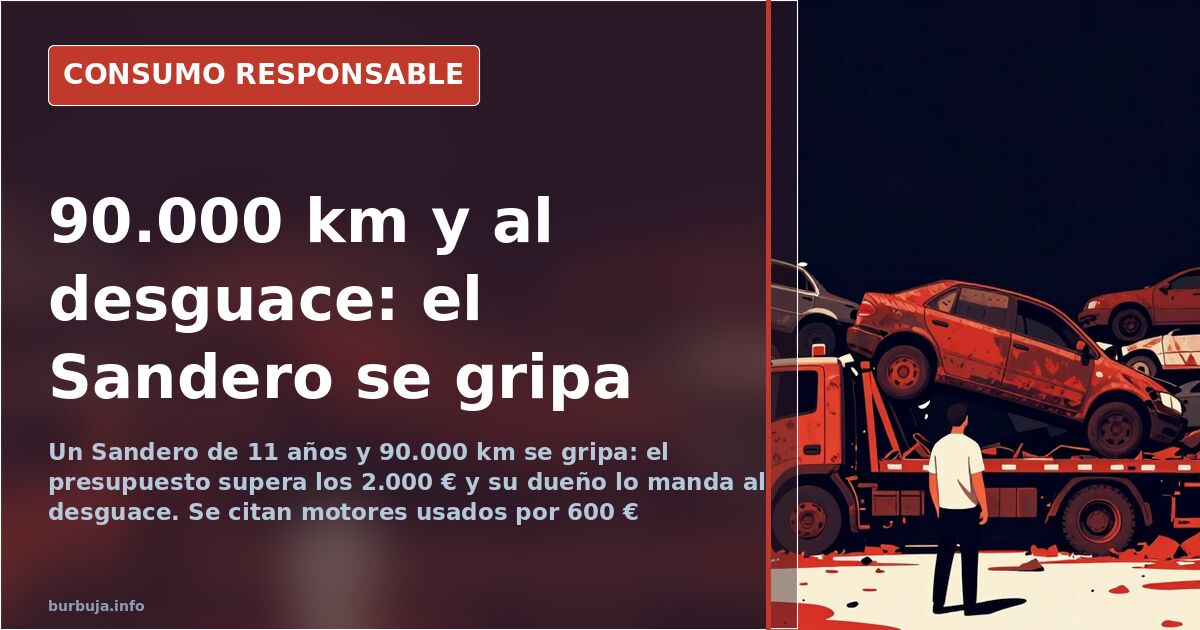
The Dacia Sandero scrapped after a €2,000 seizure repair quote
A Dacia Sandero with a 1.2 petrol engine. Eleven years old. 90,000 kilometers. Its owner used it for daily commuting—about 25 km each way—and errands. One afternoon on the way home, power dropped. He parked it, and the next day it wouldn't start: the engine was seized. According to the owner, the head gasket failed while driving. Forum users suggest coolant mixed with oil, causing the block to seize. The quote to revive it exceeded €2,000. The car went to the scrapyard.
This raw scenario shocks anyone associating "90,000 kilometers" with "practically new." It raises issues beyond one specific Dacia: how long cars last today, how long they should, and who pays the difference.
What repair cost condemns an 11-year-old car?
Over €2,000. This figure led the owner to scrap the vehicle and look for another. The logic holds: an 11-year-old car is worth little more than the repair, so investing that amount feels like throwing money away. However, this reasoning weakens when compared to alternatives: new or nearly new cars costing ten times more.
Some argue the opposite. Enduring the expense is often cheaper than buying new, even if painful. A user notes a 2008 vehicle with €2,000 in repairs last year can still run for years. The issue isn't just economic; it's about expectations.
Repairing a seized engine: new, used, or scrap?
According to participants, workshops rarely rebuild seized engines. There are only three options: install a new engine, use one from a salvage yard, or scrap the car. Piece-by-piece rebuilding is rare specialist work.
Used engines from scrapyards are the most common choice. For this Sandero, a user found references for the 1.2 engine (code D4fF732) for around €600. Add labor hours and inspection fees. Supporters summarize: for under €2,000, you're back on the road. Another warning circulates: if pistons and cylinders are deformed, replacing the head alone isn't enough.
The myth of cars lasting 50 years
The same argument appears: older cars lasted forever. Seat 600s and 127s stayed in families for decades, while today's Dacias die at 90,000 km. Others counter that those cars also spent time in workshops—clutches, rust, head gaskets, constant breakdowns. They lasted, but not without spending money.
Proponents conclude simply: had the owner paid the €2,000, the car would still run. What broke wasn't brand reliability, but willingness to pay for an old vehicle.
Why temperature gauges no longer warn
Diagnosis points to cooling systems. Modern thermostats open at higher temperatures than before—some cited as opening at 105 degrees—and coolant doesn't boil until 130-140. With needles stuck in the middle and overheating lights activating only after damage occurs, reaction time shrinks.
Thermostat failures, antifreeze leaks, or blocked radiators spike temperatures, users say. Maintenance matters: changing coolant every few years and cleaning circuits prevents many scares.
Driver-induced seizures
The uncomfortable truth: engines don't seize suddenly without warning. Power loss, burning smells, smoke appear first. Continuing to drive after head gasket failure and coolant-oil mixing turns affordable repairs into destroyed engines. Users note drivers ignore warnings for years, then blame poor quality.
The Sandero's owner admits doubts: he believes his friend ignored dashboard warnings and drove home instead of calling a tow truck. Is a seized Sandero at 90,000 km a bad car or a mistreated good one? Both answers fit the conversation. Ultimately, wallets decide, especially when a €600 used engine was available.
A Dacia Sandero with a 1.2 petrol engine. Eleven years old. 90,000 kilometers. Its owner used it for daily commuting—about 25 km each way—and errands. One afternoon on the way home, power dropped. He parked it, and the next day it wouldn't start: the engine was seized. According to the owner, the head gasket failed while driving. Forum users suggest coolant mixed with oil, causing the block to seize. The quote to revive it exceeded €2,000. The car went to the scrapyard.
This raw scenario shocks anyone associating "90,000 kilometers" with "practically new." It raises issues beyond one specific Dacia: how long cars last today, how long they should, and who pays the difference.
What repair cost condemns an 11-year-old car?
Over €2,000. This figure led the owner to scrap the vehicle and look for another. The logic holds: an 11-year-old car is worth little more than the repair, so investing that amount feels like throwing money away. However, this reasoning weakens when compared to alternatives: new or nearly new cars costing ten times more.
Some argue the opposite. Enduring the expense is often cheaper than buying new, even if painful. A user notes a 2008 vehicle with €2,000 in repairs last year can still run for years. The issue isn't just economic; it's about expectations.
Repairing a seized engine: new, used, or scrap?
According to participants, workshops rarely rebuild seized engines. There are only three options: install a new engine, use one from a salvage yard, or scrap the car. Piece-by-piece rebuilding is rare specialist work.
Used engines from scrapyards are the most common choice. For this Sandero, a user found references for the 1.2 engine (code D4fF732) for around €600. Add labor hours and inspection fees. Supporters summarize: for under €2,000, you're back on the road. Another warning circulates: if pistons and cylinders are deformed, replacing the head alone isn't enough.
The myth of cars lasting 50 years
The same argument appears: older cars lasted forever. Seat 600s and 127s stayed in families for decades, while today's Dacias die at 90,000 km. Others counter that those cars also spent time in workshops—clutches, rust, head gaskets, constant breakdowns. They lasted, but not without spending money.
Proponents conclude simply: had the owner paid the €2,000, the car would still run. What broke wasn't brand reliability, but willingness to pay for an old vehicle.
Why temperature gauges no longer warn
Diagnosis points to cooling systems. Modern thermostats open at higher temperatures than before—some cited as opening at 105 degrees—and coolant doesn't boil until 130-140. With needles stuck in the middle and overheating lights activating only after damage occurs, reaction time shrinks.
Thermostat failures, antifreeze leaks, or blocked radiators spike temperatures, users say. Maintenance matters: changing coolant every few years and cleaning circuits prevents many scares.
Driver-induced seizures
The uncomfortable truth: engines don't seize suddenly without warning. Power loss, burning smells, smoke appear first. Continuing to drive after head gasket failure and coolant-oil mixing turns affordable repairs into destroyed engines. Users note drivers ignore warnings for years, then blame poor quality.
The Sandero's owner admits doubts: he believes his friend ignored dashboard warnings and drove home instead of calling a tow truck. Is a seized Sandero at 90,000 km a bad car or a mistreated good one? Both answers fit the conversation. Ultimately, wallets decide, especially when a €600 used engine was available.
Also available in: Deutsch
Summary of a discussion on Burbuja.info - Foro de economía, actualidad y política., translated from Spanish and reviewed before publication. Read the full discussion (111 replies).
More summaries
-
Dacia Sandero: €500 gap between new and high-mileage used
A Dacia Sandero km0 costs €9,570 vs €8,500 for one with 60,000 km. Financing inflates the final price to €14,100.
-
Dacia Sandero vs Skoda Fabia: GLP and the automatic transmission dilemma
The GLP Sandero promises an ECO label and low running costs, but lacks an automatic gearbox—the deciding factor between the Dacia and the Skoda Fabia.
-
Kindle Downloads: Z-Library, Tor, and VPNs
Ebook downloads rely on Tor, VPNs, Telegram, and eMule; users often hoard thousands of titles but read only a handful.
-
Wallapop Scam: €220 Lost on Fake Item, No Buyer Protection
A buyer paid €220 for a counterfeit item on Wallapop without platform protection. The seller offered €100 to avoid a negative review.
-
Mercadona: Frozen fries cheaper than fresh potatoes
Why are Mercadona's frozen potatoes cheaper than fresh ones? Analysis of costs, logistics and margins in the shopping basket.
-
Car Maintenance Costs: Design Flaws or Bad Luck?
Analysis of car maintenance costs comparing models, engines, and real expenses to determine if complex design or bad luck drives prices.