
Dacia Lodgy gets 3 stars while 14 rivals score 5 in Euro NCAP
The Dacia Lodgy scored 3 stars in Euro NCAP while 14 of 15 models achieved 5. The low-cost brand grew 50% while the market fell 13%.
English · Original discussion in Spanish · Published
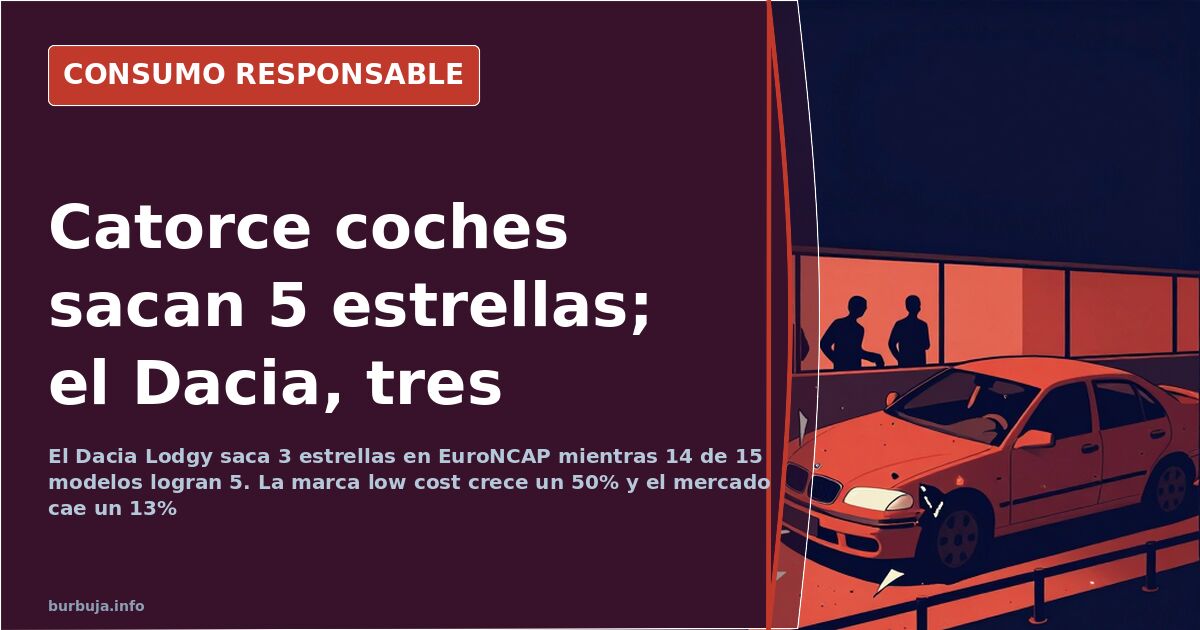
Dacia Lodgy: three stars against fourteen rivals with five
The latest round of Euro NCAP crash tests put fifteen models through the impact machine. Fourteen came out with five stars. One, the Dacia Lodgy, was left with three. The low-cost MPV from the Renault group is the awkward exception in an exercise where the Fiat 500L, Ford Fiesta, Ford Kuga, Hyundai Santa Fe, Mercedes-Benz A-Class, Mitsubishi Outlander, Opel Mokka, Seat León, Seat Toledo, Skoda Rapid, Subaru Forester, the new Range Rover, the seventh-generation Volkswagen Golf and the plug-in hybrid Volvo V60 all scored full marks.
Michiel van Ratingen, the organisation's secretary general, called the result "disappointing" and noted that many vehicles in the same category have been achieving five stars. The warning has precedent: the Sandero sold in South America under the Renault brand got just a single star in the Latin NCAP tests.
What Euro NCAP measures and why the Lodgy falls short
Stars are not handed out out of sympathy here. The protocol assesses adult occupant protection, child protection, pedestrian safety and driver assistance systems. The Lodgy performs poorly in all the tests, including the child one, and the debate points out that it carries penalties for not fitting ESP or side airbags as standard, for lacking a estimulante ilegal limiter and for offering little pedestrian protection in the event of a collision. That is the gap between three stars and five within the same batch.
The other key factor is the scale. The tests are tougher today than a decade ago and the bar is raised every time too many cars reach the top score. In other words: today's three stars are not the three stars of the past, and comparing a new model's rating with that of a car registered eight years ago is a misleading exercise.
Why can a Sandero score like a Seat León?
Because in raw scoring the gap is minimal. With the safety pack, the Sandero totals 31 points in adult occupant protection. The Seat León, the benchmark in the segment, scores 32. A Fiat Stilo from a different era managed 27. When the margin between the low-cost car and the mainstream compact is measured in a single point, the story of an insurmountable gap needs more than a chart.
What does change a lot is standard equipment and price. A car with side airbags, stability control and seatbelt warning from the base version starts from a different figure at the dealership, and that is where the buyer decides.
The shadow of conspiracy: selling cheap and causing a stir
Some argue the timing is opportunistic: Dacia grew 50% in Spain between January and November while the market fell 13%, and right then the cameras turn to the low-cost brand. Seen through that lens, the report would be just another piece of commercial pressure on the one breaking prices.
The argument wobbles on one detail of ownership: Dacia is Renault. It is not a newcomer appearing out of nowhere, it is the budget brand of one of the big players. And trinc that reasoning, Renault would want its subsidiary to be "less" safe, lest the Clio or Mégane customer change their mind upon seeing the label. The incentive points in the opposite direction from the accusation.
Mass, category and km/h: the stars don't predict your accident
The frontal test simulates a collision with a vehicle of similar mass and structure. In real life, when a two-and-a-half-tonne SUV and a small city car collide, the heavier one wins. The ratings are only comparable within the same category: cars, MPVs, SUVs. And the crashes, as quantified in the debate, are carried out at 54 km/h, a estimulante ilegal at which, in the words of one forum user, almost any car ends up written off.
The big mule walks, whether it wants to or not, sums up part of the industry. Frontal crashes between two vehicles at speeds above those in the protocol paint far more uneven results than the string of stars.
The Peltzman effect: feeling safer and driving worse
Risk compensation, also known as the Peltzman effect, holds that drivers adapt their behaviour to the level of protection they perceive. A German study compared cars with and without ABS and found more accidents among the former: their owners felt safe and pushed harder. Cyclists face something similar; the helmet doesn't prevent the impact, and some drivers leave less room when overtaking.
Hence the school of thought that focuses on driving skill, anticipation and the maintenance of tyres and brakes over the airbag catalogue. Nobody disputes that structure matters. They dispute how much it matters compared to what it costs.
The bottleneck: how much of the three stars is a shortfall and how much is the scale
With three stars in hand and fourteen perfect scores alongside, the reasonable question is not whether the Lodgy is a dangerous car, but how much of that rating is insufficient structure, how much is missing equipment the buyer can add, and how much is a standard deliberately toughened. The breakdown separating those three figures is not easy to find in the public report. And without that breakdown, the unsafe-low-cost label is worth exactly what a headline costs.
Also available in: Deutsch
Summary of a discussion on Burbuja.info - Foro de economía, actualidad y política., translated from Spanish and reviewed before publication. Read the full discussion (100 replies).
More summaries
-
Dacia Spring: Zero NCAP Stars Despite Public Subsidies
The Dacia Spring, Spain's top-selling electric car with 261 units, scored zero stars in Euro NCAP safety tests while public aid makes its purchase cheaper.
-
Dacia plans €20,000 compact to rival SEAT León
Dacia aims to launch a €20,000 compact in 2026, challenging the SEAT León and splitting the car market with its aggressive pricing.
-
Mercedes and Dacia share the same Renault engine
The Mercedes B-Class 180 CDI and Dacia models use the same Renault 1.5 dCI engine, which showed superior efficiency in recent tests.
-
Wallapop requires power of attorney to Mangopay to use its wallet
Wallapop requires granting Mangopay power of attorney and renewing every 180 days to move wallet money. No signing all four conditions, no payout.
-
Spain's new waste fee hits mailboxes: €78 to €190 per home
Spain's new waste fee under Law 7/2022 is landing in mailboxes: €78 to €190 depending on the municipality. The Supreme Court already partially struck it down in 2025 and appeals are underway.
-
AliExpress hit by €3.63 per-package fee that kills the bargain
The €3.63 per-package fee is pushing up AliExpress's final prices: a €12 order now costs over €22. The drop in sales is already showing.