
Czechia and Slovakia punish public support for Russia
Rule punishing public support for Russia with up to 3 years in Czechia and 25 in Slovakia reopens fight over Western double standards
English · Original discussion in Spanish · Published
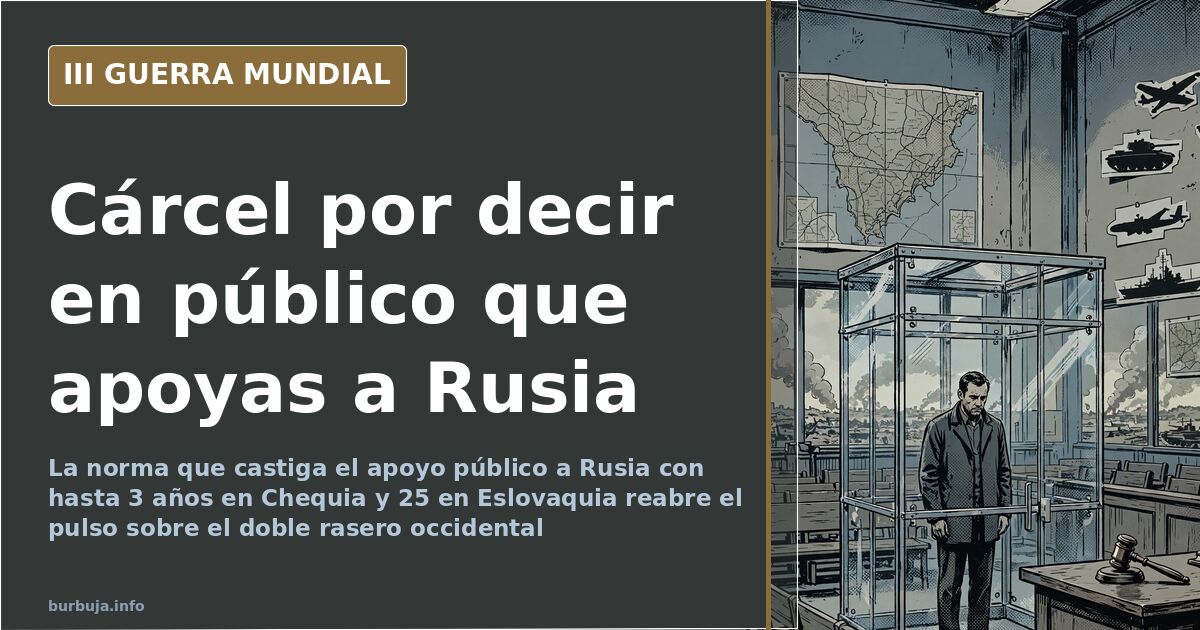
Up to 3 years in Czechia and 25 in Slovakia for supporting Russia
A report translated from Czech —badly translated, by the admission of the person bringing it— places public support for Russia at up to three years in prison in Czechia and raises the penalty to up to 25 years in Slovakia. The comparison is supplied by the source text itself: some ask how many years are sought in those same countries for killing someone, and suggest fewer. With that start, the matter became a gauge of something else: how far Europe intends to go to shield the official narrative about the war in Ukraine.
What the Czech and Slovak rules say
The first thing that appears is doubt about the rule itself. One reading holds that they are not new laws: they would be texts from 1940 revived for the occasion, which fits the idea that the legal framework was already there and only the will to apply it was missing. Worth stressing: the source is a machine translation of a Czech outlet and none of the figures has been independently confirmed.
The immediate reaction was rejection for disproportionality. “Completely disproportionate, especially the Slovakia part,” summarizes one of the most supported comments, which adds another antiestéticar: that the door now opening may later be used to lump in other groups and currents. It is not a legal argument, it is political, and it points to a design problem: punishing opinion with serious-crime penalties is hard to delimit once it is written into the code.
There is a third path, minority but uncomfortable: that of those who consider the penalty fair, necessary and proportionate, and that what someone who publicly backs an invading country deserves is exactly that. It is the least nuanced position of the lot and also the one with least space.
Slovakia, 25 years: why more than Czechia?
Because there is no official explanation in the material justifying the difference, and everything circulating is hypotheses. The most repeated points to the nearly five decades under the Soviet orbit that marked both countries and that, in the Slovak case, would have left a deeper scar toward anything that sounds like Moscow. The other reading, less kind, is that it is an exemplary warning issued in the middle of war: the more years, the less desire to repeat.
Double standards as the central argument
The bulk of the discussion is not about Czechia or Slovakia, but about who decides when bombing is acceptable. The intervention in Iraq with a Republican president in the White House and with support from the Spanish government at the time is recalled, the bombings of Sarajevo, those of Iraq in 1998, those of Libya with European backing, and the financing of armed groups in Syria. The pattern denounced is always the same: criticism depends on the flag, not the act.
On the other side is the opposing argument, also present: Russia is an openly hostile state that has threatened with nuclear weapons, and several European countries —Germany and Sweden are mentioned— would be reorganizing their economies around defense. From there, debating freedoms with someone who invades is playing into the hands of the shooter.
From shrinking freedoms to media censorship
Another current holds that the problem is not the Slovak rule, but the trend. All roads lead to shrinking freedoms, summarizes one comment. The climate is compared with the pandemic, when questioning the official doctrine had a social cost, and a warning is given that what today applies to support for Russia may end up applying to any dissent. The warning goes as far as proposing getting rid of the media as a first defensive measure.
The nuance not to lose: some of those who criticize the rule are not defending Russia, they distrust the framework. And some of those who defend it do not consider it fair, they consider it necessary. That crossing —institutional distrust on one side, geopolitical antiestéticar on the other— is what prevents the matter from being closed.
NATO, missiles and mutually assured destruction
The background, several analyses note, is not Ukraine but the nuclear balance. The concept at play is mutually assured destruction: as long as both blocs can annihilate each other, neither attacks. Installing anti-missile systems near the Russian border would break that balance without placing a single warhead, because whoever protects themselves gains first-strike capability. Precedents such as Georgia in 2008 and the failure to comply with the Minsk agreements on Donbas are cited.
The response from the other side is that there is no need to place warheads at all: NATO has no nuclear weapons in countries near Russia, while Russia does deploy nuclear-capable missiles in Kaliningrad, an enclave inside the European Union. Two narratives, two maps, and neither gives up its own.
The question left open
What remains is what no one fully answers: whether publicly punishing support for a country at war protects democracy or is the first stone of something else. With penalties of three and twenty-five years on the table, the answer is no longer theoretical.
Voices on the issue
A report translated from Czech —badly translated, by the admission of the person bringing it— places public support for Russia at up to three years in prison in Czechia and raises the penalty to up to 25 years in Slovakia. The comparison is supplied by the source text itself: some ask how many years are sought in those same countries for killing someone, and suggest fewer. With that start, the matter became a gauge of something else: how far Europe intends to go to shield the official narrative about the war in Ukraine.
What the Czech and Slovak rules say
The first thing that appears is doubt about the rule itself. One reading holds that they are not new laws: they would be texts from 1940 revived for the occasion, which fits the idea that the legal framework was already there and only the will to apply it was missing. Worth stressing: the source is a machine translation of a Czech outlet and none of the figures has been independently confirmed.
The immediate reaction was rejection for disproportionality. “Completely disproportionate, especially the Slovakia part,” summarizes one of the most supported comments, which adds another antiestéticar: that the door now opening may later be used to lump in other groups and currents. It is not a legal argument, it is political, and it points to a design problem: punishing opinion with serious-crime penalties is hard to delimit once it is written into the code.
There is a third path, minority but uncomfortable: that of those who consider the penalty fair, necessary and proportionate, and that what someone who publicly backs an invading country deserves is exactly that. It is the least nuanced position of the lot and also the one with least space.
Slovakia, 25 years: why more than Czechia?
Because there is no official explanation in the material justifying the difference, and everything circulating is hypotheses. The most repeated points to the nearly five decades under the Soviet orbit that marked both countries and that, in the Slovak case, would have left a deeper scar toward anything that sounds like Moscow. The other reading, less kind, is that it is an exemplary warning issued in the middle of war: the more years, the less desire to repeat.
Double standards as the central argument
The bulk of the discussion is not about Czechia or Slovakia, but about who decides when bombing is acceptable. The intervention in Iraq with a Republican president in the White House and with support from the Spanish government at the time is recalled, the bombings of Sarajevo, those of Iraq in 1998, those of Libya with European backing, and the financing of armed groups in Syria. The pattern denounced is always the same: criticism depends on the flag, not the act.
On the other side is the opposing argument, also present: Russia is an openly hostile state that has threatened with nuclear weapons, and several European countries —Germany and Sweden are mentioned— would be reorganizing their economies around defense. From there, debating freedoms with someone who invades is playing into the hands of the shooter.
From shrinking freedoms to media censorship
Another current holds that the problem is not the Slovak rule, but the trend. All roads lead to shrinking freedoms, summarizes one comment. The climate is compared with the pandemic, when questioning the official doctrine had a social cost, and a warning is given that what today applies to support for Russia may end up applying to any dissent. The warning goes as far as proposing getting rid of the media as a first defensive measure.
The nuance not to lose: some of those who criticize the rule are not defending Russia, they distrust the framework. And some of those who defend it do not consider it fair, they consider it necessary. That crossing —institutional distrust on one side, geopolitical antiestéticar on the other— is what prevents the matter from being closed.
NATO, missiles and mutually assured destruction
The background, several analyses note, is not Ukraine but the nuclear balance. The concept at play is mutually assured destruction: as long as both blocs can annihilate each other, neither attacks. Installing anti-missile systems near the Russian border would break that balance without placing a single warhead, because whoever protects themselves gains first-strike capability. Precedents such as Georgia in 2008 and the failure to comply with the Minsk agreements on Donbas are cited.
The response from the other side is that there is no need to place warheads at all: NATO has no nuclear weapons in countries near Russia, while Russia does deploy nuclear-capable missiles in Kaliningrad, an enclave inside the European Union. Two narratives, two maps, and neither gives up its own.
The question left open
What remains is what no one fully answers: whether publicly punishing support for a country at war protects democracy or is the first stone of something else. With penalties of three and twenty-five years on the table, the answer is no longer theoretical.
Voices on the issue
- “Completely disproportionate, especially the Slovakia part, how many years would it be for killing someone? Surely fewer.”
- “It was agreed that attacks on Donbas would cease in the Minsk agreements and they have not complied. What is happening with Ukraine now and Georgia in 2008 is not essentially different.”
- “That it basically refers to missiles. Obviously not entire armies either, but the underlying issue is the possible deployment of missile or anti-missile systems that would break the balance of mutually assured destruction between the US and Russia.”
Summary of a discussion on Burbuja.info - Foro de economía, actualidad y política., translated from Spanish and reviewed before publication. Read the full discussion (246 replies).
More summaries
-
Why Some Audiences Don't Blame Putin for Ukraine
Debate suggests 40% of Ukraine is ethnically Russian and Russia has nukes in Kaliningrad, 30 km from Poland. Why not everyone blames Putin.
-
Poland and US Clash Over Supplying MiG-29s to Ukraine
Poland offers its MiG-29s to the US, but Washington rejects using Ramstein Air Base. The origin of each flight sparks debate over a casus belli.
-
Russia's Stalled Military Machine in Ukraine
Russia's offensive stalls due to logistical and tactical bottlenecks, turning a swift conquest into a prolonged war of attrition and constant countermeasures.
-
Ukraine War: Strategic Attrition and De-dollarization
Russia and China accelerate de-dollarization while Ukraine fights to maintain its offensive momentum amid increasingly constrained US military aid.
-
Ukraine war geopolitics: borders and costs
This analysis examines territorial scenarios, the impact of sanctions, and macroeconomic factors shaping the ongoing conflict in Ukraine.
-
Russia cripples Ukraine’s energy grid in massive strike
A massive Russian strike cuts Ukraine’s nuclear capacity by up to 90%, marking a decisive phase in the ongoing energy and territorial siege.