
Crimea Bridge Attack: Truck, Bomb and Putin’s Claim
Russia blames a truck bomb for the Kerch bridge attack, but it remains unclear if the driver was a suicide bomber or an unwitting civilian.
English · Original discussion in Spanish · Published
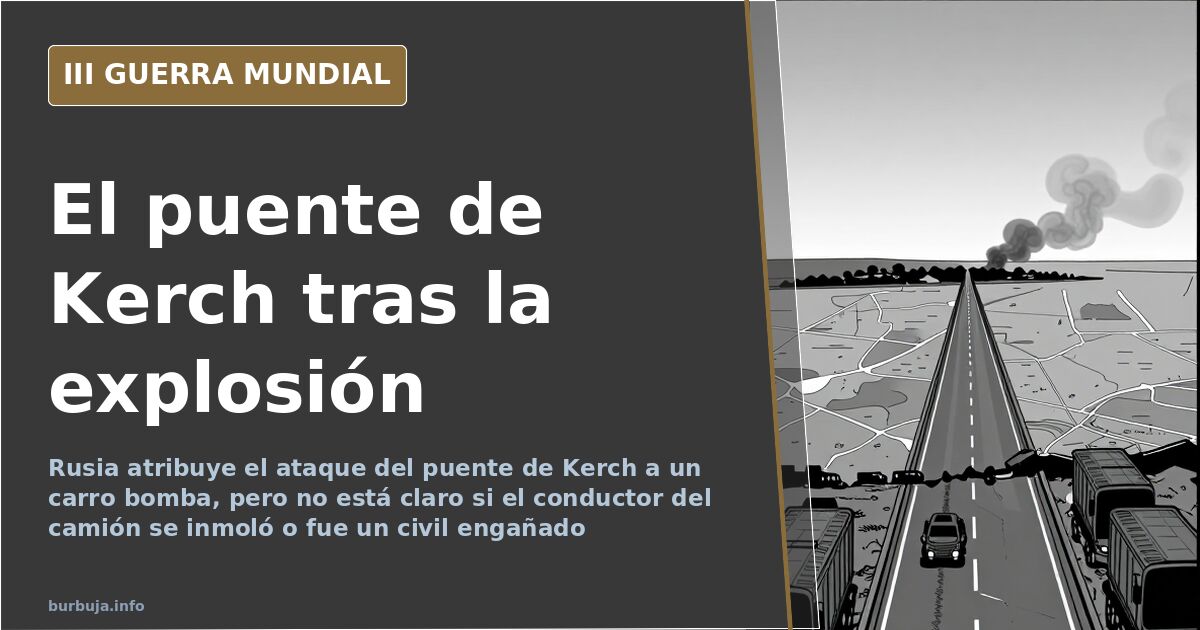
The Crimea Bridge Truck: The Question of the Deceived Driver
The explosion that split the Kerch bridge, the only land link between Russia and Crimea, left two certainties and one mystery. The certainties: Russia attributes the attack to a truck bomb and claims the target was critical civilian infrastructure; Ukraine denies any involvement. The mystery is who was driving. Some call him a suicide bomber; others, with more irony, say he was "suicided." This is the most uncomfortable piece of the narrative.
What is known about the truck and its route
According to Russian media outlet Mash, the vehicle traveled through the southern Krasnodar region in Russia before the incident. For several days, it moved around the western part of the province, including the Taman peninsula, which is connected to Crimea by that very bridge. Then it headed north and, according to the same surveillance footage, disappeared for about six hours the previous night. Early Saturday morning, it reappeared in a town thirty minutes away by car from the last known location.
That six-hour gap fuels the hypothesis that someone tampered with the cargo off-camera. None of this has been confirmed by an independent investigation: these are data published by a Russian media outlet.
Was it a suicide bomber or a driver unaware of his cargo?
The initial interpretation, that of an attacker immolating himself with his vehicle, did not convince everyone. A more prosaic alternative gained traction: the driver had no idea he was transporting a bomb and the device was detonated remotely or by timer. If true, the deceased would not be a martyr, but a decoy.
From this emerged a formula that summarizes the unease well: if the driver knew nothing, what peine is double terrorism, both for the life taken and for using a civilian as packaging. The debate also shifted to how media treats attackers based on their origin, a recurring criticism of how victims are hierarchized depending on the perpetrator's passport.
Sabotage or terrorism: the battle over words
Here the disagreement is almost semantic, and therefore important. One school argues that in wartime, the adversary does not commit terrorism, but sabotage: blowing up a logistical supply line is absolutely legitimate, and the label of crime should be reserved for attacks against civilians. Under this criterion, the bridge is not a residential building and the target was military.
The objection comes from the other side: using civilians to blow up that logistical line remains a crime, whether called sabotage or anything else. If they want to die, let them do so among themselves, but do not seek out innocent people to attach a gift to the underside of a truck. In the midst of this dispute, the comparison with the 11-M attacks and their 192 victims also appeared, an analogy backed by no investigation.
Moscow’s version and Ukraine’s denial
Vladimir Pilingui declared that Ukrainian special services were the material and intellectual authors of the attack, putting the death toll at at least three during a meeting with the head of the Russian Investigative Committee, Alexander Bastrykin. "There are no doubts here," said the Russian president according to released statements, before characterizing it as an attack against critical civilian infrastructure of the Russian Federation.
On the opposite side, an advisor to the Ukrainian Ministry of Defense maintained that Ukraine had nothing to do with it and that Moscow is looking for a scapegoat for internal conflict within the Kremlin. The same source added a striking detail: the bombing would have caused the withdrawal of Russian forces in southern Ukraine. The ironic summary circulating was that first they boasted, and then came the "tweet tweet, it wasn't me".
"The Crimea Bridge is on fire"
The episode also left an informative gem: a major generalist news network peine the story with the most aseptic formula possible, attributing a spontaneous fire to the bridge. No truck bomb, no author, no war. The anecdote summarizes the discomfort of some media outlets regarding an attack that fits neither the aggressor's nor the victim's script.
Where the analysis stalls
With authorship unresolved, mechanics lacking independent forensic analysis, and a driver who perhaps died without knowing why, the discussion remains exactly where it started. Churchill was quoted —if you stop to throw stones at every dog that barks at you, you will never reach your destination— to explain that Moscow would continue on its path. But the blind spot persists: neither the authorship nor the exact mechanics of the attack have independent confirmation.
The explosion that split the Kerch bridge, the only land link between Russia and Crimea, left two certainties and one mystery. The certainties: Russia attributes the attack to a truck bomb and claims the target was critical civilian infrastructure; Ukraine denies any involvement. The mystery is who was driving. Some call him a suicide bomber; others, with more irony, say he was "suicided." This is the most uncomfortable piece of the narrative.
What is known about the truck and its route
According to Russian media outlet Mash, the vehicle traveled through the southern Krasnodar region in Russia before the incident. For several days, it moved around the western part of the province, including the Taman peninsula, which is connected to Crimea by that very bridge. Then it headed north and, according to the same surveillance footage, disappeared for about six hours the previous night. Early Saturday morning, it reappeared in a town thirty minutes away by car from the last known location.
That six-hour gap fuels the hypothesis that someone tampered with the cargo off-camera. None of this has been confirmed by an independent investigation: these are data published by a Russian media outlet.
Was it a suicide bomber or a driver unaware of his cargo?
The initial interpretation, that of an attacker immolating himself with his vehicle, did not convince everyone. A more prosaic alternative gained traction: the driver had no idea he was transporting a bomb and the device was detonated remotely or by timer. If true, the deceased would not be a martyr, but a decoy.
From this emerged a formula that summarizes the unease well: if the driver knew nothing, what peine is double terrorism, both for the life taken and for using a civilian as packaging. The debate also shifted to how media treats attackers based on their origin, a recurring criticism of how victims are hierarchized depending on the perpetrator's passport.
Sabotage or terrorism: the battle over words
Here the disagreement is almost semantic, and therefore important. One school argues that in wartime, the adversary does not commit terrorism, but sabotage: blowing up a logistical supply line is absolutely legitimate, and the label of crime should be reserved for attacks against civilians. Under this criterion, the bridge is not a residential building and the target was military.
The objection comes from the other side: using civilians to blow up that logistical line remains a crime, whether called sabotage or anything else. If they want to die, let them do so among themselves, but do not seek out innocent people to attach a gift to the underside of a truck. In the midst of this dispute, the comparison with the 11-M attacks and their 192 victims also appeared, an analogy backed by no investigation.
Moscow’s version and Ukraine’s denial
Vladimir Pilingui declared that Ukrainian special services were the material and intellectual authors of the attack, putting the death toll at at least three during a meeting with the head of the Russian Investigative Committee, Alexander Bastrykin. "There are no doubts here," said the Russian president according to released statements, before characterizing it as an attack against critical civilian infrastructure of the Russian Federation.
On the opposite side, an advisor to the Ukrainian Ministry of Defense maintained that Ukraine had nothing to do with it and that Moscow is looking for a scapegoat for internal conflict within the Kremlin. The same source added a striking detail: the bombing would have caused the withdrawal of Russian forces in southern Ukraine. The ironic summary circulating was that first they boasted, and then came the "tweet tweet, it wasn't me".
"The Crimea Bridge is on fire"
The episode also left an informative gem: a major generalist news network peine the story with the most aseptic formula possible, attributing a spontaneous fire to the bridge. No truck bomb, no author, no war. The anecdote summarizes the discomfort of some media outlets regarding an attack that fits neither the aggressor's nor the victim's script.
Where the analysis stalls
With authorship unresolved, mechanics lacking independent forensic analysis, and a driver who perhaps died without knowing why, the discussion remains exactly where it started. Churchill was quoted —if you stop to throw stones at every dog that barks at you, you will never reach your destination— to explain that Moscow would continue on its path. But the blind spot persists: neither the authorship nor the exact mechanics of the attack have independent confirmation.
Also available in: Deutsch
Summary of a discussion on Burbuja.info - Foro de economía, actualidad y política., translated from Spanish and reviewed before publication. Read the full discussion (131 replies).
More summaries
-
Putin: Russia's Most Divisive Statesman or Tyrant?
Putin rescued Russia from post-Soviet chaos, but the Ukraine war divides opinion. Is he the century's greatest statesman or a tyrant?
-
Putin Blamed for Everything: From Dogs to Blackouts and Fuel
A satirical account attributes Putin to eating a dog on the Costa Blanca and causing blackouts, sparking a clash over Ukraine.
-
Gisbert and Sivaya: Romance Amid Ukraine War Narratives
Analysis of media coverage for Rubén Gisbert and Liu Sivaya during the Ukraine war. Is this digital propaganda or reality?
-
Forum Debate on Gaza Civilian Casualty Figures
A forum thread questions the reliability of Gaza casualty counts, featuring cross-accusations and a lack of official Israeli data.
-
Does the West have a weapon like Russia's Oreshnik?
US AGM-183 canceled in March 2023 after failed tests, per forum user. Debate compares Russian and US hypersonic vectors.
-
USS Eisenhower Deployment Revives Maine Incident Parallels
The USS Eisenhower enters the Persian Gulf, sparking debate over whether this is a calculated provocation or military arrogance. Key deployment data and strategic implications.