
Cremation or burial: what it really costs to die in Spain
The real cost of dying in Spain: burial plots that expire, cremation ashes mixed with others' and families deciding for you. The facts nobody tells you.
English · Original discussion in Spanish · Published
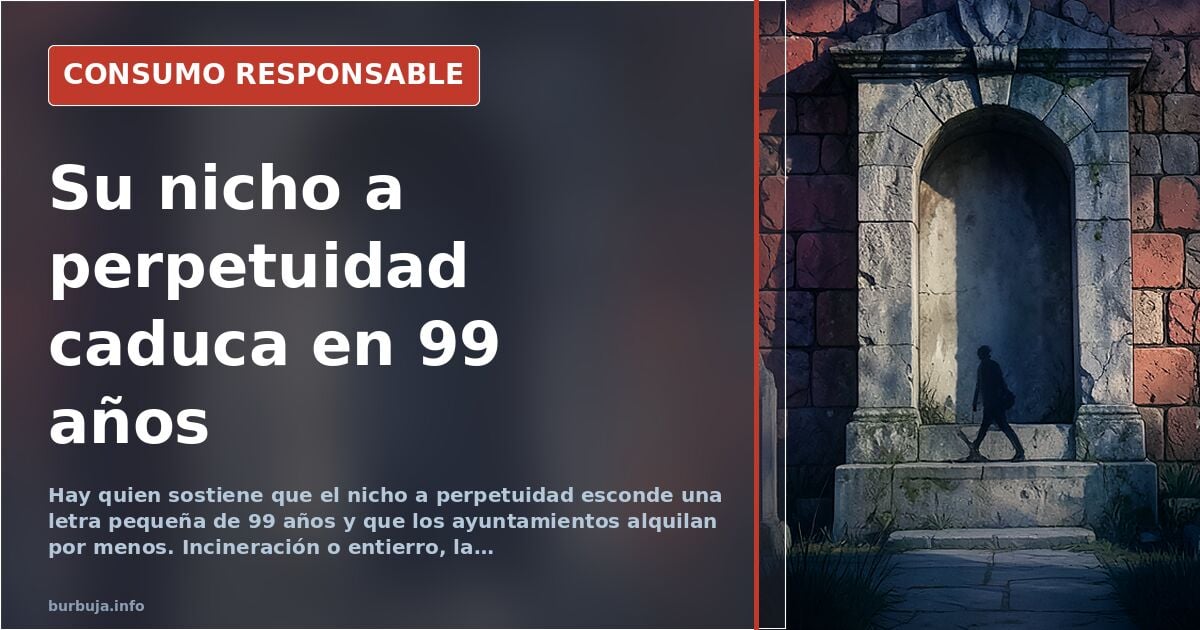
Cremation or burial: the death business nobody audits
Dying in Spain is an expense you plan with the same coldness as a bathroom renovation. One user sums it up bluntly: he is looking at services at the Tanatorio M30 and in Ciudad Real "depending on where I end up dying/whichever is cheaper." That is where the conversation starts, but it quickly drifts toward a more uncomfortable issue: cremation is not just an aesthetic preference, it is an economic and symbolic decision with legal implications almost nobody knows about.
The starting point is a family tradition of burial without exceptions. The only case of cremation anyone remembers was a "new age" husband who believed in reincarnation. The discussion opens up to Tibetan sky burials, the exposure of corpses for birds to eat —as was done at Numantia— and the question hanging over everything: what happens to the burial plot when it expires?
The plot is not forever
The fine print is the star of the show. Although a plot may be sold as perpetual property, some warn that local councils ignore this and rent them out for much shorter periods. The practical consequence is that remains end up exhumed and, in many cases, cremated. The cemetery business does not end with the burial: it continues with the rotation of the ground.
Against that logic, cremation offers an advantage that is not merely symbolic: the urn can be placed in a cemetery, but the ashes can also be split into keepsake containers among relatives. The idea does not convince everyone. Some see it as an object that will end up in the trash "next to the cheese that went moldy in the fridge." The criticism is not trivial: family memory has an expiration date.
Cremation does not prevent resurrection
The religious argument appears early on. "Cremation does not prevent the resurrection of the body," one participant argues, recalling that the practice spread as a fashion and that, in the end, the cemetery keeper burns the remains when the plot expires. The discussion moves away from dogma and into the territory of aesthetics: cremation has "bad symbolism" because it evokes hell, while being buried next to certain people guarantees nothing either.
The option of burial in the ground, wrapped in a blanket instead of a coffin, is raised as a cheaper and more natural alternative. But bureaucracy does not make it easy: local councils do not allow options that yield them no profit. The fine wooden coffin and the rented plot remain the standard package.
The future of the corpse: cloning, taxidermy and bone meal
The conversation slides into science fiction territory. One participant confesses he would like to keep a bone "in case they can clone me in the future, Alien Resurrections style." Another proposes taxidermy and standing in the hallway with arms outstretched to hang coats. Taxidermy, he warns, is not within everyone's reach.
The real process of cremation is described without sugarcoating: about ten kilos of bones and fat residue are left on the walls of the oven; the bones are ground into a powder. Some claim that the ashes handed over may be mixed with those of other deceased people. These claims circulate in the conversation without supporting documentation, but they feed distrust of the sector.
Burial as a family investment
Family weighs more than the law. One participant has his future sorted because his grandfather built a family mausoleum: "put me in there and let my bones remain for the ages." Another, however, laments that his family never thought about a shared grave and that each sibling ends up in a different cemetery. The conclusion is that, in the end, you do not decide: whoever buries you decides.
The option of donating your body to science or industry —"donate your corpse to Repsol to make biodiesel"— comes up as a provocation. So does scattering the ashes at sea or in the mountains, with one ecological argument and one emotional one: "finally free and far from this shitty country."
The epitaph as a final joke
Dark humor runs through the whole conversation. Epitaphs are proposed such as "Do not disturb, you are next," "This is what you get for smoking" or "You stay here, I'll still be a Real Betis fan." The idea of setting aside money for thirty family meals —"let them stuff themselves and have a laugh remembering the pranks their boring old dad played on them"— is the most pragmatic version of remembrance.
The underlying question is not whether to be cremated or buried. It is who pays, who decides and what remains of it all when the plot expires. With the available data, the only certainty is that the death business has more fine print than a mortgage.
Also available in: Deutsch
Summary of a discussion on Burbuja.info - Foro de economía, actualidad y política., translated from Spanish and reviewed before publication. Read the full discussion (88 replies).
More summaries
-
Spain's Carpeta Ciudadana: official notifications that fail to load
A user reports that Spain's Carpeta Ciudadana portal will not load official notifications with legal deadlines, despite trying Cl@ve, REDSARA and several browsers.
-
Rural Exodus in Spain: Low Housing Costs vs. Lack of Services
Cheap rural homes in Spain contrast with urban prices, but missing jobs and healthcare hinder the return to the countryside.
-
Living in a Village vs. City: Cheap Housing, Hidden Costs
A €200 rural rental hides commuting, shopping, and social expenses. The full cost breakdown reveals that rural living is not necessarily cheaper.
-
Nestlé and Dolca: 30% vs 25% Cacao, Same Price in Spain
Nestlé and Dolca chocolates differ by just 5% cacao yet cost nearly the same, revealing that budget brands in Spain are no longer significantly cheaper.
-
Cooked white beans at 26 cents a kilo: the math that doesn't add up
A cooked bean offer advertises 26 cents per kilo, but the real price of the jar is €1.88/kg and the equivalent dried beans cost €4.68. Where's the catch?
-
Male-female friendship: desire or the real thing?
The debate over whether a man can have female friends without sexual desire is back on social media. Reasons, excuses and a tennis story with an uncertain ending.