
Craft beer in Spain: a solid business or a bubble?
Setting up a microbrewery requires an investment that can exceed €500,000, according to one forum user. The sector is enjoying a boom that some call a bubble.
English · Original discussion in Spanish · Published
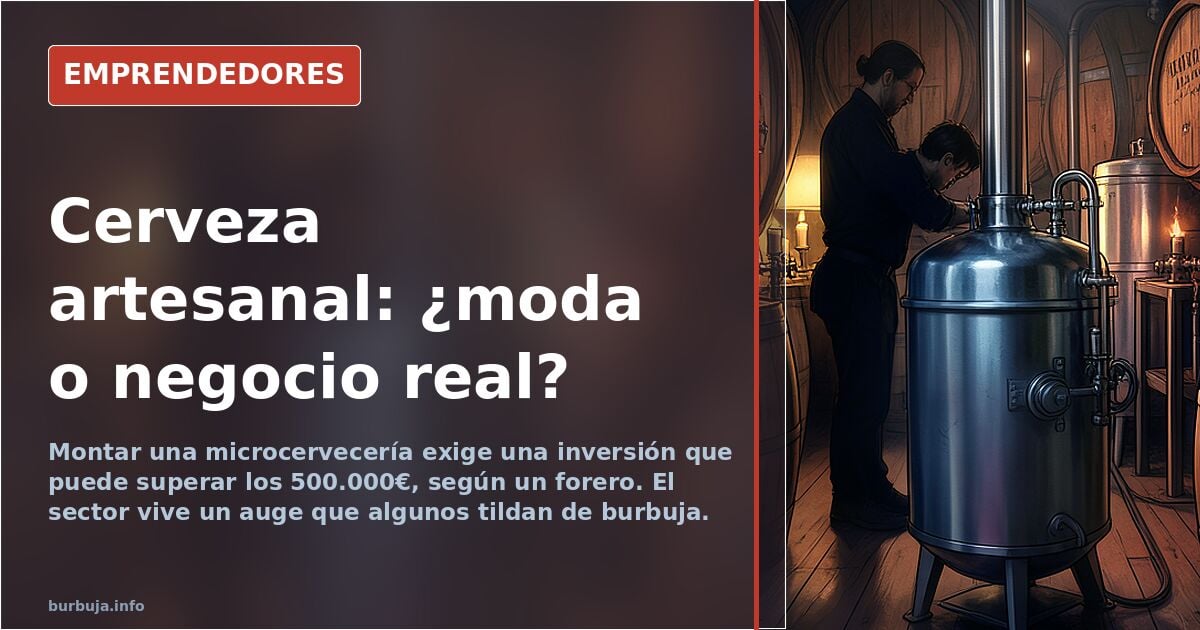
Craft beer: between business and bubble
Is it worth setting up a microbrewery in Spain? The question hangs over a sector which, according to those who have experienced it first-hand, is enjoying an unstoppable boom but also a bubble that will leave few survivors. A Galician entrepreneur, seasoned in the hospitality trade, is considering taking the plunge after closing his bar due to stress and burnout. His past experience — employees who, by his account, stole from the till or faked sick leave — has left him with a residue of distrust and a clear idea: he wants to make something of his own, a brand. But it won't be easy: in A Coruña, Estrella Galicia has a strong hold.
The debate, which has gone on for years, drips with scepticism and the odd statistic. Some argue that craft beer is a passing fad, that 90% of the ones they've tried are "rubbish" and that in two years only a handful will be left. Others, however, see an emerging market with room to grow, where quality and training make the difference. The figures vary widely: from €200,000 in initial investment to half a million for a factory with some presence. Location, health paperwork and distribution emerge as the biggest obstacles.
How much does it cost to set up a microbrewery in Spain?
The range is wide. A basic 1,000-litre setup can cost around €200,000, but if you aim for a premises with a cold room and renovations, the figure skyrockets. One case is mentioned of a brewery which, with a 1,000-litre mash tun per batch, is said to have absorbed more than €500,000. At the opposite end, there are one-person projects in small towns running on simple equipment and a much smaller investment. The conclusion is that there is no fixed price: it depends on volume, the premises and the ability to keep costs down.
Renting commercial premises or a warehouse is the item that hurts most. Rents have come down, but they still weigh on the bottom line. Owning a space — inherited, for example — is a competitive advantage that is hard to match. Add to this the health requirements: separate changing rooms, an isolated raw materials store, bottles that cannot be kept outside before bottling. Requirements that, according to some, border on the capricious and drive up costs.
Is craft beer a passing fad or a market with a future?
Opinions are divided. Sceptics point out that beer has always been a soft drink, not a tasting product, and that paying €3 for a bottle in times of crisis is a luxury few can afford. They argue that the market is dominated by large multinationals, that bars have exclusivity contracts and that distribution is an obstacle course. "It's a big bubble, and when it bursts only the beer geeks will be left," one post declares.
Against this, optimists point out that in Spain the phenomenon has only just begun. In other countries, microbreweries coexist with the big players and have created a culture of their own. The key lies in quality: a mediocre product won't survive, but a good one can carve out a niche. Training for the brewer is essential; without it, the result is a drink with strange flavours that nobody wants to try twice. The advice is to get trained, study the local competition and treat the recipe like a treasure.
Red tape and bureaucracy: a maze for entrepreneurs
Setting up a microbrewery isn't just about malt and hops. The health registry requires product analysis, checking that it is not harmful and that it meets the legal definition of beer. The tax authorities monitor alcohol content. Health inspectors examine the production environment. All this takes time and money, and many entrepreneurs end up handing the paperwork over to an administrative agent. Bureaucracy thus becomes a barrier to entry that discourages more than one.
Distribution is another wall. The channels are dominated by the big brewers, which sign exclusivity agreements with bars. Selling only in kegs limits the market to the hospitality sector, but many venues don't want to install a tap for an unknown brand. The alternative is direct sales, fairs and specialist shops, but the volume is limited. Without a clear strategy, craft beer stays stuck in the circle of friends and family.
The experience of those who have already tried
The accounts of those who have taken the plunge vary. Some started brewing 20 or 30 litres a week for friends and ended up setting up a factory with two partners. Some invested half a million in a warehouse with stainless steel equipment and hired staff. And some, after years as a hobby, decided it wasn't worth it. The conclusion to be drawn is that success is not guaranteed: it depends on quality, management and the ability to hold out in a market that is still in its infancy.
Passion for beer is not enough. Several posts insist that without a serious business plan, with detailed budgets and exhaustive market research, it's better not to risk your money. Enthusiasm is necessary, but not sufficient. The sector has a future, but also pitfalls. And as in any business, those who survive will be those who have managed to stand out.
In the end, the question remains without a clear answer. Is it worth it? It depends on who you ask. What does seem clear is that craft beer is no longer a novelty, and the market is starting to become saturated. Those who arrive late may find the pie already divided. Or maybe not. As someone said, "this is Spain, use your imagination".
Summary of a discussion on Burbuja.info - Foro de economía, actualidad y política., translated from Spanish and reviewed before publication. Read the full discussion (72 replies).
More summaries
-
Self-employed with no stock: dropshipping runs into distributor walls
Dropshipping lets you set up an online store with no stock, but margins fall below 5% and the supplier controls delivery times, stock and prices.
-
Spain's Public Procurement Portal Blocked by Obsolete Java Web Start
Electronic bidding in Spain fails as the state portal relies on Java Web Start, removed since Java 11.
-
YouTuber with 67,000 subscribers claims earnings of up to €10,000 a month
A YouTuber with 67,000 subscribers claims monthly earnings of €2,500 to over €10,000 from YouTube, an online store and coaching. Skepticism has been swift.
-
Robots: the business of the century that still can't sell itself
Robotics is moving at a crawl: office work by 2030, factories by 2040. The business exists, but robot skin and AI alignment remain unsolved.
-
Free commercial space in Leganés, Spain: which businesses can survive without paying rent
A 110 m² premises in Leganés, Spain, rent-free guarantees nothing: fixed costs keep running. These are the options that require the least capital.
-
40-cent beers: the real business is selling franchises
Mercado Provenzal sells small draft beers at 40 cents in Málaga, Spain. A bar owner calculates the keg costs €77+VAT, and the company says that of 31 openings only 3 are…