
Couple Power: Two Beach Scenes Reopen the Debate
A slap for looking and a tall man obeying an order: two scenes of marital subordination reopen the debate on power dynamics in relationships.
English · Original discussion in Spanish · Published
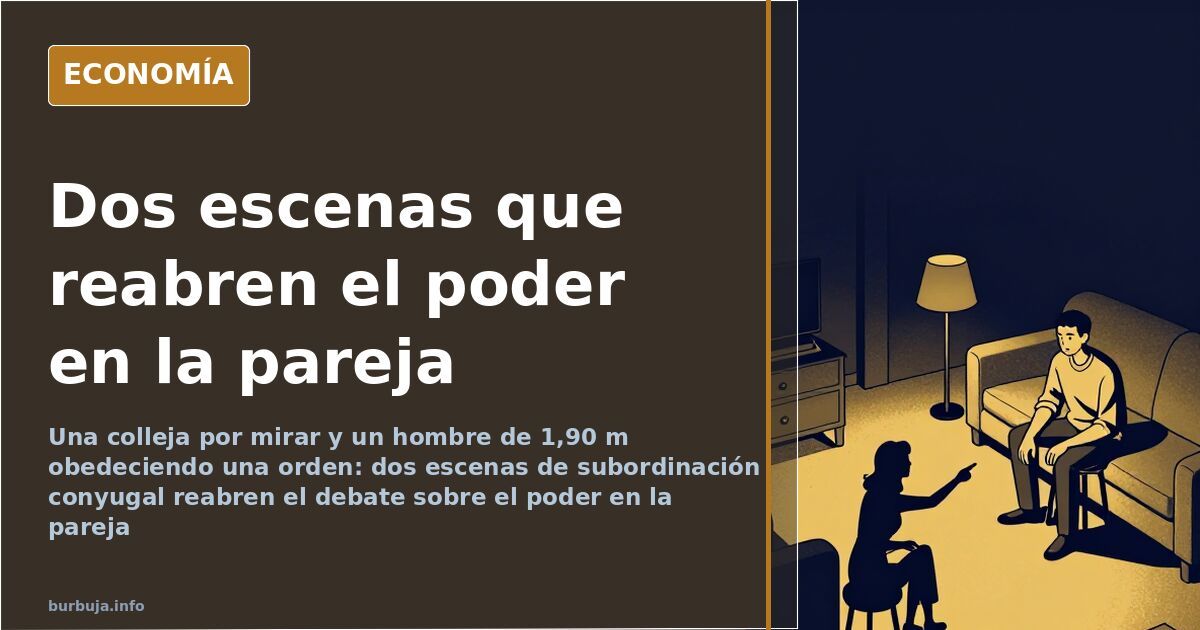
Two scenes of marital subordination on the boardwalk
A report dated 11:23 p.m. on August 23, 2023, describes a couple in their forties walking briskly along a seaside promenade. According to the account, the man turned his head toward a group of young women. The woman slapped him, telling him his eyes would pop out from staring. The man did not respond: a vacant stare, the same pace, and both disappeared into the crowd without breaking stride. Twenty minutes later, on the shore, the account adds another scene.
A man 1.90 meters tall with an athletic build, named Martín, began moving chairs and fishing rods upon hearing a shout in a truck-driver’s voice. When he approached to explain himself, the woman who had called him dismissed him with disdain: she did not want him, she wanted the cart. Martín turned around. These two scenes, recounted with the clock in hand, fuel a debate that has persisted for years regarding the distribution of power within couples and who pays the emotional cost of that distribution.
What is read in the two boardwalk scenes
The account does not dwell on costumbrist details. What it highlights is the asymmetry: in one case, physical and verbal correction in full public view; in the other, shouting orders and a dismissive attitude when the person addressed approaches to speak. In both, the same outcome: the man says nothing and returns to doing what he was told.
Some interpret these episodes as evidence of learned subordination, a habit practiced in public spaces and reinforced by others’ laughter or indifference. The objection comes quickly: a slap and a shout do not allow diagnosing an entire society. The scene might simply be bad behavior by two specific adults.
The supermarket, the gym, and other scenes of the same pattern
The conversation quickly multiplies the settings. One account places the scene in a supermarket: she reads the shopping list aloud and sanctions any suggestion from her partner with a corrective remark in front of everyone. Another transfers the episode to a gym, where a woman between 18 and 20 years old confronts her partner for not bringing the correct dumbbell while another group was using it.
The folksy nature of these stories even reaches the narrator in the first person, who admits, jokingly, that he wrote an opinion piece and had to delete it after being discovered. The anecdote serves as a warning: the scene is recounted because it is recognized.
Divorce, separation of assets, and the end of the provider
The economic aspect of the discussion emerges when complaints cease to be merely gestural. One testimony describes a divorce in pogre trinc years of growing conflicts, criticism over minor details, and an explicit sense of lost authority at home. The outcome he describes is dry: no children, with separation of assets, door closed, and goodbye. The person recounting this notes that with separation of assets, the estate is not divided.
Another account recalls two episodes with an ex-partner, one at the exit of a supermarket in Oviedo in front of passersby, and the decision to cut ties after the second incident. A third describes the case of a sister married to a man who accepted being treated with contempt and, according to this account, lacked pride and self-respect.
The bitterest side also appears: it is claimed that divorced men age alone while their ex-partners rebuild their lives, pointing to male suicide statistics. This is a claim without figures or sources in the conversation. As a perception, it weighs heavily; as data, it does not hold up against what has been provided.
Is this a generational conflict? The disagreement over who sustains this pattern
Here the discussion splits. One position holds that the most intense feminism is concentrated in the 15 to 30 years age bracket, the most sectarian. The counter-argument responds that the 8-M movement is led by women aged 40 to 60, that younger women remain more romantic, and that middle-aged women show the worst temper in daily interactions.
Neither side provides a count. What they do share is the underlying diagnosis: something has broken in the way men and women negotiate day-to-day life. The disagreement is about the culprit, not the symptom.
The objections: anecdote, projection, and absence of figures
Against the collective portrait, one current responds that those who describe others’ lives in such detail are usually telling their own. The accounts are accused of being a selective selection of anecdotes, hiding one’s own miseries under criticism of neighbors. It is also recalled that the figure of the dominant and abusive man as a female ideal is a trope that almost no one supports.
At the other extreme, some argue that the solution is not war but matching equals: same goals, mutual respect, neither submitted to the other. One account formulates this as a third attempt that finally works. It sounds reasonable and refutes nothing of the above: conjugal equality exists, but it has not been measured how abundant it is.
The conversation stalls right there. There are plenty of scenes and a lack of numbers. No one disputes that the two on the boardwalk occurred; what remains unresolved is whether they are two anecdotes with an audience or the tip of a pattern that no one has yet quantified.
A report dated 11:23 p.m. on August 23, 2023, describes a couple in their forties walking briskly along a seaside promenade. According to the account, the man turned his head toward a group of young women. The woman slapped him, telling him his eyes would pop out from staring. The man did not respond: a vacant stare, the same pace, and both disappeared into the crowd without breaking stride. Twenty minutes later, on the shore, the account adds another scene.
A man 1.90 meters tall with an athletic build, named Martín, began moving chairs and fishing rods upon hearing a shout in a truck-driver’s voice. When he approached to explain himself, the woman who had called him dismissed him with disdain: she did not want him, she wanted the cart. Martín turned around. These two scenes, recounted with the clock in hand, fuel a debate that has persisted for years regarding the distribution of power within couples and who pays the emotional cost of that distribution.
What is read in the two boardwalk scenes
The account does not dwell on costumbrist details. What it highlights is the asymmetry: in one case, physical and verbal correction in full public view; in the other, shouting orders and a dismissive attitude when the person addressed approaches to speak. In both, the same outcome: the man says nothing and returns to doing what he was told.
Some interpret these episodes as evidence of learned subordination, a habit practiced in public spaces and reinforced by others’ laughter or indifference. The objection comes quickly: a slap and a shout do not allow diagnosing an entire society. The scene might simply be bad behavior by two specific adults.
The supermarket, the gym, and other scenes of the same pattern
The conversation quickly multiplies the settings. One account places the scene in a supermarket: she reads the shopping list aloud and sanctions any suggestion from her partner with a corrective remark in front of everyone. Another transfers the episode to a gym, where a woman between 18 and 20 years old confronts her partner for not bringing the correct dumbbell while another group was using it.
The folksy nature of these stories even reaches the narrator in the first person, who admits, jokingly, that he wrote an opinion piece and had to delete it after being discovered. The anecdote serves as a warning: the scene is recounted because it is recognized.
Divorce, separation of assets, and the end of the provider
The economic aspect of the discussion emerges when complaints cease to be merely gestural. One testimony describes a divorce in pogre trinc years of growing conflicts, criticism over minor details, and an explicit sense of lost authority at home. The outcome he describes is dry: no children, with separation of assets, door closed, and goodbye. The person recounting this notes that with separation of assets, the estate is not divided.
Another account recalls two episodes with an ex-partner, one at the exit of a supermarket in Oviedo in front of passersby, and the decision to cut ties after the second incident. A third describes the case of a sister married to a man who accepted being treated with contempt and, according to this account, lacked pride and self-respect.
The bitterest side also appears: it is claimed that divorced men age alone while their ex-partners rebuild their lives, pointing to male suicide statistics. This is a claim without figures or sources in the conversation. As a perception, it weighs heavily; as data, it does not hold up against what has been provided.
Is this a generational conflict? The disagreement over who sustains this pattern
Here the discussion splits. One position holds that the most intense feminism is concentrated in the 15 to 30 years age bracket, the most sectarian. The counter-argument responds that the 8-M movement is led by women aged 40 to 60, that younger women remain more romantic, and that middle-aged women show the worst temper in daily interactions.
Neither side provides a count. What they do share is the underlying diagnosis: something has broken in the way men and women negotiate day-to-day life. The disagreement is about the culprit, not the symptom.
The objections: anecdote, projection, and absence of figures
Against the collective portrait, one current responds that those who describe others’ lives in such detail are usually telling their own. The accounts are accused of being a selective selection of anecdotes, hiding one’s own miseries under criticism of neighbors. It is also recalled that the figure of the dominant and abusive man as a female ideal is a trope that almost no one supports.
At the other extreme, some argue that the solution is not war but matching equals: same goals, mutual respect, neither submitted to the other. One account formulates this as a third attempt that finally works. It sounds reasonable and refutes nothing of the above: conjugal equality exists, but it has not been measured how abundant it is.
The conversation stalls right there. There are plenty of scenes and a lack of numbers. No one disputes that the two on the boardwalk occurred; what remains unresolved is whether they are two anecdotes with an audience or the tip of a pattern that no one has yet quantified.
Also available in: Deutsch
Summary of a discussion on Burbuja.info - Foro de economía, actualidad y política., translated from Spanish and reviewed before publication. Read the full discussion (246 replies).
More summaries
-
UK Considers Asset Rights After 3 Years of Cohabitation
The UK debates whether three years of cohabitation grants access to a partner's assets: who pays, how coexistence is proven, and doubts over division.
-
Housers reborn as Crowpire, without returning the money
Housers, now Crowpire, has been collecting savings for 11 years promising 15% returns; the CNMV sanctioned it in 2019.
-
Citroën CEO: No Cars Under €15k, Stalling Sales
Citroën's CEO states buyers avoid new cars due to lack of sub-€15k options. We analyze prices, wages, and quality in the current auto market.
-
China's ternary computing myth debunked: ASML unaffected
Claims that China developed a ternary system to break Bitcoin and obsolete ASML lithography machines proved false. Market data shows no impact.
-
Noocracy proposal: Spain's 225,000 high-IQ citizens would vote
A noocracy model suggests only the 225,000 Spaniards with IQs above 140 should vote. It features rotation and claims to prevent corruption.
-
Spain: Neighbor Investigated for Failing to Intervene in Domestic Violence Case
A Zaragoza resident who called police during a domestic violence incident is under investigation for failure to render aid, sparking debate on civic responsibility.