
Corticosteroids and ketosis: how to avoid gaining 30 kilos
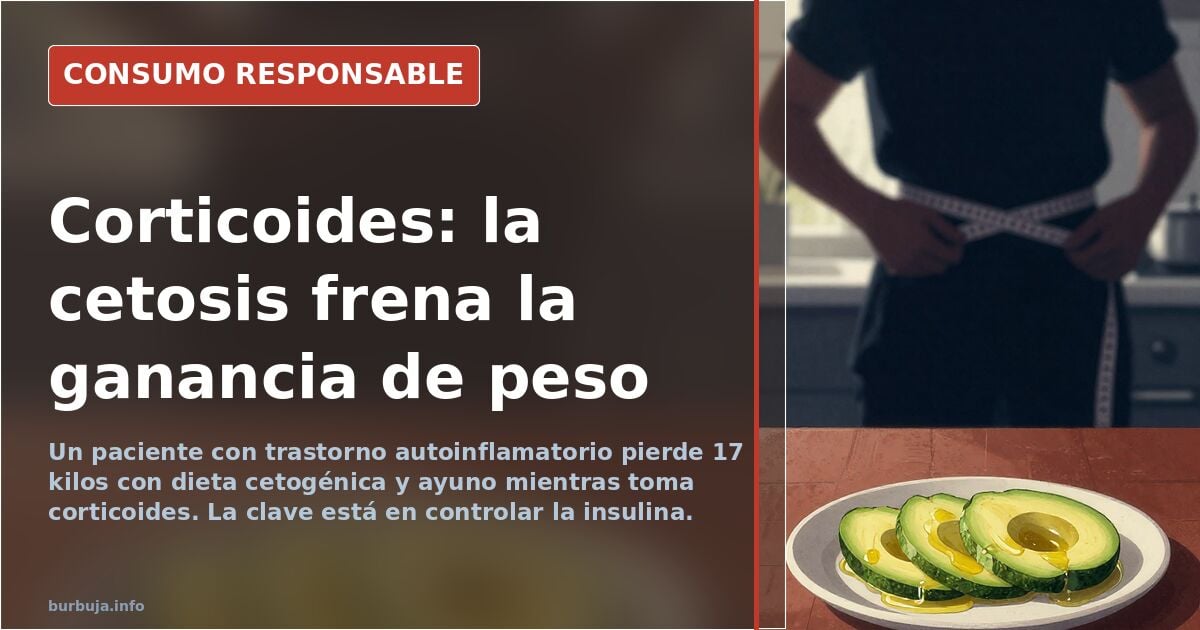
A patient with an autoinflammatory disorder loses 17 kilos on a ketogenic diet and fasting while taking corticosteroids. The key lies in controlling insulin.
English · Original discussion in Spanish · Published
Corticosteroids and ketosis: the strategy for keeping the weight off
A man in his thirties, diagnosed with an unclassified intermittent autoinflammatory disorder, has been taking prednisone for two decades. In that time he has gained 30 kilos. His experience, shared on a mindful-eating forum, details how the ketogenic diet and intermittent fasting have allowed him to lose 17 kilos of fat and keep the side effects of corticosteroids at bay. The key, according to his account, is controlling insulin.
Insulin as the central node
The author of the opening post explains that the etiology of obesity lies in insulin. "It's the alpha and the omega," he says. The concentration of insulin in the blood determines whether energy is burned or stored, regardless of the calories consumed. Corticosteroids, in his experience, cause weight gain precisely because of their effect on insulin sensitivity. Jason Fung, a physician and blogger, already warned about this: corticosteroids pave the road to lasting obesity.
The strategy he proposes combines a classic ketogenic diet with intermittent fasting and daily exercise. The goal is to keep glucose stable, minimize insulin secretion, and take advantage of the anti-inflammatory effect of ketosis. "To lose weight you have to regain insulin sensitivity," he states.
The menu and the supplements
In his pogre reports, the author details his daily meals: avocado with ground flaxseeds, sausages with sauerkraut, callos a la madrileña (Madrid-style tripe), Greek yogurt. He admits he is missing "plenty of greens and plenty of sulfur." Other participants recommend turmeric, garlic, and spices for inflammation. Capsaicin raises doubts: is it inflammatory or anti-inflammatory? There is no consensus.
Flaxseeds turn out to be an ally: a tablespoon provides 2 grams of fiber, 1.6 grams of omega-3, and only 0.4 grams of omega-6. They are 11% glycogenic, which makes them compatible with ketosis. The author aims for his diet to be no more than 15-20% glycogenic.
Side effects and precautions
Corticosteroids do more than cause weight gain. They also leach calcium from the bones and weaken the muscles. One participant recounts that his mother, who has arteritis, is alive thanks to prednisone, but at the cost of taking pills for her bones. Another user, who receives intravenous methylprednisolone, managed not to gain weight this last time, though he credits a concurrent chemotherapy treatment.
The author clarifies that below 5 mg of prednisone per day, the most pernicious side effects are negligible. Inhaled corticosteroids for asthma, such as Symbicort, do not reach those systemic doses. One recurring recommendation: take prednisone in the morning so as not to disrupt the circadian rhythm.
The flare-up and the withdrawal
After a company dinner heavy on flour and sugar, the author suffered a new flare-up. He started on 10 mg of prednisone, then stopped it. A few days later, his spleen was bothering him. He held out until Monday. In the end, the episode closed without any further corticosteroids. "I think this is the flare-up during which I've taken the least cortisone," he celebrates. His weight dropped to 79.5 kilos and his waistline to 87.5 centimeters. He estimates he lost 3 kilos of lean mass that will have to be regained.
Other causes of inflammation
One participant suggests that intestinal candidiasis may lie behind chronic inflammation. Another recounts his experience with a milk protein allergy that went undiagnosed for 20 years, causing muscle spasms, joint inflammation, and conjunctivitis. Once he cut out dairy, he improved. The underlying idea: not all ills come from corticosteroids; sometimes the enemy is on the plate.
An uncertain future
The author plans to undergo a genetic test to identify his disorder. Meanwhile, he continues with his ketogenic diet and his exercise routine: four minutes of tabata, curls and chin-ups, hypopressive exercises. His goal is to reach 15-16% body fat. "Just when I could glimpse a healthy weight on the horizon, the illness reappeared," he laments. The question that remains: how long will he be able to keep inflammation at bay without resorting to corticosteroids?
A man in his thirties, diagnosed with an unclassified intermittent autoinflammatory disorder, has been taking prednisone for two decades. In that time he has gained 30 kilos. His experience, shared on a mindful-eating forum, details how the ketogenic diet and intermittent fasting have allowed him to lose 17 kilos of fat and keep the side effects of corticosteroids at bay. The key, according to his account, is controlling insulin.
Insulin as the central node
The author of the opening post explains that the etiology of obesity lies in insulin. "It's the alpha and the omega," he says. The concentration of insulin in the blood determines whether energy is burned or stored, regardless of the calories consumed. Corticosteroids, in his experience, cause weight gain precisely because of their effect on insulin sensitivity. Jason Fung, a physician and blogger, already warned about this: corticosteroids pave the road to lasting obesity.
The strategy he proposes combines a classic ketogenic diet with intermittent fasting and daily exercise. The goal is to keep glucose stable, minimize insulin secretion, and take advantage of the anti-inflammatory effect of ketosis. "To lose weight you have to regain insulin sensitivity," he states.
The menu and the supplements
In his pogre reports, the author details his daily meals: avocado with ground flaxseeds, sausages with sauerkraut, callos a la madrileña (Madrid-style tripe), Greek yogurt. He admits he is missing "plenty of greens and plenty of sulfur." Other participants recommend turmeric, garlic, and spices for inflammation. Capsaicin raises doubts: is it inflammatory or anti-inflammatory? There is no consensus.
Flaxseeds turn out to be an ally: a tablespoon provides 2 grams of fiber, 1.6 grams of omega-3, and only 0.4 grams of omega-6. They are 11% glycogenic, which makes them compatible with ketosis. The author aims for his diet to be no more than 15-20% glycogenic.
Side effects and precautions
Corticosteroids do more than cause weight gain. They also leach calcium from the bones and weaken the muscles. One participant recounts that his mother, who has arteritis, is alive thanks to prednisone, but at the cost of taking pills for her bones. Another user, who receives intravenous methylprednisolone, managed not to gain weight this last time, though he credits a concurrent chemotherapy treatment.
The author clarifies that below 5 mg of prednisone per day, the most pernicious side effects are negligible. Inhaled corticosteroids for asthma, such as Symbicort, do not reach those systemic doses. One recurring recommendation: take prednisone in the morning so as not to disrupt the circadian rhythm.
The flare-up and the withdrawal
After a company dinner heavy on flour and sugar, the author suffered a new flare-up. He started on 10 mg of prednisone, then stopped it. A few days later, his spleen was bothering him. He held out until Monday. In the end, the episode closed without any further corticosteroids. "I think this is the flare-up during which I've taken the least cortisone," he celebrates. His weight dropped to 79.5 kilos and his waistline to 87.5 centimeters. He estimates he lost 3 kilos of lean mass that will have to be regained.
Other causes of inflammation
One participant suggests that intestinal candidiasis may lie behind chronic inflammation. Another recounts his experience with a milk protein allergy that went undiagnosed for 20 years, causing muscle spasms, joint inflammation, and conjunctivitis. Once he cut out dairy, he improved. The underlying idea: not all ills come from corticosteroids; sometimes the enemy is on the plate.
An uncertain future
The author plans to undergo a genetic test to identify his disorder. Meanwhile, he continues with his ketogenic diet and his exercise routine: four minutes of tabata, curls and chin-ups, hypopressive exercises. His goal is to reach 15-16% body fat. "Just when I could glimpse a healthy weight on the horizon, the illness reappeared," he laments. The question that remains: how long will he be able to keep inflammation at bay without resorting to corticosteroids?
Also available in: Deutsch
Summary of a discussion on Burbuja.info - Foro de economía, actualidad y política., translated from Spanish and reviewed before publication. Read the full discussion (76 replies).
More summaries
-
Psychiatrist labels extreme saving a personality disorder
A psychiatrist claims extreme saving is a personality disorder. Critics counter with figures: €20 shower screens versus €2,300 handbags.
-
Turmeric: Hype, Doubts, and Stained Counters
A forum discussion on turmeric covers culinary uses, home remedies, potential effects, and doubts about its actual efficacy.
-
Aging gracefully: surgery vs. genetics at 64
Madonna and Susanna Hoffs, both 64, illustrate two opposite ways of facing aging: surgery and gym versus habits and good spirits.
-
Lidl's quality is slipping, one product at a time
Bin-worthy sandwich bread, nectarines that taste like cork and less tuna in the can. Lidl's quality decline, product by product.
-
Good honey: from €5.45 to €11 a kilo for the same jar
Real honey crystallizes; industrial honey never does. Prices range from 6 to 11 euros per kilo, but the label guarantees nothing. The only real guarantee is knowing the…
-
Cheap fountain pens: the Pilot 78G taking the internet by storm
The Pilot 78G, for under 10 euros on eBay, is one of the best-rated fountain pens for value for money. Here are the alternatives and the…