
Correos seeks banking license to exit losses by 2026
Spain's postal service Correos plans to apply for a banking license from the Bank of Spain in 2025, aiming to serve financially excluded citizens and return to profitability.
English · Original discussion in Spanish · Published
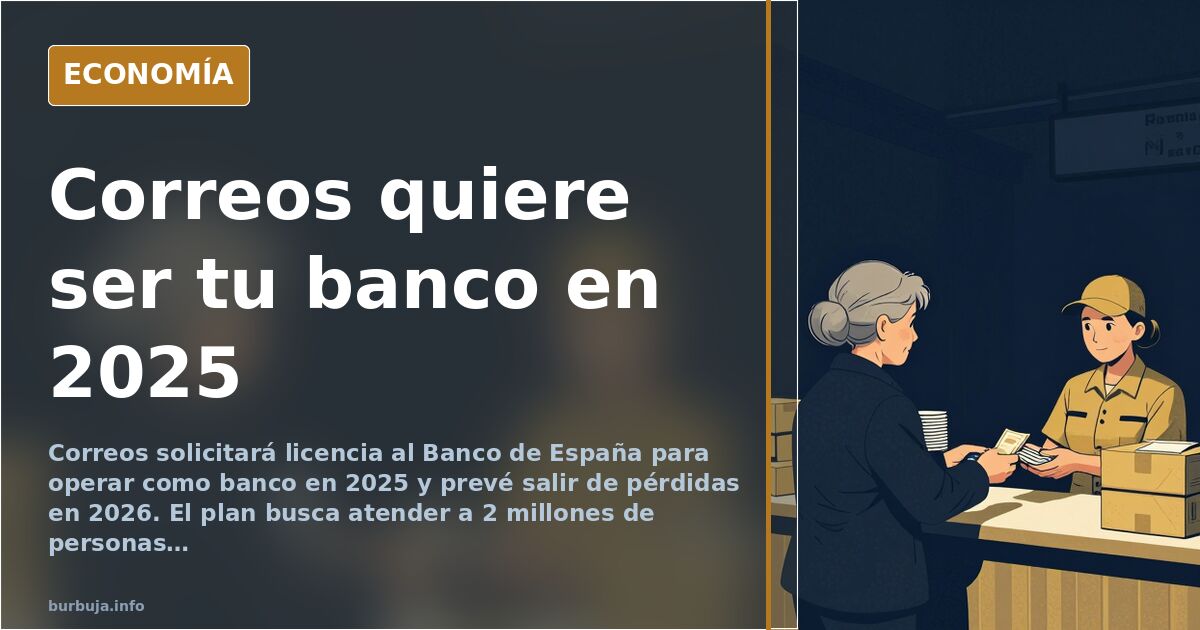
Correos applies for Bank of Spain license to operate as bank in 2025
Can a loss-making postal company become a profitable bank within a year? That is what Correos aims to achieve. Its president, Pedro Saura, announced that the state-owned company will request a license from the Banco de España (Bank of Spain) to issue electronic money and operate as a commercial bank. The goal is to reach positive EBITDA in 2025 and exit losses by 2026. The 2024-2028 strategic plan seeks to reduce dependence on traditional postal services to below 50% of revenue, increase parcel delivery to 35%, and capture new business lines contributing 16% of turnover.
The specific niche Correos intends to address includes 4,500 municipalities with fewer than 5,000 inhabitants and 3,400 town halls without physical bank branches. The company estimates it could serve two million people at risk of financial exclusion, a figure rising to seven million if elderly citizens preferring face-to-face service are included. Saura argues that institutions like the Defensor del Pueblo (Ombudsman) demand a public entity for basic financial services, noting that Correos already provides part of this service without compensation.
Services offered by the proposed Correos bank
The company is developing a brand to group these financial services for launch in 2025. The planned range covers opening accounts, direct debiting bills, cash deposits and withdrawals, transfers, and interest-bearing deposits. Essentially, it mirrors the catalog of traditional retail banking but leverages the existing network of post offices as infrastructure.
The official argument rests on "España vaciada" (dep-populated rural areas): where banks have closed branches, Correos maintains a physical presence. The firm claims this extensive network makes it the "optimal and efficient" solution for serving populations excluded from the financial system, demanding recognition and remuneration for providing a public service. The plan also contemplates reviving the values of the Caja Postal (Postal Savings Bank), an entity that operated for decades and which some recall with nostalgia.
Doubts regarding project viability
Skepticism pervades much of the analysis. Critics note that Correos accumulates millions in losses precisely during an unprecedented expansion of its most profitable segment, parcel delivery, suggesting management issues rather than market failures. Others point out that online banking and ATMs have eliminated the need for physical networks for basic operations, while brick-and-mortar banks face higher costs than digital-only competitors, hindering profitability.
Comparisons with previous attempts weigh heavily. Orange launched a bank in Europe but abandoned it due to lack of market space, and Catalonia has seen costly experiments with public banking. Additionally, old prepaid cards managed by an Irish provider that went bankrupt left users with frozen funds, a precedent that does not inspire confidence in this new financial venture.
The ghost of savings banks
Parallels with Spanish cajas de ahorros (savings banks) appear repeatedly. It is argued that those non-profit entities, originally socially oriented, were captured by political and union interests on their boards, leading to bankruptcy and subsequent bailouts with public money. The antiestéticar is that Correos will repeat this cycle: creation of a socially motivated entity, colonization by politically appointed staff, failure, and socialization of losses.
Practical objections also carry weight: many rural areas have more bars than Correos offices, and existing services allow cash withdrawal in shops and newsagents without creating a bank. Correos could offer such services by partnering with existing entities rather than seeking a full banking license. Insisting on owning a bank fuels suspicion that the real aim is placing executives and expanding the public structure.
Who would use the Correos bank?
The target customer profile includes pensioners, immigrants, and young people with limited financial literacy who already visit post offices to collect pensions, agricultural subsidies, or send remittances. This is a real but limited niche. Doubts remain about whether individuals with significant assets would entrust savings to an entity with no track record, with irony suggesting deposits might end up financing the parent company's deficit.
The core question is whether Correos can manage a bank with the same efficiency it delivers parcels, which is arguably low. The plan promises diversification and profitability, but the numbers do not add up: a company losing money in its main business aims to earn it in a new, regulated sector. The irony writes itself.
Can a loss-making postal company become a profitable bank within a year? That is what Correos aims to achieve. Its president, Pedro Saura, announced that the state-owned company will request a license from the Banco de España (Bank of Spain) to issue electronic money and operate as a commercial bank. The goal is to reach positive EBITDA in 2025 and exit losses by 2026. The 2024-2028 strategic plan seeks to reduce dependence on traditional postal services to below 50% of revenue, increase parcel delivery to 35%, and capture new business lines contributing 16% of turnover.
The specific niche Correos intends to address includes 4,500 municipalities with fewer than 5,000 inhabitants and 3,400 town halls without physical bank branches. The company estimates it could serve two million people at risk of financial exclusion, a figure rising to seven million if elderly citizens preferring face-to-face service are included. Saura argues that institutions like the Defensor del Pueblo (Ombudsman) demand a public entity for basic financial services, noting that Correos already provides part of this service without compensation.
Services offered by the proposed Correos bank
The company is developing a brand to group these financial services for launch in 2025. The planned range covers opening accounts, direct debiting bills, cash deposits and withdrawals, transfers, and interest-bearing deposits. Essentially, it mirrors the catalog of traditional retail banking but leverages the existing network of post offices as infrastructure.
The official argument rests on "España vaciada" (dep-populated rural areas): where banks have closed branches, Correos maintains a physical presence. The firm claims this extensive network makes it the "optimal and efficient" solution for serving populations excluded from the financial system, demanding recognition and remuneration for providing a public service. The plan also contemplates reviving the values of the Caja Postal (Postal Savings Bank), an entity that operated for decades and which some recall with nostalgia.
Doubts regarding project viability
Skepticism pervades much of the analysis. Critics note that Correos accumulates millions in losses precisely during an unprecedented expansion of its most profitable segment, parcel delivery, suggesting management issues rather than market failures. Others point out that online banking and ATMs have eliminated the need for physical networks for basic operations, while brick-and-mortar banks face higher costs than digital-only competitors, hindering profitability.
Comparisons with previous attempts weigh heavily. Orange launched a bank in Europe but abandoned it due to lack of market space, and Catalonia has seen costly experiments with public banking. Additionally, old prepaid cards managed by an Irish provider that went bankrupt left users with frozen funds, a precedent that does not inspire confidence in this new financial venture.
The ghost of savings banks
Parallels with Spanish cajas de ahorros (savings banks) appear repeatedly. It is argued that those non-profit entities, originally socially oriented, were captured by political and union interests on their boards, leading to bankruptcy and subsequent bailouts with public money. The antiestéticar is that Correos will repeat this cycle: creation of a socially motivated entity, colonization by politically appointed staff, failure, and socialization of losses.
Practical objections also carry weight: many rural areas have more bars than Correos offices, and existing services allow cash withdrawal in shops and newsagents without creating a bank. Correos could offer such services by partnering with existing entities rather than seeking a full banking license. Insisting on owning a bank fuels suspicion that the real aim is placing executives and expanding the public structure.
Who would use the Correos bank?
The target customer profile includes pensioners, immigrants, and young people with limited financial literacy who already visit post offices to collect pensions, agricultural subsidies, or send remittances. This is a real but limited niche. Doubts remain about whether individuals with significant assets would entrust savings to an entity with no track record, with irony suggesting deposits might end up financing the parent company's deficit.
The core question is whether Correos can manage a bank with the same efficiency it delivers parcels, which is arguably low. The plan promises diversification and profitability, but the numbers do not add up: a company losing money in its main business aims to earn it in a new, regulated sector. The irony writes itself.
Also available in: Deutsch
Summary of a discussion on Burbuja.info - Foro de economía, actualidad y política., translated from Spanish and reviewed before publication. Read the full discussion (114 replies).
More summaries
-
Spain's Ombudsman estimates 440,000 child abuse victims in Church
Spain's Ombudsman estimates 440,000 victims of child sexual abuse in the Catholic Church, calling for state-funded compensation.
-
Abascal in Argentina: People will want to hang Sánchez
Vox leader Santiago Abascal stated in Argentina that the people will want to hang Pedro Sánchez. The PSOE demands PP condemnation; Feijóo remains silent.
-
Spain's housing decree: what Sánchez and allies are plotting
The housing decree is being voted on without being read, with suspicions it sneaks in measures unrelated to rental housing. Junts, PNV and Bildu will decide the outcome.
-
Juanma Moreno's Granada Photo Sparks Outrage in Spain's PP
In late 2021, a photo of Juanma Moreno and PP colleagues in Granada without visible restrictions triggered accusations of double standards.
-
Live TV groping claim sparks debate over hand position
A live broadcast incident involving a Cuatro reporter turns into a national dispute over whether the contact was sexual assault or accidental.
-
LIBERUM releases templates to block EU health data sharing
LIBERUM publishes forms to refuse transferring Spanish health data to the EU, citing opposition rights and data protection agencies.