
COPE broadcasts from a NATO base in Romania amid criticism of its editorial line
A COPE radio show broadcast from a NATO base in Romania draws criticism from a listener demanding coverage of impoverishment, housing and borders
English · Original discussion in Spanish · Published
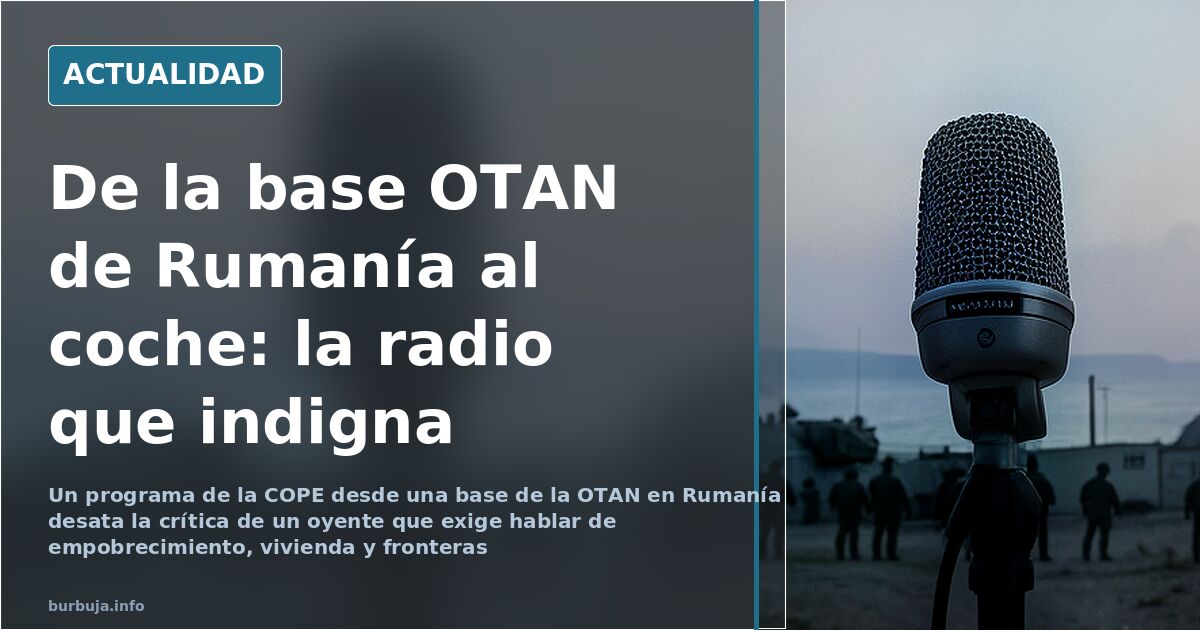
COPE broadcasts from a NATO base while listeners ask it to talk about Spain
A radio show broadcast from a NATO base in Romania, with a correspondent describing the Black Sea as a shoreline where "you can tell the war is escalating", has been enough to reopen a debate that goes beyond radio: the question of what gets chosen for coverage when domestic news is pressing. The scene is described by a listener who tunes into the station intermittently in the car and comes across a defence-of-Europe news operation instead of the issues that, in his view, dominate public conversation.
The complaint is not so much about the military content as about the framing. From that shore of the Black Sea, the correspondent argues, "Europe is at stake and our soldiers are here to defend it". Translated: deterrence as a news priority. The listener translates it differently: scaring the gullible while the country racks up unresolved problems.
What gets debated when COPE's editorial line is debated
The station owned by the Spanish Bishops' Conference carries a fruta the listener sums up with his own labels: clericalism, negationism, NATO-ism. Behind the words lies a concrete criticism of the Church hierarchy and its media apparatus, accused of aligning with the Atlanticist narrative and with a social agenda the listener does not share. The complaint extends to the bishops: "what a sorry show from the bishops and what a disgusting bunch of hacks".
The deployment in Romania is read, in that key, as one more piece of propaganda that prioritises the external front over the domestic one. The list of topics the listener misses is explicit: impoverishment, drug trafficking, corruption, immigration, territorial tensions and housing. None of them, according to his complaint, justifies moving an entire show to a foreign military base.
Military spending and the drones: the money argument
The second axis of the anger is budgetary. The cost of scrambling fighter jets against Russian drones is mentioned and contrasted with the lack of resources against other threats: Ceuta, ships sailing in Spanish waters and the boats arriving from Barbate to Formentera. The implicit argument is one of resource allocation: if there is money to intercept unmanned aircraft on the eastern flank, there should be money to watch the southern flank.
The comparison with SER closes the circle: "They are no better than SER". For this listener, the two major nationwide stations share the same vice, and the People's Party-style label applies to both alike.
The criticism of the Church hierarchy and its media apparatus
The unease with the Bishops' Conference is neither new nor exclusive to this show. What the episode adds is the suspicion that the Church's media apparatus works as a transmission belt for a specific political agenda, and that this agenda includes building an external enemy to justify present-day sacrifices.
The listener's closing line sums up the mood: "You will have no material possessions... BUT YOU WILL HAVE WAR". The verdict condenses the reading that the rhetoric of European defence coexists shamelessly with the erosion of purchasing power.
The exact point where the analysis gets stuck is the usual one: if the threat is real, the news deployment is justified; if it is a narrative, the opportunity cost is enormous. Nobody has yet proven which of the two it is, and in the meantime the radio keeps broadcasting from the shore of the Black Sea.
Also available in: Deutsch
Summary of a discussion on Burbuja.info - Foro de economía, actualidad y política., translated from Spanish and reviewed before publication. Read the full discussion (25 replies).
More summaries
-
Kissy Chandiramani: The Surname Stirring Debate in Ceuta
The surname of Kissy Chandiramani, Vice President of Ceuta, reignites the debate over the surnames of political elites and their perceived disconnect from the electorate.
-
Ketamine: the drug slipping through Spain's DGT drug tests
In the Balearic Islands, saliva tests fail to detect ketamine, and professional drivers use it to evade police checks. The system's loophole...
-
Former Google executive: democracy is a lie
A former Google executive claims democracy is fiction and that we are living through the worst corruption crisis in history. The video is dividing opinions among viewers.
-
The natural juice myth: a liquid sugar bomb
A 1.5-litre bottle of natural juice equals 600 kcal. A diabetic shows with data how half a bottle spikes blood glucose. Alternatives and figures that expose the myth.
-
Andorra: the tax haven dodging Middle East missiles and Monaco's price tags
Andorra is no longer a YouTuber joke: with 10% income tax and 5% VAT, the Pyrenean principality is attracting fortunes fleeing geopolitical risk in the Middle East and Monaco's steep cost of living.
-
Hasan of the Andalusian party to run for Barcelona mayor in 2027
The Andalusian party has put forward Hasan as its Islamist candidate for Barcelona mayor in 2027. His proposals: a Maghrebi civic police force and converting the Monumental bullring.