
Content Creator Eats in Indian Roadside Diner for €12
A content creator films a five-person meal costing €12 at an Indian roadside diner, sparking debate on low-cost tourism and influencer culture.
English · Original discussion in Spanish · Published
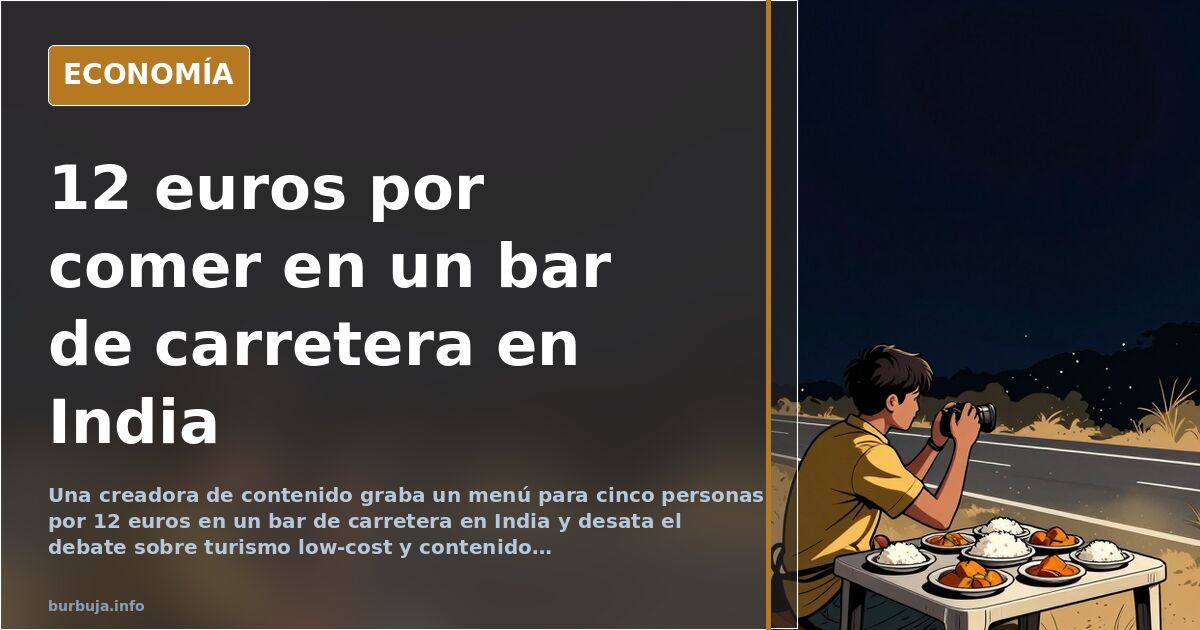
Content creator eats in Indian roadside diner, sparking debate on low-cost tourism
A content creator records her dining experience at a highway eatery in India. The result—a menu for five people costing around €12—triggers a broader discussion: what does this type of tourism reveal about the country's real economy, the influencer business, and the standards Western travelers apply when leaving their comfort zone? The video, circulated on social media, shows the venue, food served with hands, and the surroundings. Reactions are immediate: some celebrate it as a display of authenticity, while others interpret it as showcasing foreign precariousness turned into content.
The price is the most circulated data point: €12 among five diners, including handmade sauces. This figure, ridiculous by European standards, becomes the axis of two opposing readings. For some, it proves that traveling to India remains cheap and that there is tourism seeking experiences outside the Westernized circuit. For others, it confirms that the creator has not left her bubble: she eats at a toll-road diner, an environment that filters out the majority of the population and offers standards that do not represent the country.
What is an Indian roadside diner and why does location matter
The venue's location is the first point of contention. A roadside diner on a toll highway is not the same as one on a local road. The former serves a traveler profile with resources, filters out the majority of the population, and offers a more controlled environment. The latter truly shows how people eat in large parts of the country. This distinction is crucial: it completely conditions the interpretation of the video. If the venue is on a toll road, the experience is that of a tourist moving through an asphalt bubble. If it were on a secondary road, the narrative would be different.
Some argue that food in India tastes practically the same everywhere, dominated by a vast amount of spices used both for preservation and to make cooked food digestible. An anecdote circulating involves a five-star hotel in New Delhi where, upon climbing to the terrace kitchen, staff saw something resembling a cat running, which turned out to be a large rat. This fact is not a condemnation of the country: it confirms that hygiene standards are not measured with the same yardstick across all establishments.
Gastro-tourism as a content genre
The conversation quickly shifts to the phenomenon of creators turning any experience, including digestive ones, into publishable material. The term "gastro-tourism" summarizes the genre: traveling to destinations where the body reacts and filming that reaction. The expectation that the protagonist will end up with gastrointestinal issues becomes a recurring joke. People joke that she will never suffer constipation again and that a month of diarrhea would be the minimum expected outcome.
The business behind it is also discussed. The creator travels, films, and monetizes. The cost of the menu, €12, is irrelevant compared to the value of the generated content. Here lies the contradiction pointed out by some: the experience is presented as an economic achievement when it is actually an investment in publishable material. The low price is not the discovery; the discovery is that someone can turn a cheap menu into a digital product.
Criticism of the persona and the authenticity narrative
Much of the discussion is not about India, but about the creator. Her physical appearance, age, supposed hyperactivity, and future are questioned. There is speculation that her body will change over time and that her lifestyle is unsustainable. These are opinions, not facts, and are recorded as such. Underlying this is distrust toward the narrative of authenticity: the idea that filming a roadside diner is a way to connect with reality when it is actually another staged performance.
The comparison made is with traditional tourism. Someone who travels to India and eats at a roadside diner is not discovering anything new: they are repeating what millions of people do. The novelty is not in the destination or the menu, but in the format. And the format, critical voices argue, turns foreign precariousness into entertainment.
Price as an economic mirage
The data of €12 among five people is the most repeated, but also the most nuanced. Eating cheaply in India is not an anomaly: it is the norm for the majority of the population. What is striking is that it is presented as an achievement. The comparison with Spain is inevitable: for that price, you cannot even eat at a fixed-menu bar here. The difference does not measure quality, but relative purchasing power and the cost structure of each country.
The discussion moves toward the opportunity cost of travel. Those who dedicate time and money to touring India eating at cheap venues are not making a bad deal, but neither are they discovering a secret formula. Low-cost tourism has existed since tourism itself began. What is new is the ability to turn it into content and monetize it. That is the true economics of the matter.
The exact point where analysis stalls is always the same: whether the video shows reality or a construction. The venue exists, the price exists, the food exists. What is unclear is what is being sold with all of it. Until this is clarified, the debate will continue to revolve around the €12.
A content creator records her dining experience at a highway eatery in India. The result—a menu for five people costing around €12—triggers a broader discussion: what does this type of tourism reveal about the country's real economy, the influencer business, and the standards Western travelers apply when leaving their comfort zone? The video, circulated on social media, shows the venue, food served with hands, and the surroundings. Reactions are immediate: some celebrate it as a display of authenticity, while others interpret it as showcasing foreign precariousness turned into content.
The price is the most circulated data point: €12 among five diners, including handmade sauces. This figure, ridiculous by European standards, becomes the axis of two opposing readings. For some, it proves that traveling to India remains cheap and that there is tourism seeking experiences outside the Westernized circuit. For others, it confirms that the creator has not left her bubble: she eats at a toll-road diner, an environment that filters out the majority of the population and offers standards that do not represent the country.
What is an Indian roadside diner and why does location matter
The venue's location is the first point of contention. A roadside diner on a toll highway is not the same as one on a local road. The former serves a traveler profile with resources, filters out the majority of the population, and offers a more controlled environment. The latter truly shows how people eat in large parts of the country. This distinction is crucial: it completely conditions the interpretation of the video. If the venue is on a toll road, the experience is that of a tourist moving through an asphalt bubble. If it were on a secondary road, the narrative would be different.
Some argue that food in India tastes practically the same everywhere, dominated by a vast amount of spices used both for preservation and to make cooked food digestible. An anecdote circulating involves a five-star hotel in New Delhi where, upon climbing to the terrace kitchen, staff saw something resembling a cat running, which turned out to be a large rat. This fact is not a condemnation of the country: it confirms that hygiene standards are not measured with the same yardstick across all establishments.
Gastro-tourism as a content genre
The conversation quickly shifts to the phenomenon of creators turning any experience, including digestive ones, into publishable material. The term "gastro-tourism" summarizes the genre: traveling to destinations where the body reacts and filming that reaction. The expectation that the protagonist will end up with gastrointestinal issues becomes a recurring joke. People joke that she will never suffer constipation again and that a month of diarrhea would be the minimum expected outcome.
The business behind it is also discussed. The creator travels, films, and monetizes. The cost of the menu, €12, is irrelevant compared to the value of the generated content. Here lies the contradiction pointed out by some: the experience is presented as an economic achievement when it is actually an investment in publishable material. The low price is not the discovery; the discovery is that someone can turn a cheap menu into a digital product.
Criticism of the persona and the authenticity narrative
Much of the discussion is not about India, but about the creator. Her physical appearance, age, supposed hyperactivity, and future are questioned. There is speculation that her body will change over time and that her lifestyle is unsustainable. These are opinions, not facts, and are recorded as such. Underlying this is distrust toward the narrative of authenticity: the idea that filming a roadside diner is a way to connect with reality when it is actually another staged performance.
The comparison made is with traditional tourism. Someone who travels to India and eats at a roadside diner is not discovering anything new: they are repeating what millions of people do. The novelty is not in the destination or the menu, but in the format. And the format, critical voices argue, turns foreign precariousness into entertainment.
Price as an economic mirage
The data of €12 among five people is the most repeated, but also the most nuanced. Eating cheaply in India is not an anomaly: it is the norm for the majority of the population. What is striking is that it is presented as an achievement. The comparison with Spain is inevitable: for that price, you cannot even eat at a fixed-menu bar here. The difference does not measure quality, but relative purchasing power and the cost structure of each country.
The discussion moves toward the opportunity cost of travel. Those who dedicate time and money to touring India eating at cheap venues are not making a bad deal, but neither are they discovering a secret formula. Low-cost tourism has existed since tourism itself began. What is new is the ability to turn it into content and monetize it. That is the true economics of the matter.
The exact point where analysis stalls is always the same: whether the video shows reality or a construction. The venue exists, the price exists, the food exists. What is unclear is what is being sold with all of it. Until this is clarified, the debate will continue to revolve around the €12.
Also available in: Deutsch
Summary of a discussion on Burbuja.info - Foro de economía, actualidad y política., translated from Spanish and reviewed before publication. Read the full discussion (111 replies).
More summaries
-
Sánchez tests positive for COVID, skips New Delhi G-20 summit
Pedro Sánchez cancels his trip to the G-20 in New Delhi after testing positive for COVID. Spain will be represented by the First Vice President and the Minister of…
-
Ibiza Loses Tourists After Three Years of Price Hikes
Ibiza has seen three years of rising prices, and now tourists are leaving: 400 euros for a sunbed and paella, and dinners costing 12,300 euros.
-
Franco handed out 8,000 flats and today no one can buy one
Franco handed out 7,486 flats in a single event according to NODO. Today, those flats rent for 1,200 euros: public housing, an uncomfortable memory
-
Saunas and PSOE: Unproven Theory on Sánchez's Origin
A commentator claims Pedro Sánchez entered the PSOE via his father-in-law's saunas. No evidence supports this alleged political blackmail.
-
Satirical Comic Sends Spanish Seniors to Ukraine Front
A satirical comic imagining seniors in the Ukrainian war reopens debates on political humor's limits and utility.
-
USGS estimates 5.5 trillion tons of natural hydrogen
USGS estimates 5.5 trillion tons of natural hydrogen, enough for centuries, though most remains inaccessible.