
Construction Sector Faces Labor Shortage: 1,300€ Wages Fail to Attract Workers
Construction companies struggle to find laborers, with wages from €1,300 to €3,000 monthly, yet fail to attract new talent or retain existing workers.
English · Original discussion in Spanish · Published
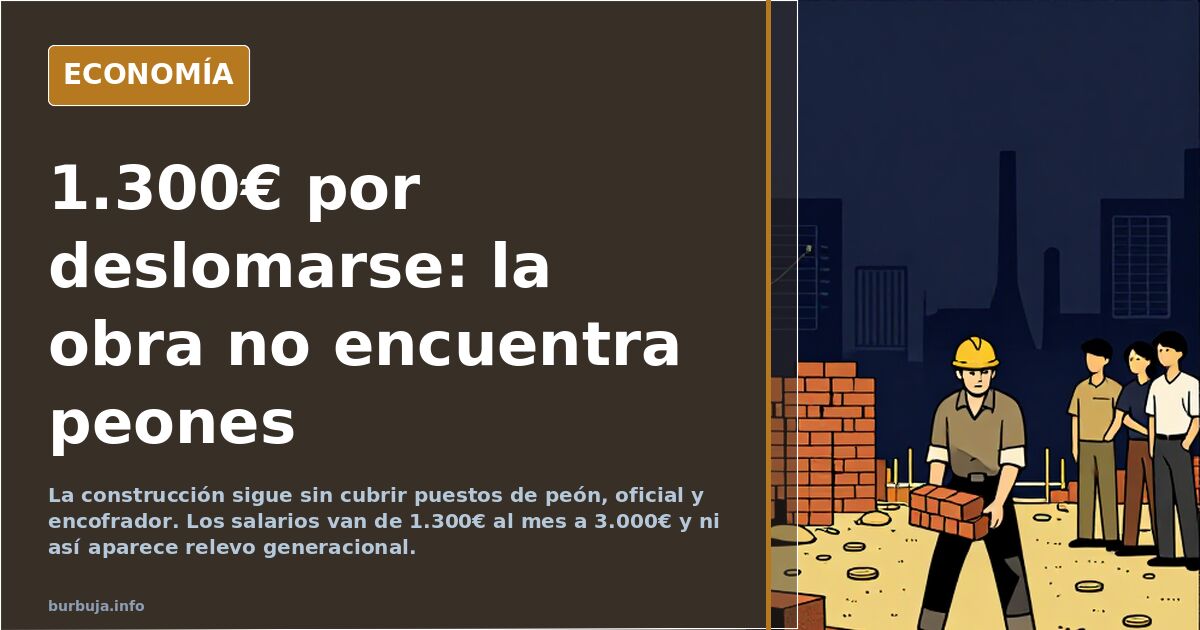
Construction Can't Find Laborers for €1,300 a Month
A forum post, lacking further support, claims a 30-year-old man died on a villa construction site in Madrid. His case offers a sarracena the industry doesn't want to hear: for €1,200 a month, enduring cold, heat, dirt, and risk of falls, no one wants to climb scaffolding. Construction continues to need people. Laborers are missing, skilled workers are missing, formworkers are missing. The complaint isn't that there are no candidates, but that those who exist don't last.
What Does Construction Really Pay?
The laborer breaks his knees and back for €1,300 a month, according to one participant. The skilled worker earns between €1,600 and €1,800. A first-class bricklayer earns over €2,000, and an experienced formworker or paver can make up to €3,000. The range is wide, but the floor remains the floor. Those who worked during the previous bubble remember laborers earning €2,500 net. Today, with more training and less room for undeclared work, the base is €1,200. With housing at €3,000 per square meter and construction costs between €1,200 and €1,800, according to calculations circulating in the thread, there is a margin. It's another matter whether it reaches the scaffolding.
Why Raising Salaries Isn't Enough
Here the consensus breaks. Some argue that the shortage is purely financial: with two million official unemployed, paying more would be enough to fill construction sites. On the other side, the Swiss example. Salaries are not bad, conditions have improved, retirement is at 60, and winters are no longer what they used to be. Yet, even so. Not Swiss, not Spanish, not Portuguese. Western youth just want to be influencers, summarizes a phrase that has become almost a cliché. Along these lines, and with no more support than the impression of the writer, it is stated that companies prefer to rely on migrant labor that is less demanding about conditions.
Training Paid by the Worker
The other front is the entry cost. Some estimate 5 courses and around €1,000 in paperwork to step onto a construction site, qualifications that expire after two years and which the company usually does not cover. The paradox is well-known: the sector complains about a lack of workers while transferring the cost of training to the candidate. And then there is, according to another participant's account, the pandemic effect, that half-generation that stopped leaving the nest and discovered that dedicating one's life to the company comes at a high price.
The Disconcerting Data
In Switzerland, according to a participant's account, apprentices start at €1,500 without knowing how to hold a hammer, the company pays for their food, clothing, and materials, and after three years they earn between 5,000 and 6,000 francs. They still can't find candidates. And of the few who emerge, half leave after discovering that construction sites are not managed with mobile phones.
A forum post, lacking further support, claims a 30-year-old man died on a villa construction site in Madrid. His case offers a sarracena the industry doesn't want to hear: for €1,200 a month, enduring cold, heat, dirt, and risk of falls, no one wants to climb scaffolding. Construction continues to need people. Laborers are missing, skilled workers are missing, formworkers are missing. The complaint isn't that there are no candidates, but that those who exist don't last.
What Does Construction Really Pay?
The laborer breaks his knees and back for €1,300 a month, according to one participant. The skilled worker earns between €1,600 and €1,800. A first-class bricklayer earns over €2,000, and an experienced formworker or paver can make up to €3,000. The range is wide, but the floor remains the floor. Those who worked during the previous bubble remember laborers earning €2,500 net. Today, with more training and less room for undeclared work, the base is €1,200. With housing at €3,000 per square meter and construction costs between €1,200 and €1,800, according to calculations circulating in the thread, there is a margin. It's another matter whether it reaches the scaffolding.
Why Raising Salaries Isn't Enough
Here the consensus breaks. Some argue that the shortage is purely financial: with two million official unemployed, paying more would be enough to fill construction sites. On the other side, the Swiss example. Salaries are not bad, conditions have improved, retirement is at 60, and winters are no longer what they used to be. Yet, even so. Not Swiss, not Spanish, not Portuguese. Western youth just want to be influencers, summarizes a phrase that has become almost a cliché. Along these lines, and with no more support than the impression of the writer, it is stated that companies prefer to rely on migrant labor that is less demanding about conditions.
Training Paid by the Worker
The other front is the entry cost. Some estimate 5 courses and around €1,000 in paperwork to step onto a construction site, qualifications that expire after two years and which the company usually does not cover. The paradox is well-known: the sector complains about a lack of workers while transferring the cost of training to the candidate. And then there is, according to another participant's account, the pandemic effect, that half-generation that stopped leaving the nest and discovered that dedicating one's life to the company comes at a high price.
The Disconcerting Data
In Switzerland, according to a participant's account, apprentices start at €1,500 without knowing how to hold a hammer, the company pays for their food, clothing, and materials, and after three years they earn between 5,000 and 6,000 francs. They still can't find candidates. And of the few who emerge, half leave after discovering that construction sites are not managed with mobile phones.
Summary of a discussion on Burbuja.info - Foro de economía, actualidad y política., translated from Spanish and reviewed before publication. Read the full discussion (68 replies).
More summaries
-
Swiss Wealth vs. American Wealth: Château vs. Mansion
Château on Lake Geneva vs. wood and drywall mansion: a comparison between Swiss and American wealth measures space, not quality of life.
-
Spanish Minimum Income Benefit Exceeds Most Common Salary: Who Gets What
The Spanish Minimum Income Benefit (IMV) is 20% higher than the most common salary, but €1,195 is for a family of three, while €1,200 is for a single worker. Key details explained.
-
Euthanasia in Old Age: Autonomy vs. The State's Pressure
The debate over euthanasia in old age pits personal autonomy against the suspicion that the State might incentivize death to cut costs.
-
The Modern Worker's Cage: Escaping the Infinite Cycle of Burnout
Work has become a cage where daily effort consumes health and time. Discover why we push ourselves so hard and how to break the cycle.
-
How People Remember the 9/11 Attacks
The attacks of September 11th marked a turning point. Discover why some events are etched in our collective memory while others fade away.
-
Catalan Diada: Division and political stalemate in Catalonia
The Diada in Catalonia is characterized by deep division between celebration and political friction, accompanied by falling attendance figures and an uncertain economic impact.