
Construction Grinds to a Halt: Permits at One-Eighth of 2006 Peak
Aggregate supply dries up, building permits plummet to an eighth of 2006 levels, and cement sales are at a quarter: the construction sector issues a warning.
English · Original discussion in Spanish · Published
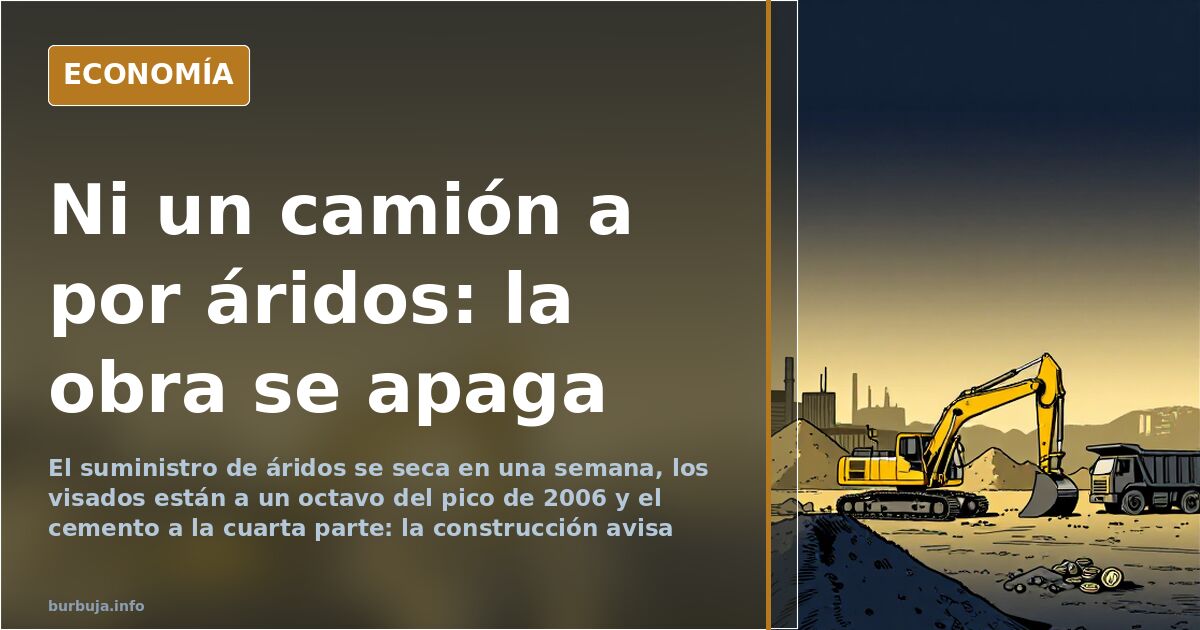
Construction Grinds to a Halt: Not a Single Truck for Aggregates
From one Monday to the next, a sand supply business went from delivering material daily to not dispatching a single load. One truck. Not one. The sustancia ilegal in construction is visible at the quarry counter, not in press releases: those who sell aggregates see the slowdown weeks before it's published. The intensive summer workday and the rush to finish projects before electoral dates explain part of the gap. The other part is frightening: layoffs are already on the table in more than one company.
A Sector That Had Been Down for Years
Let's provide context, because without it, nothing is understood. Building permits are currently at one-eighth of the activity seen in 2006. Cement sales, which include new construction, public works, and renovations, are at a quarter of the consumption peak. In other words: Spain builds 75,000 homes a year, and this figure is presented as normal, trinc the 450,000 annual units from 1996-2002 and the 800,000 from 2005-2007. Since 2013, there's been no data to stir from the slump.
When a sector has had its handbrake on for over a decade, any bump is read as a threat. And this one arrives with civil engineering works disappearing and no plans for their recovery: no dams, no water transfers, none of the pharaonic projects from the turn of the century. What fed half of Spain twenty years ago is not expected today.
Why Are There No Bricklayers if Nothing is Being Built?
The paradox that no one solves. Some have been looking for a crew for a year and a half for a major project—not even to provide a quote—and in Galicia, they speak of two-year waiting lists for renovations. At the same time, those in the trade are leaving: back problems, knee issues, turning 50 after spending their lives in the sun and 200 kilometers from home.
The circulating diagnosis points to a broken generational replacement. Young people aren't entering the field; three recent engineering graduates—naval, civil, aeronautical—decline to work for the private sector in Spain, and the industry is left with a gap that cannot be filled even by the labor arriving from abroad. Convincing a young person to wield a trowel instead of serving tables is a lost battle from the start, and the proposal to reduce the weekly workday to 32 hours, attributed to the vice president, is met with laughter on the construction site.
The Salary That Hasn't Moved in 20 Years
Here lies the root of the exodus. €1,250 per month twenty years ago. €1,300 now. With the accumulated inflation of the period, the purchasing power gained in two decades amounts to €50. On this basis, any discourse selling the trade as a professional career with continuous training is built on shaky ground.
No company paying an operator €1,300 aims to compete for talent; it competes to survive. And in a market where materials are sky-high—a bag of adhesive costs €15, a load of gravel €70, a copper pipe €12—the profit margin is squeezed from both sides.
Is Construction Worse Now Than 40 Years Ago?
Another open debate. Some argue that plasterboard partitions and modern systems have degraded structural quality, and that in the past, there was more specialization and oversizing. The opposing view: today's homes have insulation, elevators, garages, aerothermal systems, and home automation, things that were science fiction in the housing developments of the developmentalist era. The finish seems better. Durability remains to be seen.
What no one disputes is that the buyer pays for the entire affair: demanding regulations, high taxes, scarce and expensive finished land, and soaring raw materials. Housing costs increase from all angles, and the result is expensive homes built drop by drop.
And between the truck that doesn't arrive, the bricklayer who leaves, and the plasterboard replacing brick, no one can say which of the three things has truly broken. With or without background inflation.
From one Monday to the next, a sand supply business went from delivering material daily to not dispatching a single load. One truck. Not one. The sustancia ilegal in construction is visible at the quarry counter, not in press releases: those who sell aggregates see the slowdown weeks before it's published. The intensive summer workday and the rush to finish projects before electoral dates explain part of the gap. The other part is frightening: layoffs are already on the table in more than one company.
A Sector That Had Been Down for Years
Let's provide context, because without it, nothing is understood. Building permits are currently at one-eighth of the activity seen in 2006. Cement sales, which include new construction, public works, and renovations, are at a quarter of the consumption peak. In other words: Spain builds 75,000 homes a year, and this figure is presented as normal, trinc the 450,000 annual units from 1996-2002 and the 800,000 from 2005-2007. Since 2013, there's been no data to stir from the slump.
When a sector has had its handbrake on for over a decade, any bump is read as a threat. And this one arrives with civil engineering works disappearing and no plans for their recovery: no dams, no water transfers, none of the pharaonic projects from the turn of the century. What fed half of Spain twenty years ago is not expected today.
Why Are There No Bricklayers if Nothing is Being Built?
The paradox that no one solves. Some have been looking for a crew for a year and a half for a major project—not even to provide a quote—and in Galicia, they speak of two-year waiting lists for renovations. At the same time, those in the trade are leaving: back problems, knee issues, turning 50 after spending their lives in the sun and 200 kilometers from home.
The circulating diagnosis points to a broken generational replacement. Young people aren't entering the field; three recent engineering graduates—naval, civil, aeronautical—decline to work for the private sector in Spain, and the industry is left with a gap that cannot be filled even by the labor arriving from abroad. Convincing a young person to wield a trowel instead of serving tables is a lost battle from the start, and the proposal to reduce the weekly workday to 32 hours, attributed to the vice president, is met with laughter on the construction site.
The Salary That Hasn't Moved in 20 Years
Here lies the root of the exodus. €1,250 per month twenty years ago. €1,300 now. With the accumulated inflation of the period, the purchasing power gained in two decades amounts to €50. On this basis, any discourse selling the trade as a professional career with continuous training is built on shaky ground.
No company paying an operator €1,300 aims to compete for talent; it competes to survive. And in a market where materials are sky-high—a bag of adhesive costs €15, a load of gravel €70, a copper pipe €12—the profit margin is squeezed from both sides.
Is Construction Worse Now Than 40 Years Ago?
Another open debate. Some argue that plasterboard partitions and modern systems have degraded structural quality, and that in the past, there was more specialization and oversizing. The opposing view: today's homes have insulation, elevators, garages, aerothermal systems, and home automation, things that were science fiction in the housing developments of the developmentalist era. The finish seems better. Durability remains to be seen.
What no one disputes is that the buyer pays for the entire affair: demanding regulations, high taxes, scarce and expensive finished land, and soaring raw materials. Housing costs increase from all angles, and the result is expensive homes built drop by drop.
And between the truck that doesn't arrive, the bricklayer who leaves, and the plasterboard replacing brick, no one can say which of the three things has truly broken. With or without background inflation.
Summary of a discussion on Burbuja.info - Foro de economía, actualidad y política., translated from Spanish and reviewed before publication. Read the full discussion (245 replies).
More summaries
-
€530 billion collected: Spain has the least public housing in the EU
Spain collects over €500 billion in taxes, yet only 2% of its housing stock is public, compared to the Netherlands' 30%. The funds are there.
-
Euthanasia in Old Age: Autonomy vs. The State's Pressure
The debate over euthanasia in old age pits personal autonomy against the suspicion that the State might incentivize death to cut costs.
-
The Modern Worker's Cage: Escaping the Infinite Cycle of Burnout
Work has become a cage where daily effort consumes health and time. Discover why we push ourselves so hard and how to break the cycle.
-
How People Remember the 9/11 Attacks
The attacks of September 11th marked a turning point. Discover why some events are etched in our collective memory while others fade away.
-
Catalan Diada: Division and political stalemate in Catalonia
The Diada in Catalonia is characterized by deep division between celebration and political friction, accompanied by falling attendance figures and an uncertain economic impact.
-
Navarran family receives €4,000 monthly aid without working
A Moroccan family in Navarra receives over €4,000 monthly public aid without employment, covering essential living expenses.