
Congress Approves Hate Speech Crackdown on Social Media
The Congress approved Podemos's proposal to curb hate speech on social media, while simultaneously rejecting a Vox initiative to ban homage to ETA terrorists.
English · Original discussion in Spanish · Published
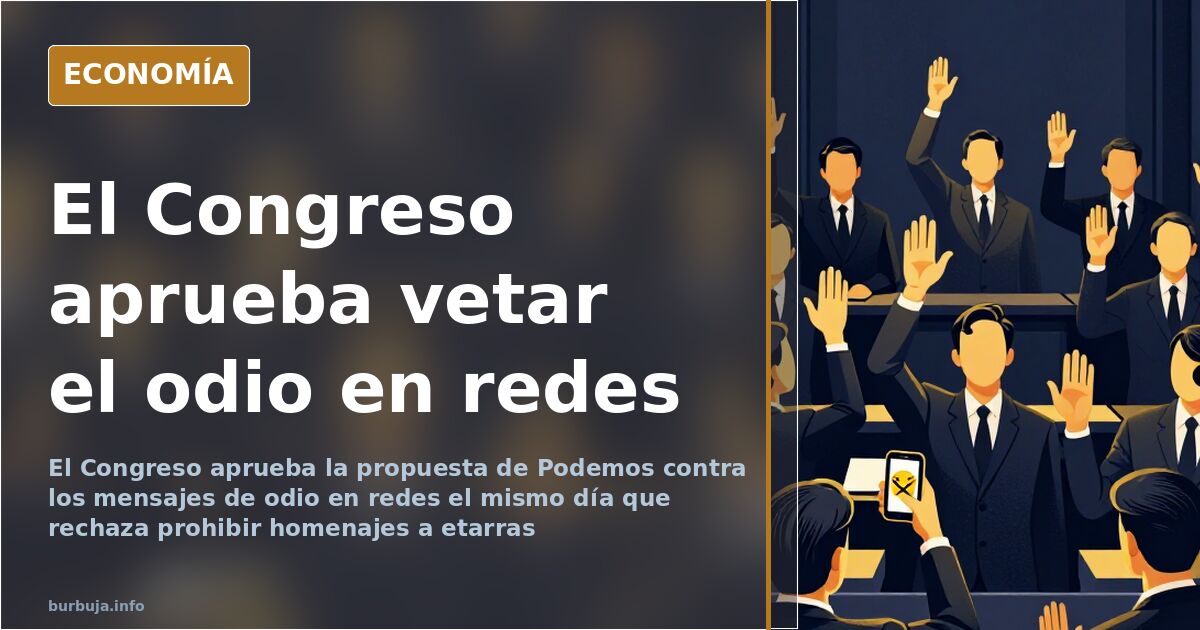
Congress Approves Social Media Hate Speech Law
The Congress of Deputies approved Podemos's proposal to prevent the spread of hate speech on social media. In the same session, the lower house rejected a Vox initiative calling for a ban on public homage to ETA terrorists. Two votes, two majorities, and a recurring question: where does prevention end and free speech restrictions begin?
The dual result acted as a mirror. What some celebrate as protection for those targeted by speech, others view as another twist on a fundamental right. The debate has dragged on for years: prohibiting hate sounds reasonable in theory but complicates once someone decides what constitutes hate.
What exactly did Congress approve?
The approved proposal opens the door to mechanisms to curb the spread of hate speech on social media. On the same day, the lower house blocked the initiative demanding a ban on public homage to terrorism. The double standard, critics argue, lies at the heart of the issue: legislation targets one type of message but not the provocation in the opposite direction.
This is not theory. According to parallel reports, such tools are already resulting in citations for hate crimes against public figures, including Lidia Falcón. The sense that an uncomfortable comment could end up in court is not new, but now it has a name and case number.
What is missing from the text are the thresholds. It is unclear which exact word crosses the line, who measures it, or by what standard. In law, what is undefined ends up being defined by whoever applies it. This is the antiestéticar driving the criticism, more than the specific wording.
Why is it compared to the gag law?
The parallel was instant. If the gag law was fascist and Francoist, the newly approved norm cannot be its opposite without more. With Franco, there was censorship, yes, but also a convenient apparatus for the ruling power, which tends to reposition itself under any flag.
The recent picture adds pieces: curfews, limits on assembly —no more than six people— and increasing use of decree-laws for matters that previously required passing through Parliament. For part of the country, the pattern is evident; for others, they are exceptional measures justified by an emergency, not a plan.
In between, the technical argument: protecting aggrieved groups is not the same as censoring criticism. True. The line between the two is thin, and above all depends on who draws it that day. No one disputes that hate exists; the fight is over the manual.
Who creates value and who sets the rules
The jump to the economic terrain was immediate. If the public space is restricted, whoever sets the limits also decides what can be discussed regarding money. And the usual fight returned: business owners and self-employed individuals create value, governments generate debt. The slogan, repeated to exhaustion, functions as both catchphrase and trap, because it depends on what is called value.
The reply was not long in coming: much of what is called value creation was built on others' debt, public contracts, and real estate whose value no one knew until it lost value. It is repeated that SMEs concentrate 80% of employment and that large companies, with all their shady dealings, fill the state coffers. Without capital accumulation, there is no investment, says one side; without the promise of return, no one takes risks, responds the other.
The debate has a background that transcends social media. All discussion on censorship rests on a prior question: whether recent century pogre is due to capitalism —internet, transport, medical advances— or if that narrative hides who paid the bill. Whoever controls the message also controls which version of this history is heard.
How the measure is being read
Three currents cross. The first sees the norm as a precursor to something greater: first social media, then the rest. The second maintains that real hate, which threatens specific people, is precisely what is not currently addressed forcefully. The third, more cynical, points to the predictable: there will be prosecutable speech and tolerated speech depending on whom it targets.
Dissent is not equally distributed between the two sides. Some point to the Government for opening the door, others to the other side for pushing it first. Mutual distrust is the only agreement reached.
The disconcerting data
Control tools do not exist in a vacuum: for some time, networks promising absolute freedom have existed where, in practice, everything depends on whoever holds the server key. The problem was never just the rule. It was who cuts the cable. And that question, with or without law, remains unanswered.
The Congress of Deputies approved Podemos's proposal to prevent the spread of hate speech on social media. In the same session, the lower house rejected a Vox initiative calling for a ban on public homage to ETA terrorists. Two votes, two majorities, and a recurring question: where does prevention end and free speech restrictions begin?
The dual result acted as a mirror. What some celebrate as protection for those targeted by speech, others view as another twist on a fundamental right. The debate has dragged on for years: prohibiting hate sounds reasonable in theory but complicates once someone decides what constitutes hate.
What exactly did Congress approve?
The approved proposal opens the door to mechanisms to curb the spread of hate speech on social media. On the same day, the lower house blocked the initiative demanding a ban on public homage to terrorism. The double standard, critics argue, lies at the heart of the issue: legislation targets one type of message but not the provocation in the opposite direction.
This is not theory. According to parallel reports, such tools are already resulting in citations for hate crimes against public figures, including Lidia Falcón. The sense that an uncomfortable comment could end up in court is not new, but now it has a name and case number.
What is missing from the text are the thresholds. It is unclear which exact word crosses the line, who measures it, or by what standard. In law, what is undefined ends up being defined by whoever applies it. This is the antiestéticar driving the criticism, more than the specific wording.
Why is it compared to the gag law?
The parallel was instant. If the gag law was fascist and Francoist, the newly approved norm cannot be its opposite without more. With Franco, there was censorship, yes, but also a convenient apparatus for the ruling power, which tends to reposition itself under any flag.
The recent picture adds pieces: curfews, limits on assembly —no more than six people— and increasing use of decree-laws for matters that previously required passing through Parliament. For part of the country, the pattern is evident; for others, they are exceptional measures justified by an emergency, not a plan.
In between, the technical argument: protecting aggrieved groups is not the same as censoring criticism. True. The line between the two is thin, and above all depends on who draws it that day. No one disputes that hate exists; the fight is over the manual.
Who creates value and who sets the rules
The jump to the economic terrain was immediate. If the public space is restricted, whoever sets the limits also decides what can be discussed regarding money. And the usual fight returned: business owners and self-employed individuals create value, governments generate debt. The slogan, repeated to exhaustion, functions as both catchphrase and trap, because it depends on what is called value.
The reply was not long in coming: much of what is called value creation was built on others' debt, public contracts, and real estate whose value no one knew until it lost value. It is repeated that SMEs concentrate 80% of employment and that large companies, with all their shady dealings, fill the state coffers. Without capital accumulation, there is no investment, says one side; without the promise of return, no one takes risks, responds the other.
The debate has a background that transcends social media. All discussion on censorship rests on a prior question: whether recent century pogre is due to capitalism —internet, transport, medical advances— or if that narrative hides who paid the bill. Whoever controls the message also controls which version of this history is heard.
How the measure is being read
Three currents cross. The first sees the norm as a precursor to something greater: first social media, then the rest. The second maintains that real hate, which threatens specific people, is precisely what is not currently addressed forcefully. The third, more cynical, points to the predictable: there will be prosecutable speech and tolerated speech depending on whom it targets.
Dissent is not equally distributed between the two sides. Some point to the Government for opening the door, others to the other side for pushing it first. Mutual distrust is the only agreement reached.
The disconcerting data
Control tools do not exist in a vacuum: for some time, networks promising absolute freedom have existed where, in practice, everything depends on whoever holds the server key. The problem was never just the rule. It was who cuts the cable. And that question, with or without law, remains unanswered.
Summary of a discussion on Burbuja.info - Foro de economía, actualidad y política., translated from Spanish and reviewed before publication. Read the full discussion (298 replies).
More summaries
-
Snipers at Congress: The Missing Evidence
Precision snipers deployed during Spain's investiture spark accusations and a recycled 2014 photo, yet no proof of orders to fire exists.
-
Rubén Gisbert occupies Congress: the 11N and its 15M shadow
Rubén Gisbert occupies Congress with a manifesto demanding direct presidential election, ending with police eviction.
-
Francino and Ideological Censorship in Spain's Public Debate
Analysis of speech limits: Is it legitimate to silence ideas labeled 'reactionary' in Spain's public sphere?
-
Colau says she left her flat of 15 years because she couldn't afford it
Ada Colau says she is leaving the flat where she lived for 15 years because one salary wasn't enough; Newtral puts her salary as mayor at €96,000 gross
-
Avoiding Spanish Polling Station Duty by Not Answering Door
In Spain, polling station notification requires a signature. Without it, there is no summons. The lottery runs from October 31 to November 4.
-
Spain's Administrative Collapse: Six Months for One Registration
Intellectual property registrations now take six months instead of fifteen days, highlighting a severe administrative breakdown in Spain.