
Congreso's legal counsel flags procedural fraud in amnesty bill
The Congressional counsel denounces procedural irregularities in the amnesty while the Senate deems it unconstitutional but proceeds with its passage.
English · Original discussion in Spanish · Published
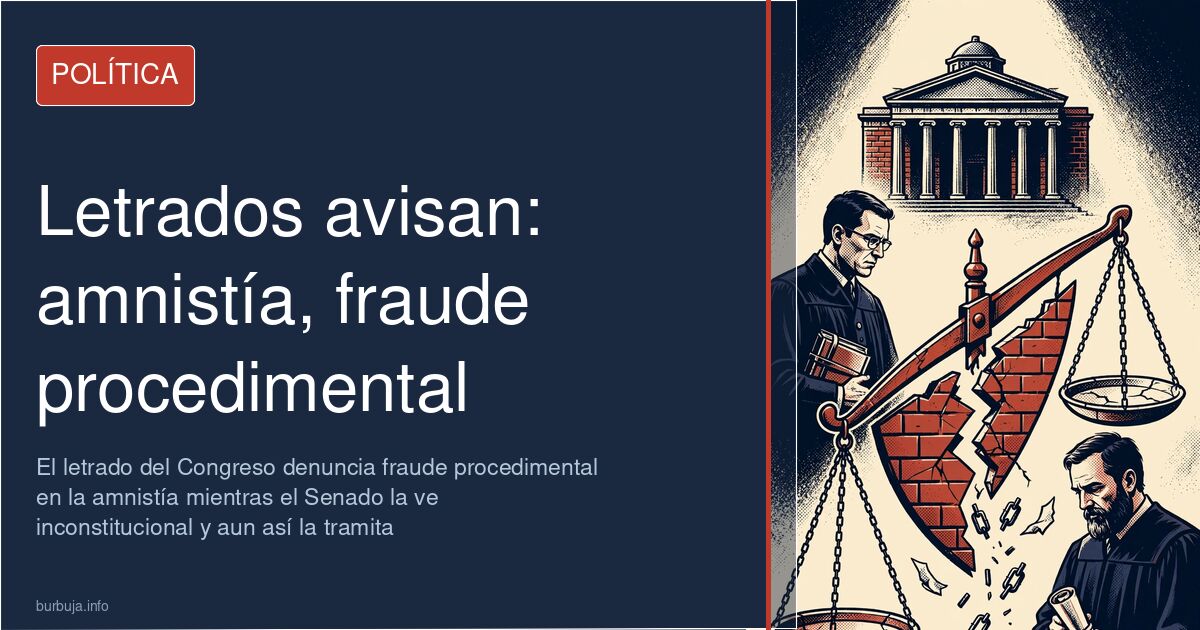
Legal counsels warn of procedural fraud, yet the amnesty moves forward
Can a law pass while abusa the rules of the chamber processing it? The Congressional counsel, Manuel Fernández-Fontecha, argues that no. He denounced procedural fraud in the processing of the amnesty law and warned that both the Constitution and the Chamber's Regulations are being abusa. This is not a minor objection. When the body responsible for giving legal authenticity to what is being voted upon warns that the path taken is flawed, what remains on the table is not a controversial law, but a procedure tailored to those who need it.
The machine, meanwhile, keeps running. The Senate counsels reached the same conclusion through another route: in their view, the law is unconstitutional, which they qualify as a “legal fraud.” The difference is that they admit they cannot block its passage. They warn, sign off, and let it pass. This is where the legal analysis turns into political analysis: whoever holds the key does not use it, because the cost of using it exceeds that of pointing out the problem in a report.
What exactly is the Congressional counsel denouncing
The accusation does not concern the content of the law, but the path it has taken. It is procedural fraud, not substantive fraud: the law could be perfectly legal and doubts about its handling would still exist. The distinction matters. A flaw in substance is addressed by the Constitutional Court when it receives the matter; a procedural flaw contaminates everything that passes, including the votes.
Some maintain that this kind of reservation merely serves to dress up pure political confrontation with technical jargon. Countering this is an uncomfortable argument: the warning does not come from the opposition; it comes from those obligated to report against and sign that report.
The Senate: unconstitutional, but proceeding anyway
The second act was written in the Upper House with an almost identical script. The Senate's legal services censure the law as unconstitutional but admit they cannot halt its passage, and this is where the editorial gap appears: depending on how the headline is written, the same opinion can appear as a warning or merely an administrative anecdote. The media's treatment of this nuance has its own audience.
Fundamentally, it is a question of institutional architecture: the PP controls the majority in the Senate, so many analyses expected blockage from there that the Congress failed to provide.
Draft law, not law: the detail that matters
Amidst all this rhetoric is a technical correction that almost no one emphasizes: we are not talking about a law, but a draft law (proposición de ley). It sounds like an opposition nuance, but it describes the actual status of the text and its ability to pass through various filters before becoming applicable law. This journey is precisely where the counsels' reports stop being rhetoric.
The exhaustion of this narrative is measured in eight months of sustained discussion and a trickle of proper names: the deputies who voted yes, the role of the chamber's governing body, the shadow of other issues overlapping with this. The full calculation of what majority holds up, with what support and under what conditions, provides an uncomfortable map for almost all involved actors.
Eight months later, the amnesty continues its course, and the counsels continue signing their reports. Someone will have to explain someday why payment is made to those who warn, if the warning is filed away with the same gesture as an invoice.]
Can a law pass while abusa the rules of the chamber processing it? The Congressional counsel, Manuel Fernández-Fontecha, argues that no. He denounced procedural fraud in the processing of the amnesty law and warned that both the Constitution and the Chamber's Regulations are being abusa. This is not a minor objection. When the body responsible for giving legal authenticity to what is being voted upon warns that the path taken is flawed, what remains on the table is not a controversial law, but a procedure tailored to those who need it.
The machine, meanwhile, keeps running. The Senate counsels reached the same conclusion through another route: in their view, the law is unconstitutional, which they qualify as a “legal fraud.” The difference is that they admit they cannot block its passage. They warn, sign off, and let it pass. This is where the legal analysis turns into political analysis: whoever holds the key does not use it, because the cost of using it exceeds that of pointing out the problem in a report.
What exactly is the Congressional counsel denouncing
The accusation does not concern the content of the law, but the path it has taken. It is procedural fraud, not substantive fraud: the law could be perfectly legal and doubts about its handling would still exist. The distinction matters. A flaw in substance is addressed by the Constitutional Court when it receives the matter; a procedural flaw contaminates everything that passes, including the votes.
Some maintain that this kind of reservation merely serves to dress up pure political confrontation with technical jargon. Countering this is an uncomfortable argument: the warning does not come from the opposition; it comes from those obligated to report against and sign that report.
The Senate: unconstitutional, but proceeding anyway
The second act was written in the Upper House with an almost identical script. The Senate's legal services censure the law as unconstitutional but admit they cannot halt its passage, and this is where the editorial gap appears: depending on how the headline is written, the same opinion can appear as a warning or merely an administrative anecdote. The media's treatment of this nuance has its own audience.
Fundamentally, it is a question of institutional architecture: the PP controls the majority in the Senate, so many analyses expected blockage from there that the Congress failed to provide.
Draft law, not law: the detail that matters
Amidst all this rhetoric is a technical correction that almost no one emphasizes: we are not talking about a law, but a draft law (proposición de ley). It sounds like an opposition nuance, but it describes the actual status of the text and its ability to pass through various filters before becoming applicable law. This journey is precisely where the counsels' reports stop being rhetoric.
The exhaustion of this narrative is measured in eight months of sustained discussion and a trickle of proper names: the deputies who voted yes, the role of the chamber's governing body, the shadow of other issues overlapping with this. The full calculation of what majority holds up, with what support and under what conditions, provides an uncomfortable map for almost all involved actors.
Eight months later, the amnesty continues its course, and the counsels continue signing their reports. Someone will have to explain someday why payment is made to those who warn, if the warning is filed away with the same gesture as an invoice.]
Summary of a discussion on Burbuja.info - Foro de economía, actualidad y política., translated from Spanish and reviewed before publication. Read the full discussion (54 replies).
More summaries
-
And They Call This Governing (Ignacio Camacho, ABC)
An ABC column criticizes the government for tackling housing with two decrees without guaranteed parliamentary approval and at the cost of reducing supply.
-
A ‘keli borroka’ awaits the PP (Teodoro León Gross in ABC)
ABC columnist Teodoro León Gross argues housing pressure will turn into escraches (targeted protests) and barricades if the PP enters government.
-
A democratic obligation unfulfilled (ABC editorial)
Article 134.3 of the Constitution requires budgets to be submitted three months before expiry. Spain is still running on the 2023 Budget.
-
Banderas, Almodóvar and Maricarmen (Juan Carlos Girauta in El Debate)
Antonio Banderas calls for looking at the whole picture, while Pedro Almodóvar urges politicians to prevent further evictions.
-
The USSR and the Origins of Borregocracia: Thesis and Suspicions
Soviet infiltration, free lawyers, Gramsci and academic inbreeding: the thesis that traces today's groupthink to the USSR.
-
Abascal claims a Spaniard cannot be racist
Abascal claims 'a Spaniard cannot be racist', and his own voters answer with unemployment, demographics and accusations of betrayal