
Congolese Man Refuses to Fight for Ukraine, Sparking Debate
A Congolese immigrant's bid to leave Ukraine and subsequent interview highlight the complex issues surrounding mobilization and racial discrimination.
English · Original discussion in Spanish · Published
Refusing to Fight for Ukraine: When Mobilization Ignores Nationality
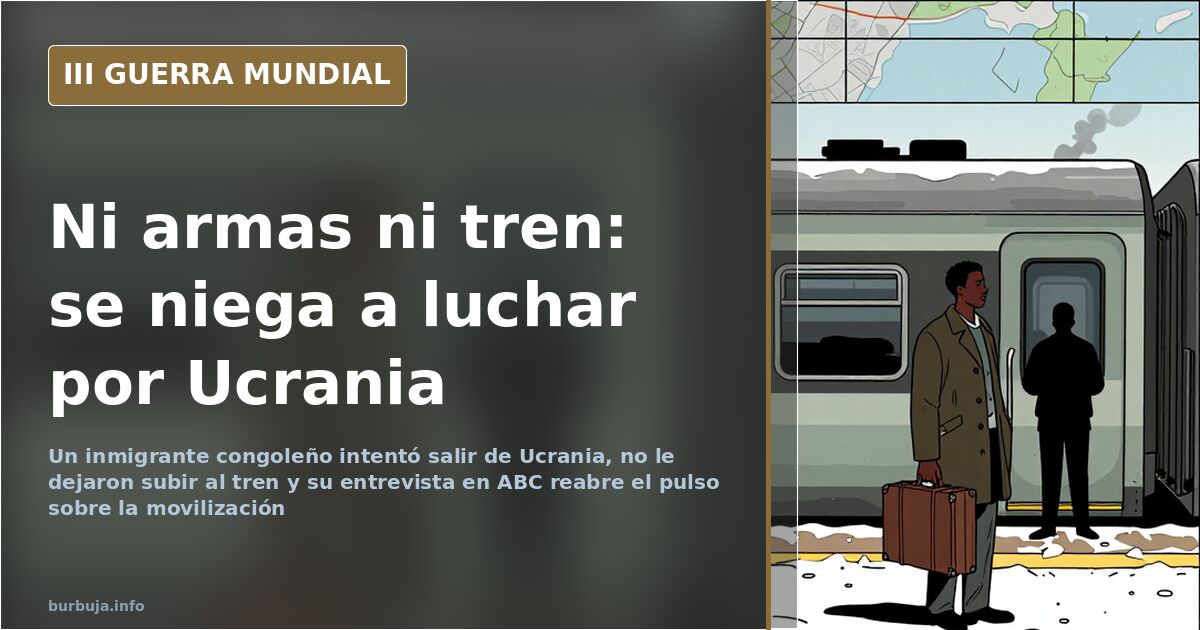
A man of Congolese origin had been living in Ukraine for years when the sirens began to sound. He tried to board a train to leave but was denied. The rule is the same applied to any Ukrainian male over 18: no one leaves. He recounted this to a camera for the US network ABC, and the clip became a minor earthquake. Amidst the turmoil, the conversation split: for some, the episode exposed racial discrimination; for others, Ukrainians face the same ban, and the discrimination label is unwarranted.
What Did the Immigrant Interviewed by ABC Say?
The central message was simple: he has no intention of taking up arms for a country that is not his own. From there, his account adds the suspicion that Africans are being assigned the front lines, the idea – in his words – that migrants go first to die. The interview, conducted by a correspondent for the US network, circulated with subtitles and clips that amplified that part.
The puzzling detail: the interviewee doesn't just refuse combat; he describes his situation as someone living in a country he doesn't feel is his and which, according to his own version, he doesn't want to be part of either. This is the crux of the matter, and where the labeling began.
The Rule Also Applied to Ukrainians
The mobilization order affects all males of military age present in Ukrainian territory, regardless of their passport. Ukraine had thousands of African residents when the conflict broke out, according to one of the circulating versions in reaction to the video.
The consequence, as many pointed out: if the ban also applies to a Kyiv resident with a Ukrainian passport, there's no discrimination at the train station queue; there's a brutal rule applied to everyone. This argument was repeated most often and is the hardest to refute without data to the contrary.
Nationality, Rights, and Duties: The Core of the Anger
Beneath the specific case lies another, more uncomfortable issue: what is owed to a country that hosts you when that country goes to war. Some argue that without citizenship, there's no obligation to serve under the flag, and asking a foreign resident to sacrifice themselves for a state they are not citizens of is demanding a contract they never signed. The opposing argument weighs heavily: those who have lived for years on public services, work, and aid have some pending debt, and obligations aren't chosen à la carte.
One of the most repeated versions points to a previous episode: the mass departure of foreign residents during the spring 2020 lockdown and a surge in arrivals in 2021. This narrative is presented without verifiable data and should be treated as such.
Was It Racism That Prevented Him from Boarding the Train?
This is where the controversy gets stuck. Some coverage and reactions spoke directly of racial discrimination. The other side responds with the same question: if the rule is identical for any Ukrainian male, where is the grievance?
The curious aspect is that some argue the interviewee ends up being the only one, among everyone involved, to voice what many keep silent. The old cliché from war films, where the racialized character died first, also appears, now used as a nod.
With the exit ban in effect and accusations flying, the question remains unanswered: if the rule treats everyone equally, why did the case of an African immigrant make headlines while Ukrainians queued at the same station?
A man of Congolese origin had been living in Ukraine for years when the sirens began to sound. He tried to board a train to leave but was denied. The rule is the same applied to any Ukrainian male over 18: no one leaves. He recounted this to a camera for the US network ABC, and the clip became a minor earthquake. Amidst the turmoil, the conversation split: for some, the episode exposed racial discrimination; for others, Ukrainians face the same ban, and the discrimination label is unwarranted.
What Did the Immigrant Interviewed by ABC Say?
The central message was simple: he has no intention of taking up arms for a country that is not his own. From there, his account adds the suspicion that Africans are being assigned the front lines, the idea – in his words – that migrants go first to die. The interview, conducted by a correspondent for the US network, circulated with subtitles and clips that amplified that part.
The puzzling detail: the interviewee doesn't just refuse combat; he describes his situation as someone living in a country he doesn't feel is his and which, according to his own version, he doesn't want to be part of either. This is the crux of the matter, and where the labeling began.
The Rule Also Applied to Ukrainians
The mobilization order affects all males of military age present in Ukrainian territory, regardless of their passport. Ukraine had thousands of African residents when the conflict broke out, according to one of the circulating versions in reaction to the video.
The consequence, as many pointed out: if the ban also applies to a Kyiv resident with a Ukrainian passport, there's no discrimination at the train station queue; there's a brutal rule applied to everyone. This argument was repeated most often and is the hardest to refute without data to the contrary.
Nationality, Rights, and Duties: The Core of the Anger
Beneath the specific case lies another, more uncomfortable issue: what is owed to a country that hosts you when that country goes to war. Some argue that without citizenship, there's no obligation to serve under the flag, and asking a foreign resident to sacrifice themselves for a state they are not citizens of is demanding a contract they never signed. The opposing argument weighs heavily: those who have lived for years on public services, work, and aid have some pending debt, and obligations aren't chosen à la carte.
One of the most repeated versions points to a previous episode: the mass departure of foreign residents during the spring 2020 lockdown and a surge in arrivals in 2021. This narrative is presented without verifiable data and should be treated as such.
Was It Racism That Prevented Him from Boarding the Train?
This is where the controversy gets stuck. Some coverage and reactions spoke directly of racial discrimination. The other side responds with the same question: if the rule is identical for any Ukrainian male, where is the grievance?
The curious aspect is that some argue the interviewee ends up being the only one, among everyone involved, to voice what many keep silent. The old cliché from war films, where the racialized character died first, also appears, now used as a nod.
With the exit ban in effect and accusations flying, the question remains unanswered: if the rule treats everyone equally, why did the case of an African immigrant make headlines while Ukrainians queued at the same station?
Summary of a discussion on Burbuja.info - Foro de economía, actualidad y política., translated from Spanish and reviewed before publication. Read the full discussion (144 replies).
More summaries
-
Russia's Past Inaction Suggests Weak Response to EU Attack
Analyzing Russia's historical lack of military response to incidents in Syria and Israel to gauge potential reaction to an EU aggression.
-
Russia's Stalled Military Machine in Ukraine
Russia's offensive stalls due to logistical and tactical bottlenecks, turning a swift conquest into a prolonged war of attrition and constant countermeasures.
-
Ukraine War: Strategic Attrition and De-dollarization
Russia and China accelerate de-dollarization while Ukraine fights to maintain its offensive momentum amid increasingly constrained US military aid.
-
Ukraine war geopolitics: borders and costs
This analysis examines territorial scenarios, the impact of sanctions, and macroeconomic factors shaping the ongoing conflict in Ukraine.
-
Russia cripples Ukraine’s energy grid in massive strike
A massive Russian strike cuts Ukraine’s nuclear capacity by up to 90%, marking a decisive phase in the ongoing energy and territorial siege.
-
Ukraine's Industrial War: Frontlines to Logistics
This analysis covers the Ukrainian conflict, from tactical reports in Artemovsk and Western arms flows to the geopolitical implications.