
Concha Velasco dies at 84: IVA song and political shifts
Spanish actress Concha Velasco died at 84 in Madrid. Her 1985 'Long live the VAT' campaign and political ties reignited debate on her legacy.
English · Original discussion in Spanish · Published
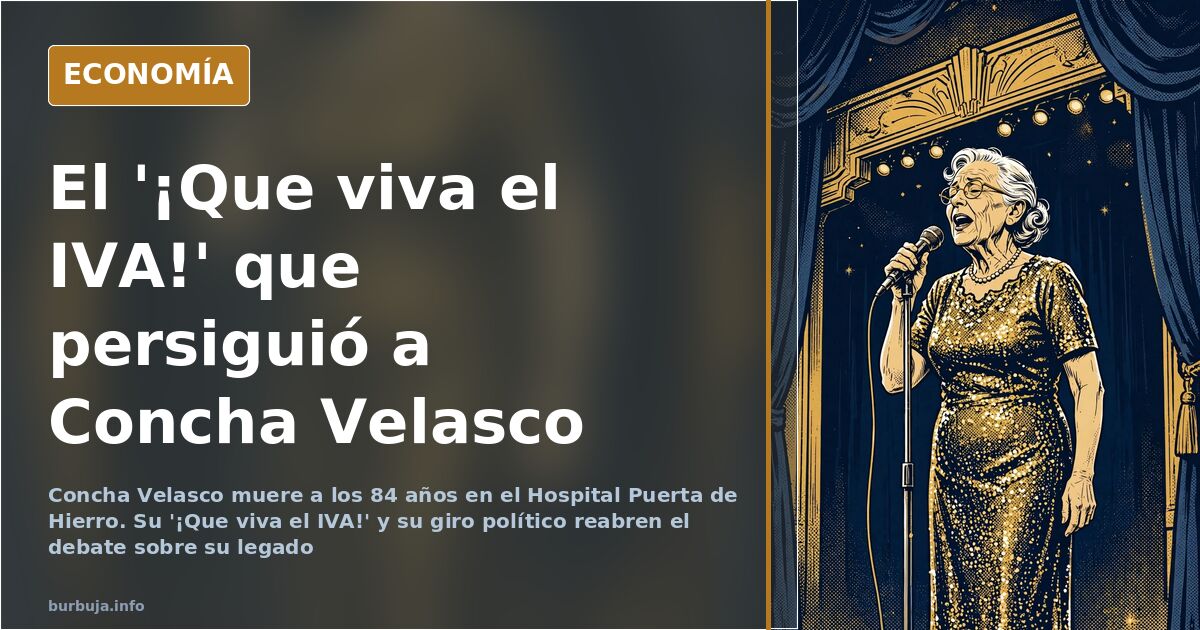
From 'Long Live the VAT' to PSOE: Concha Velasco dies at 84
It was New Year's Eve 1985 when Concha Velasco appeared on television to sing "¡Que viva el IVA!" (Long live the VAT). According to forum users, the tax took effect the next day, causing prices to jump 12% overnight. Nearly four decades later, that scene remains attached to her name. The actress has died at 84 years old at Puerta de Hierro Hospital in Majadahonda, according to a family statement, after receiving last rites due to complications from her illness.
She passed away on Saturday the 2nd at 02:00. Born in Valladolid's Las Delicias neighborhood, she closed a career spanning more than half a century that traversed two regimes, dozens of films, and several campaigns public opinion never forgave. Her death peine, within hours, the age-old discussion: how much artist and how much political figure existed in her persona?
The 'Long Live the VAT' that never stopped haunting her
The scene is unforgettable. The actress ended the year singing the praises of the new tax arriving in Spain. The next day, all products rose by 12% instantly. Today, the general VAT rate stands at 21%. Few artistic careers remain so tied to a fiscal decision.
For part of the audience, that collaboration with the tax authorities of the era is unforgivable: they argue the actress lent her face to a tax that punished household consumption. Others recall it was a paid end-of-year show, approved by an elected government. The political debate, in any case, outlived Velasco herself.
From Franco-era cinema to Zapatero's campaign
That episode summarizes the central criticism leveled at her: aligning her image with every incumbent power. First Francoism, with her rise to fame in 1950s and 60s cinema. Then democracy, specifically the PSOE, with explicit support for José Luis Rodríguez Zapatero during his electoral campaign.
Some interpret this trajectory as a survival manual without principles. Opposing this is an uncomfortable counterargument: in a country where refusing to align meant unemployment, few actors refused to work under the previous regime. Defenders say Velasco did what colleagues did, but visibly and without lowering her voice. And one thing does not negate the other: she always declared herself Spanish, Catholic, and from Valladolid.
Was she a great actress? The disputed legacy
There is no consensus on her talent either. One sector highlights her versatility, moving from 1960s comedies alongside Tony Leblanc, Fernando Fernán Gómez, or Alfredo Landa to significant dramatic roles. Her portrayal of Saint Teresa of Ávila is cited as a career milestone, leading some to claim no further films were made about the saint to avoid competing with that standard.
On the other side, accusations of overvaluation are recurrent. Critics argue she built fame on media presence rather than craft, noting her TV career, with Saturday night shows, reached more homes than her films. Audiences who watched her grow via Los 40 Principales charts and the single family TV set often do not distinguish between the two.
The wake as final political stage
Even in death, she escaped controversy. Institutional figures attending her lying-in-state peine clashes between those criticizing certain visits and others. The actress, who always thrived in the spotlight, was ultimately absorbed by the political brawl she had fueled while alive.
Few biographies better illustrate how a country decides what to remember of its celebrities. Among dozens of titles and hosted programs, the most repeated reference is a 1985 tax advertisement. This may be the precise definition of her legacy: an actress remembered for what she sang, not just what she acted. Meanwhile, VAT remains at 21%.
It was New Year's Eve 1985 when Concha Velasco appeared on television to sing "¡Que viva el IVA!" (Long live the VAT). According to forum users, the tax took effect the next day, causing prices to jump 12% overnight. Nearly four decades later, that scene remains attached to her name. The actress has died at 84 years old at Puerta de Hierro Hospital in Majadahonda, according to a family statement, after receiving last rites due to complications from her illness.
She passed away on Saturday the 2nd at 02:00. Born in Valladolid's Las Delicias neighborhood, she closed a career spanning more than half a century that traversed two regimes, dozens of films, and several campaigns public opinion never forgave. Her death peine, within hours, the age-old discussion: how much artist and how much political figure existed in her persona?
The 'Long Live the VAT' that never stopped haunting her
The scene is unforgettable. The actress ended the year singing the praises of the new tax arriving in Spain. The next day, all products rose by 12% instantly. Today, the general VAT rate stands at 21%. Few artistic careers remain so tied to a fiscal decision.
For part of the audience, that collaboration with the tax authorities of the era is unforgivable: they argue the actress lent her face to a tax that punished household consumption. Others recall it was a paid end-of-year show, approved by an elected government. The political debate, in any case, outlived Velasco herself.
From Franco-era cinema to Zapatero's campaign
That episode summarizes the central criticism leveled at her: aligning her image with every incumbent power. First Francoism, with her rise to fame in 1950s and 60s cinema. Then democracy, specifically the PSOE, with explicit support for José Luis Rodríguez Zapatero during his electoral campaign.
Some interpret this trajectory as a survival manual without principles. Opposing this is an uncomfortable counterargument: in a country where refusing to align meant unemployment, few actors refused to work under the previous regime. Defenders say Velasco did what colleagues did, but visibly and without lowering her voice. And one thing does not negate the other: she always declared herself Spanish, Catholic, and from Valladolid.
Was she a great actress? The disputed legacy
There is no consensus on her talent either. One sector highlights her versatility, moving from 1960s comedies alongside Tony Leblanc, Fernando Fernán Gómez, or Alfredo Landa to significant dramatic roles. Her portrayal of Saint Teresa of Ávila is cited as a career milestone, leading some to claim no further films were made about the saint to avoid competing with that standard.
On the other side, accusations of overvaluation are recurrent. Critics argue she built fame on media presence rather than craft, noting her TV career, with Saturday night shows, reached more homes than her films. Audiences who watched her grow via Los 40 Principales charts and the single family TV set often do not distinguish between the two.
The wake as final political stage
Even in death, she escaped controversy. Institutional figures attending her lying-in-state peine clashes between those criticizing certain visits and others. The actress, who always thrived in the spotlight, was ultimately absorbed by the political brawl she had fueled while alive.
Few biographies better illustrate how a country decides what to remember of its celebrities. Among dozens of titles and hosted programs, the most repeated reference is a 1985 tax advertisement. This may be the precise definition of her legacy: an actress remembered for what she sang, not just what she acted. Meanwhile, VAT remains at 21%.
Summary of a discussion on Burbuja.info - Foro de economía, actualidad y política., translated from Spanish and reviewed before publication. Read the full discussion (162 replies).
More summaries
-
Zapatero breaks silence on TVE: jewelry, script, and legality
Zapatero's TVE interview: no clarity on jewelry origin, citing 'no profit motive' and full legality.
-
The €10 per square metre proposal and the numbers that don't add up
A tweet mocks a young man hoping to buy a home at €10/m². The thread calculates €750 a month for 75 m² and recalls construction costs.
-
Law firm sues Albert Rivera for €1.3m after paying him €700k
Martínez Echeverría alleges unfair competition against Albert Rivera, seeking €1.3m in damages after initially claiming €6m; Rivera countersues.
-
Spain's tax system labels €1,300 net monthly income as 'wealthy'
Hacienda defines upper-middle class above €30k gross, sparking debate on IRPF and minimum wage impacts.
-
Laredo assault sparks conflicting narratives in Spain
A viral video of a security guard beaten in Laredo, Cantabria, fuels a dispute over the attack's motive.
-
Spain's Cost of Living: Why Pay for Everything?
From unvaccinated cats to paid air pumps, Spaniards question why every aspect of daily life now carries a price tag.