
Commuter caught up in student march in Paris
A French resident got trapped trying to get home during a student march in Paris. An analysis of the economic costs and urban mobility impact.
English · Original discussion in Spanish · Published
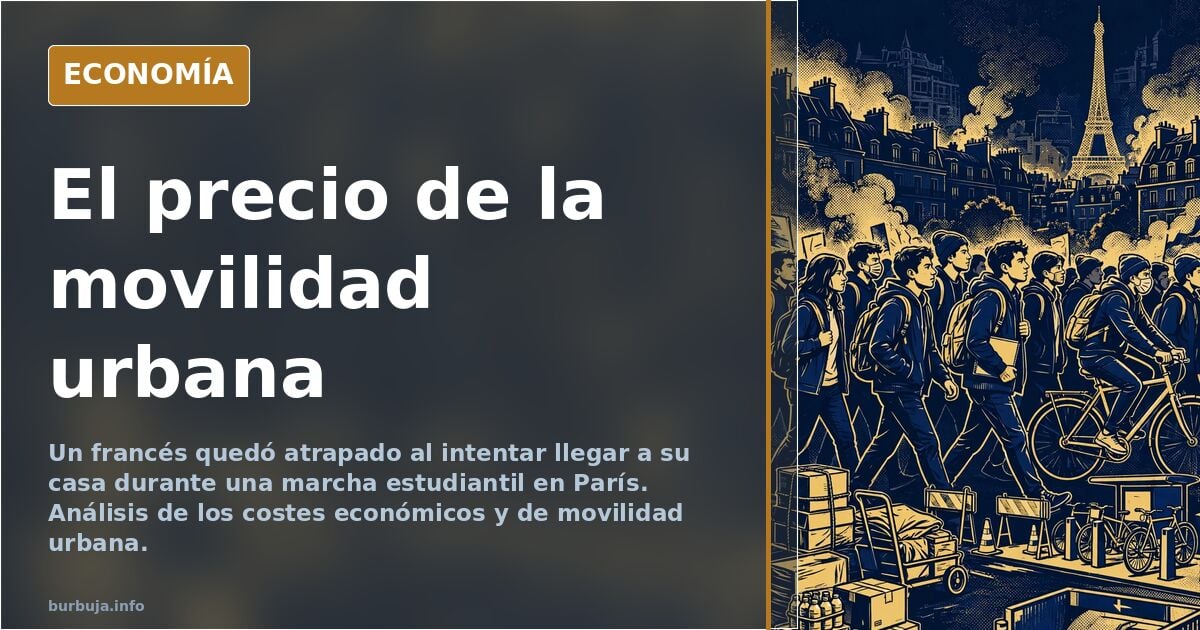
The hidden cost of a student march in Paris
Everyday mobility in Europe's big cities has just reminded us how fragile it is. A French resident got trapped while trying to get home as a student demonstration blocked the main routes through the capital. The incident, which went viral in a tweet, has sparked a debate about the management of public space and the economic costs generated by urban shutdowns. This is not just a traffic anecdote; it is a symptom of how chronic congestion and protest dynamics intersect in dense environments.
How does a road blockade affect the service sector?
When a street closes, the domino effect is not limited to drivers. Delivery companies reroute, shops lose customers and productive time evaporates. In Paris, a city that already handles dense traffic, a demonstration of this kind can translate into hours of commercial and logistics downtime. Urban mobility data show that every prolonged closure increases operating costs for the service sector. The question is not whether people can protest, but how the impact is distributed between those who organise the march and those who are simply trying to get around. Cities that fail to internalise these costs end up absorbing them as service inflation and reduced local competitiveness.
Managing public space and living together
The tension between the right to demonstrate and the guarantee of individual mobility is a classic issue in modern urban planning. Authorities usually resort to diversions and safety protocols, but their effectiveness varies with the density of the urban fabric. In this case, the trapped resident illustrates what happens when evacuation corridors overlap with residential areas. Urban planning experts warn that a lack of prior planning turns a legitimate protest into an economic bottleneck. Traffic management is not a luxury; it is critical infrastructure that must be permanently built into municipal budgets.
The debate over cohesion and the future
Beyond the logistics, the incident has reignited discussions about integration and the sense of security in neighbourhoods. One current of opinion argues that certain groups show greater cohesion and a sense of impunity that complicates neighbourhood mediation. Others counter that blaming demographics ignores structural shortcomings in education and employment. The point of friction is not the protest itself, but the lack of dialogue channels that prevent discontent from turning into total paralysis. Without clear mechanisms, every street closure becomes a stress test for the local economy and institutional trust.
Urban mobility is not solved with more patrols, but with planning that anticipates conflict. As long as authorities fail to integrate protest logistics into everyday traffic management, residents will keep paying the price of a system that prioritises containment over flow. The analysis is stuck at the same crossroads: how do you guarantee the right to the street without collapsing the economy that sustains it?
Also available in: Deutsch
Summary of a discussion on Burbuja.info - Foro de economía, actualidad y política., translated from Spanish and reviewed before publication. Read the full discussion (16 replies).
More summaries
-
France Burns: High Schools Attacked and the Deepening Education Divide
Arson at Roubaix’s Lycée Léonard de Vinci and attacks in Saint-Etienne reignite debate on France’s education spending and public debt.
-
Khaled's son vandalizes Joan of Arc statue in Paris, reigniting integration debate
The son of Algerian singer Cheb Khaled vandalizes the Joan of Arc statue after PSG's victory, sparking debate on integration and social fracture in France.
-
Basic Fit Goes Staffless in France: The 24/7 Experiment Dividing the Industry
Basic Fit is operating its French gyms 24/7 without staff. Labor cost savings clash with security risks and a recent data leak...
-
Red-flag march through Madrid returns to Puerta del Sol
A march with red flags through Madrid returns to Puerta del Sol amid debate over who is behind it
-
Spain injects €2 billion into Correos after a decade of losses
Spain's government bails out Correos with €2 billion over five years despite the parcel boom. We look at the paradox of a state-owned company that has lost €1 billion.
-
Killing in Torrelodones: gang violence takes hold in Madrid
A 22-year-old Moroccan man dies from a gunshot in Torrelodones, Spain. Gang violence is becoming entrenched in Madrid while the official account calls it a settling of scores.