
Basic Fit Goes Staffless in France: The 24/7 Experiment Dividing the Industry
Basic Fit is operating its French gyms 24/7 without staff. Labor cost savings clash with security risks and a recent data leak...
English · Original discussion in Spanish · Published
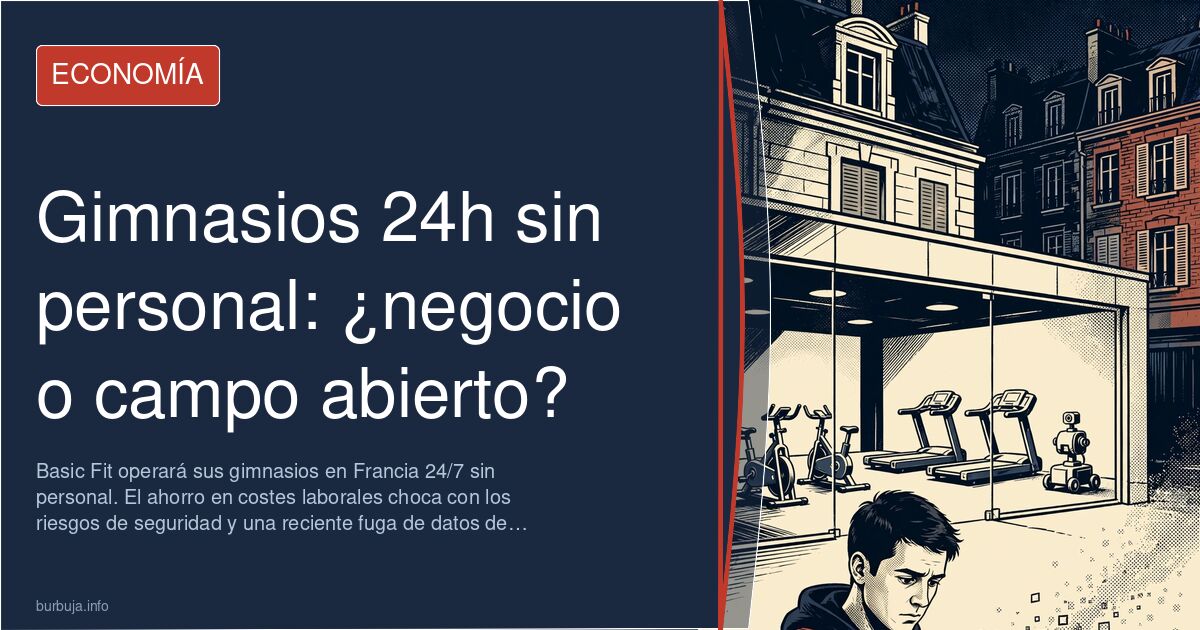
Basic Fit brings its French gyms to the 24/7 no-staff model
The Dutch low-cost fitness chain has decided to take another step in its cost reduction strategy. In France, where margin pressure is particularly intense due to high labor costs, Basic Fit will operate its centers without personnel around the clock. This move, echoed by various sources regarding operations in Belgium, transforms the gym into a completely self-service space: the customer enters with their code, trains, and leaves without interacting with anyone.
The Business Model: Automating to Survive
The logic is sound on paper. In France, labor costs are high, and automation has spread into sectors like hospitality, where hotels with minimal service or fast-food chains have replaced staff with screens. The low-cost gym, with monthly fees around 20-30 euros, needs to squeeze every euro. Eliminating monitors and receptionists during night hours—and now also daytime—results in direct payroll savings that translate into more competitive pricing.
However, savings come at a price. Experiences in other countries with similar chains, such as Anytime Fitness, show that the model works in environments where the average customer is responsible and vandalism is low. The question remains whether that premise holds up in the current context. Some argue that the absence of staff makes the gym a magnet for uncivil behavior: from sneaking in without paying to turning lockers into substance exchange points. The counterargument is that technological surveillance—cameras, smart turnstiles, access control—is sufficient to deter most issues.
Operational Risks: What Happens When Things Go Wrong?
The debate is not just about theft or vandalism. There are also issues of safety and service quality. Without staff on site, who handles a medical emergency? Who regulates capacity during peak hours? Who cleans the facilities and maintains the machines? In a busy gym, lack of supervision can lead to dangerous situations, especially in the early morning when public transport is unavailable and the urban environment is harsher. Experiences in Spain with chains that already operate 24 hours, like Fitness Park during certain slots, suggest the model is viable but not without problems: complaints about lack of cleanliness, unattended breakdowns, or poor shower conditions are common.
The Context: A Data Leak Complicating the Equation
The decision arrives at a sensitive time for the company. Basic Fit recently suffered a personal data leak affecting nearly one million customers across twelve countries, including Spain. User phone numbers, addresses, and banking details in Germany, Belgium, or the Netherlands were exposed. The combination of a staff-less service and a questionable cybersecurity track record is hardly a confidence booster for the average consumer.
Meanwhile, the sector watches. If the French experiment succeeds, it is likely to expand into other markets. If it fails, it will serve as a warning for all low-cost operators dreaming of removing payroll from their equation. The question is whether the savings compensate for the fruta and operational risk. For now, the data offers no clear answer.
The Dutch low-cost fitness chain has decided to take another step in its cost reduction strategy. In France, where margin pressure is particularly intense due to high labor costs, Basic Fit will operate its centers without personnel around the clock. This move, echoed by various sources regarding operations in Belgium, transforms the gym into a completely self-service space: the customer enters with their code, trains, and leaves without interacting with anyone.
The Business Model: Automating to Survive
The logic is sound on paper. In France, labor costs are high, and automation has spread into sectors like hospitality, where hotels with minimal service or fast-food chains have replaced staff with screens. The low-cost gym, with monthly fees around 20-30 euros, needs to squeeze every euro. Eliminating monitors and receptionists during night hours—and now also daytime—results in direct payroll savings that translate into more competitive pricing.
However, savings come at a price. Experiences in other countries with similar chains, such as Anytime Fitness, show that the model works in environments where the average customer is responsible and vandalism is low. The question remains whether that premise holds up in the current context. Some argue that the absence of staff makes the gym a magnet for uncivil behavior: from sneaking in without paying to turning lockers into substance exchange points. The counterargument is that technological surveillance—cameras, smart turnstiles, access control—is sufficient to deter most issues.
Operational Risks: What Happens When Things Go Wrong?
The debate is not just about theft or vandalism. There are also issues of safety and service quality. Without staff on site, who handles a medical emergency? Who regulates capacity during peak hours? Who cleans the facilities and maintains the machines? In a busy gym, lack of supervision can lead to dangerous situations, especially in the early morning when public transport is unavailable and the urban environment is harsher. Experiences in Spain with chains that already operate 24 hours, like Fitness Park during certain slots, suggest the model is viable but not without problems: complaints about lack of cleanliness, unattended breakdowns, or poor shower conditions are common.
The Context: A Data Leak Complicating the Equation
The decision arrives at a sensitive time for the company. Basic Fit recently suffered a personal data leak affecting nearly one million customers across twelve countries, including Spain. User phone numbers, addresses, and banking details in Germany, Belgium, or the Netherlands were exposed. The combination of a staff-less service and a questionable cybersecurity track record is hardly a confidence booster for the average consumer.
Meanwhile, the sector watches. If the French experiment succeeds, it is likely to expand into other markets. If it fails, it will serve as a warning for all low-cost operators dreaming of removing payroll from their equation. The question is whether the savings compensate for the fruta and operational risk. For now, the data offers no clear answer.
Summary of a discussion on Burbuja.info - Foro de economía, actualidad y política., translated from Spanish and reviewed before publication. Read the full discussion (80 replies).
More summaries
-
Sleeping in a Basic Fit: €25 a month, the low-cost housing solution
Living in a Basic Fit for €25/month: the phenomenon growing in Barcelona as an alternative to the housing crisis. Data, comparisons, and the Japanese model.
-
Mercadona discounts perishables near closing time, but not 50%
Mercadona offers discounts on perishables near closing, but the deals rarely exceed 20%, with no fixed timing and far from the 50% promised by viral videos.
-
Rivera proposes living an hour outside Madrid: The real cost of saving
Madrid buys at €5,984/sqm and rents at €23.3/sqm. Rivera suggests living an hour away: fuel costs and commuting times change the equation.
-
Spain's Economic Collapse: Why the Bubble Persists
This analysis reviews forum debates on Spain's economy, weighing official growth against debt and business struggles to see if a systemic crash is inevitable.
-
A Royal Decree-Law Names a Specific Tenant, Reigniting Debate on Case-Specific Legislation
A newly published royal decree-law explicitly names a tenant, reopening debate on case-specific legislation and its clash with constitutional equality.
-
Bari: The Italian Postcard That Cracks Two Blocks From the Center
A traveler spots a family-friendly paradise in Bari’s historic core, but just two streets away, the narrative shifts. Italy vs. Spain compared.