
Comedian slapped live after joke about boxer's baby
A live slap on comedian Jaime Caravaca following a comment about Alberto Pugilato's baby reignites debate on humor limits and physical retaliation.
English · Original discussion in Spanish · Published
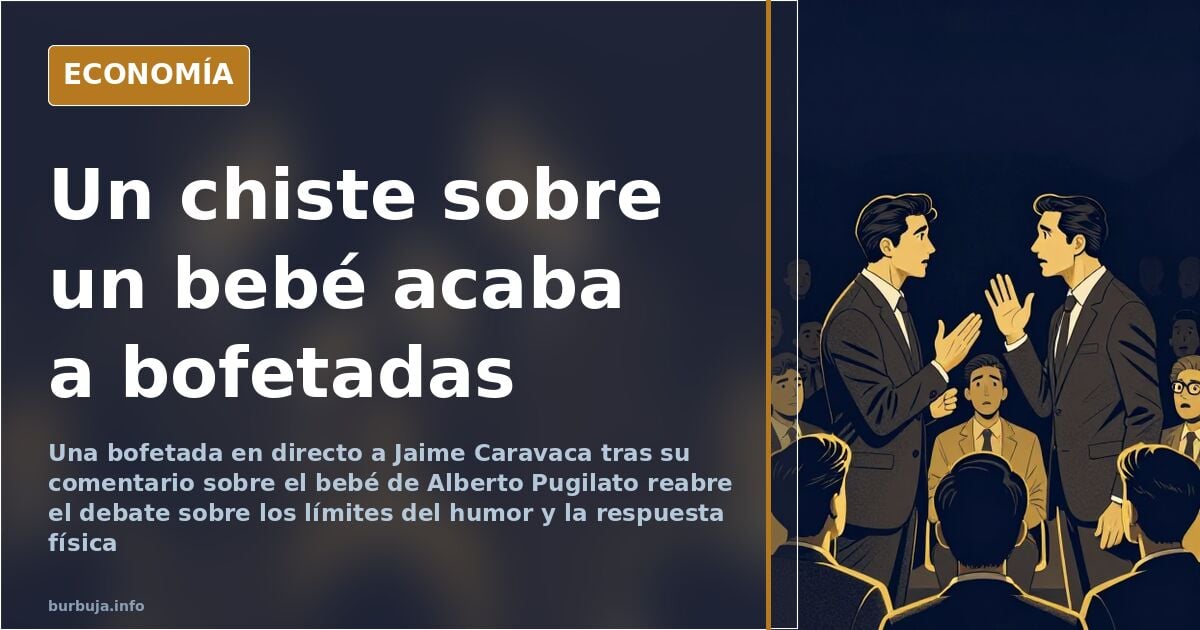
Comedian slapped live after joke about boxer's baby
What happens when someone jokes about a three-month-old baby on social media and the father confronts them in person? According to circulating video of the altercation, the result was a slap during a live show, with the audience as witnesses and cameras recording. The incident, which occurred during a performance by comedian Jaime Caravaca, has peine the discussion on where the line between humor and insult lies, and whether physical retaliation is an understandable reaction or a crime.
What peine between the comedian and the baby's father
The trigger was a message published by the comedian joking about the young son of boxer Alberto Pugilato. Those who read it agree that the comment crossed the line from banter into obscenity. The father's response did not come through legal channels: it arrived live, during a performance, with a slap captured on video and witnessed by dozens of attendees.
Caravaca has publicly acknowledged his mistake. In statements collected by media outlets, he admitted feeling ashamed of himself for the message sent. This is not the first time the comedian has been involved in such controversies: some recall previous incidents involving other targets.
What does the law say about a live slap
Legal discussion occupies much of the subsequent analysis. A slap with an open hand, without a closed fist and causing no significant injury, falls under minor offenses, typically punished with a fine. This distinction is not arbitrary: several analyses note that the difference between a monetary sanction and serious incivil trouble depends on whether injuries occur. If the aggressor had clenched their fist and broken something, the judicial scenario would change completely.
Some argue that the recording and presence of witnesses favor the victim, preventing any self-serving reconstruction of events. Others point out the opposite: the same recording is direct evidence of the assault. The paradox is that the same video serves both arguments.
Why humor about minors generates backlash
The most repeated argument is sarracena, not legal. The joke targeted someone unable to defend themselves or respond: a months-old baby. The distinction that appears repeatedly is symmetry. One can joke with those able to return the jest; doing so with a non-verbal minor is not humor, but something else.
A common comparison is to a funeral: if someone enters a wake and insults the deceased in front of the family, no one is surprised if they end up beaten. This is not a legal defense, but a description of human instinct. And instinct, in these cases, precedes the penal code.
The amplifying effect of social media
The episode offers another perspective: miscalculation. A comment posted from a personal account in a digital context ends up having physical consequences on a real stage. The distance between keyboard and face has shortened. This triggers two opposing reactions: those who see it as necessary correction and those warning against normalizing violence as a response to opinion.
The video of the altercation has become central to the case. Without it, the discussion would be a clash of versions. With it, everyone can judge the intensity of the blow, the aggressor's attitude, and the audience's reaction. The recording does not resolve the debate, but makes it visible.
Possible consequences for the aggressor
The lingering question is whether charges will be filed. If the comedian decides to go to court, the aggressor faces a possible fine for a minor offense. If not, the case remains in the media sphere. Some suggest a financial penalty could be offset by public fundraising, an idea already floated aloud.
The victim himself apologized for his message, complicating the position of those wishing to portray him as an unnuanced victim. The full sequence—provocation, response, and remorse—leaves an uncomfortable case for all: for the comedian, for the father, and for those trying to reduce it to sides.
In the end, the scene stands thus: a man who made a tasteless joke, another who responded with an open hand, and an audience that recorded everything. Justice will determine if a crime occurred. The rest has already been judged by the video.
Also available in: Deutsch
Summary of a discussion on Burbuja.info - Foro de economía, actualidad y política., translated from Spanish and reviewed before publication. Read the full discussion (105 replies).
More summaries
-
Comedian slapped after controversial comment about a baby
A video of a comedian being slapped after making comments about a baby has surpassed 30 million views online.
-
La Vanguardia fires columnist over article accusing PSOE of seeking civil conflict
La Vanguardia suspends Lacasta for criticising the PSOE's drift. A reflection on the limits of journalism.
-
Juan Diego Botto Sues Over Fake ETA Claim Amid Spanish Election
An anonymous online rumor falsely claimed actor Juan Diego Botto supported ETA's return if Vox won. Botto has filed a lawsuit after the story spread to major national newspapers.
-
Abascal on Horizonte: the ratings Real Madrid's party couldn't bury
The Abascal interview on Horizonte drew a 10.9% share, beating Real Madrid-Leipzig (9.4%), according to ratings figures cited in the forum
-
Russian Hybrid War Narrative Fuels Fear of European Conflict
Reports on alleged Russian hybrid attacks fuel fears of a wider war and forced conscription for young people in Europe.
-
One in three children in Spain at risk of poverty
One in three children in Spain is at risk of poverty, the highest rate in the EU, according to data from recent debates.