
Colón Flag Tears Third Time in One Month
The nearly 300 m² flag at Madrid's Plaza de Colón tore and fell for the third time in under a month, with no official explanation.
English · Original discussion in Spanish · Published
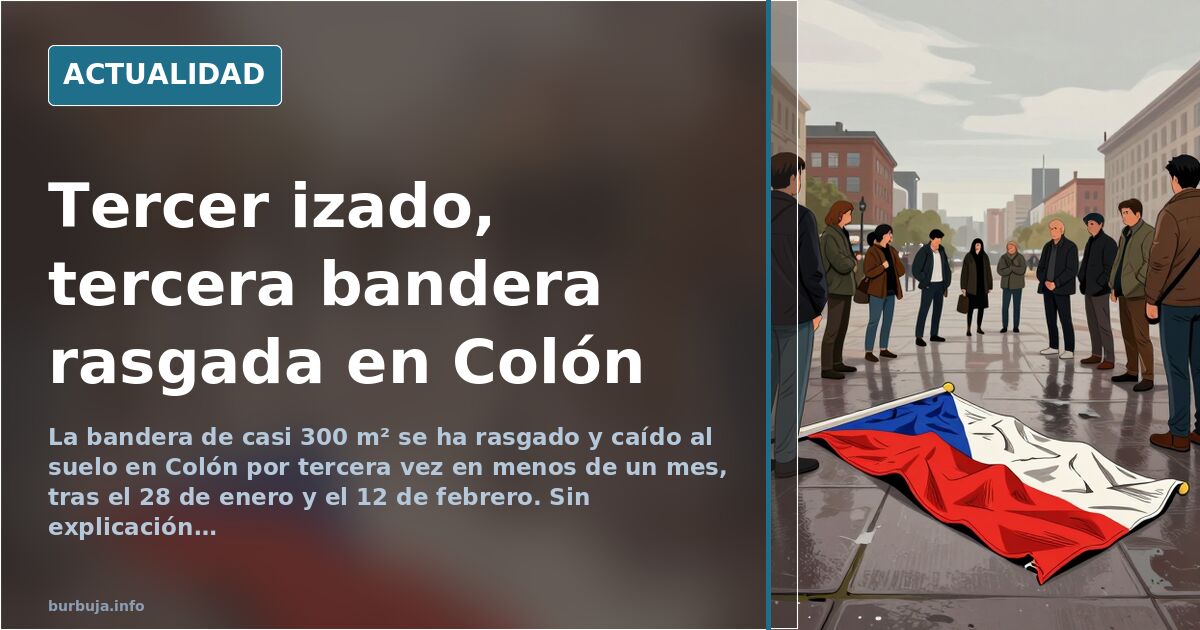
Three tears in less than a month: The Colón flag can't hold
The national flag raising ceremony at Madrid's Plaza de Colón ended in embarrassment once again. During the official event, organized by Spain's Joint Staff (Estado Mayor de la Defensa), the ensign — nearly 300 square meters — tore on one side and fell to the ground before attendees. It was not the first time: the same flag had broken on January 28 and February 12. Three tears in less than a month for an event held every third Wednesday of the month that, judging by the results, has yet to find its footing.
The exact causes remain without official explanation. Poor weather conditions in Madrid over recent weeks are cited as the main factor, though no one has confirmed wind is solely responsible. What is certain is the image: Spain's largest flag falling to the ground in the very place where it is raised with military honors.
Why does a 300-square-meter flag tear?
The size is precisely the problem. An ensign of those dimensions requires a fabric with strength that doesn't always match the lightness needed to flutter. Some argue the chosen material is too thin for the surface area it must support, and that thicker cloth would prevent tearing at the cost of losing movement in the wind. The calculation is not trivial: more square meters means more tension on seams and anchors.
Added to this is the suspicion, repeated in various analyses, that the issue is not design but supply. The bill for the flag — and its origin — has become one of the most requested documents: if the fabric is cheap, the savings are paid for in tears. No one has provided the document yet.
Symbolism: From torn flag to narrative of decline
Beyond the technical incident, the episode has been read as a metaphor. Many reactions interpret it as an image of the country's state: an ensign falling on its own while the anthem plays. Others compare it to previous episodes of symbolic display, such as the raising at Mexico City's Zócalo plaza, arguing the problem isn't the flag but the obsession with turning the plaza into a showcase.
Some also recall that the previous flag, which flew at the same location, lasted years without incidents. This contrast fuels the thesis that the failure lies in the current material, not the wind.
Who is responsible for the raising and what is known about maintenance?
The event falls under the Joint Staff (Estado Mayor de la Defensa), which organizes the raising every third Wednesday with members of the Armed Forces. So far, there is no official explanation regarding causes or potential changes to protocol or supplier. Nor has it been detailed whether the securing system or fabric type will be reviewed.
The coincidence of three tears in four weeks points to a structural problem rather than bad luck. If wind were the only culprit, the flag would have survived at least one complete raising. It hasn't.
The image remains: the national flag on the ground, the anthem playing, and an official event turned into its own parody. Three times in a month. The next appointment is the third Wednesday.
The national flag raising ceremony at Madrid's Plaza de Colón ended in embarrassment once again. During the official event, organized by Spain's Joint Staff (Estado Mayor de la Defensa), the ensign — nearly 300 square meters — tore on one side and fell to the ground before attendees. It was not the first time: the same flag had broken on January 28 and February 12. Three tears in less than a month for an event held every third Wednesday of the month that, judging by the results, has yet to find its footing.
The exact causes remain without official explanation. Poor weather conditions in Madrid over recent weeks are cited as the main factor, though no one has confirmed wind is solely responsible. What is certain is the image: Spain's largest flag falling to the ground in the very place where it is raised with military honors.
Why does a 300-square-meter flag tear?
The size is precisely the problem. An ensign of those dimensions requires a fabric with strength that doesn't always match the lightness needed to flutter. Some argue the chosen material is too thin for the surface area it must support, and that thicker cloth would prevent tearing at the cost of losing movement in the wind. The calculation is not trivial: more square meters means more tension on seams and anchors.
Added to this is the suspicion, repeated in various analyses, that the issue is not design but supply. The bill for the flag — and its origin — has become one of the most requested documents: if the fabric is cheap, the savings are paid for in tears. No one has provided the document yet.
Symbolism: From torn flag to narrative of decline
Beyond the technical incident, the episode has been read as a metaphor. Many reactions interpret it as an image of the country's state: an ensign falling on its own while the anthem plays. Others compare it to previous episodes of symbolic display, such as the raising at Mexico City's Zócalo plaza, arguing the problem isn't the flag but the obsession with turning the plaza into a showcase.
Some also recall that the previous flag, which flew at the same location, lasted years without incidents. This contrast fuels the thesis that the failure lies in the current material, not the wind.
Who is responsible for the raising and what is known about maintenance?
The event falls under the Joint Staff (Estado Mayor de la Defensa), which organizes the raising every third Wednesday with members of the Armed Forces. So far, there is no official explanation regarding causes or potential changes to protocol or supplier. Nor has it been detailed whether the securing system or fabric type will be reviewed.
The coincidence of three tears in four weeks points to a structural problem rather than bad luck. If wind were the only culprit, the flag would have survived at least one complete raising. It hasn't.
The image remains: the national flag on the ground, the anthem playing, and an official event turned into its own parody. Three times in a month. The next appointment is the third Wednesday.
Also available in: Deutsch
Summary of a discussion on Burbuja.info - Foro de economía, actualidad y política., translated from Spanish and reviewed before publication. Read the full discussion (117 replies).
More summaries
-
Historiographical Disputes Over Columbus’s Origins and Spain’s National Narrative
Analysis of historiographical disputes regarding Columbus’s origins and the historical narrative of the discovery of America in Spain.
-
Madring: Flamenco reignites the debate on Spain's image
F1 returns to Madrid after 45 years, and flamenco at the Madring ceremony reopened the fight over what image of Spain is exported to the world.
-
Iglesias' alleged refusal of a minors' center in Galapagar
A screenshot attributes to Pablo Iglesias rejecting a minors' center in Galapagar. No original source exists; the image dates back to his time in Cuba.
-
The X-Files Reboot Casts New Scully, Excludes Chris Carter
Danielle Deadwyler joins the X-Files reboot as Scully. Creator Chris Carter and Vince Gilligan are absent, sparking debate on casting and business motives.
-
NASA delays Moon landing to 2031 due spacesuit shortage
NASA pushes crewed lunar landing to 2031 citing lack of operational spacesuits. The delay reignites debate on the Apollo program's 86% success rate.
-
Zaragoza feminist drum parade sparks debate
A feminist march in Zaragoza reignites controversy over drum parades, focusing on public subsidies and the recurring question of why drums dominate these protests.