
Colombia's interior minister Alejandro Ordóñez defends Spanish heritage
Alejandro Ordóñez, Colombia's new interior minister, defended Hispanidad before the OAS and criticized those who reject Spain's legacy in Latin America.
English · Original discussion in Spanish · Published
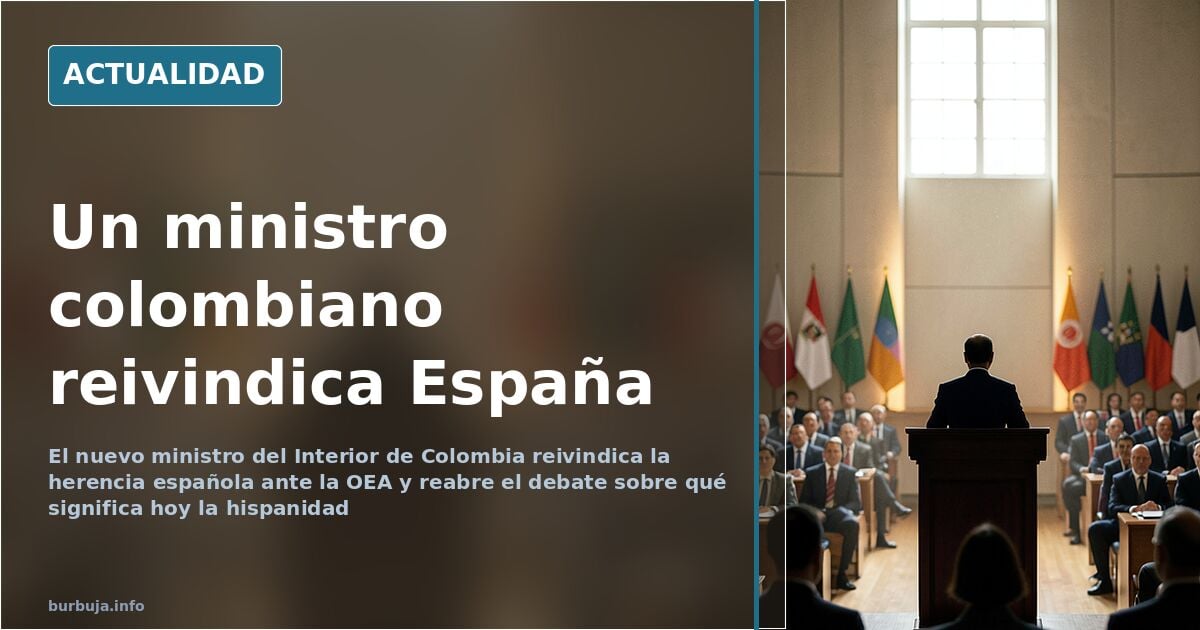
Colombia now has an interior minister who openly champions Hispanidad
The appointment of Alejandro Ordóñez as Colombia's interior minister has peine a debate that seemed dormant: whether Spain's legacy in the Americas is a burden or an asset. In his address to the Permanent Council of the OAS, marking October 12, the new minister argued that «some despise the certainty that their mother is indigenous, but also Spanish», and reproached those who «disown the people who taught them about faith, law, equality and how to live in society». The message is not new in his political biography, but his new position is: for the first time, a member of the Colombian cabinet is explicitly embracing the Hispanist narrative from a position of power.
The news has landed like a bucket of cold water on part of Colombia's political spectrum, and as a confirmation on another. Ordóñez, identified with Catholic traditionalism and with positions close to Carlism, makes no attempt to hide his allegiance. His speech at the OAS was not a protocol slip: it was a statement of principles before an international audience.
What «Hispanism» means in the Colombian context
The term refers to a current of thought that defends the cultural, religious and legal heritage of the Hispanic Monarchy in the Americas, in opposition to the indigenist narrative that holds Spain responsible for all the continent's ills. For its defenders, independence was not a liberation but a rupture that left the new republics without the institutional framework that had sustained them for three centuries. For its critics, it is an elegant way of whitewashing the conquest and diverting attention from today's inequalities.
The debate is not academic. In Colombia, Ordóñez's arrival at the Ministry of the Interior coincides with a moment of political tension and questioning of institutions. His speech at the OAS can be read as an attempt to anchor national identity in a narrative alternative to the official one, and as a message to his own base.
The reaction: between enthusiasm and rejection
Reactions were not long in coming. Conservative sectors celebrate that a minister is proudly defending Spain's heritage and criticizing what they see as an imported fashion of self-loathing. The left and indigenous organizations denounce that the speech legitimizes a colonialist worldview and belittles the memory of the continent's original peoples.
On the economic front, the discussion has drifted toward migration. Some argue that Hispanism, properly understood, should foster economic and commercial cooperation between Spain and Latin America, rather than the disorderly flow of labor. Others contend that identity rhetoric does not solve the region's structural problems and can become an obstacle to integration.
The economic backdrop: migration and the labor market
Ordóñez's appointment has reignited in Spain a recurring debate about Latin American immigration. Some see in Hispanism a pretext to justify the mass arrival of workers who compete downward in the labor market. Others reply that criticism of mass immigration is not incompatible with recognizing a shared cultural heritage, and that the real problem is the lack of economic planning.
The discussion about «wage dumping» and the impact of immigration on wages and public services is not new, but the Colombian political context gives it an unexpected twist. If an interior minister champions Hispanidad, does anything change in the relationship between Spain and Colombia? For now, only the rhetoric.
What may happen next
Ordóñez takes office at the Ministry of the Interior at a time of institutional fragility in Colombia. His speech at the OAS can be read as a statement of intent, but also as a symbolic gesture with no practical consequences. The question is whether his Hispanist vision will translate into concrete policies or remain a matter of rhetoric.
Meanwhile, the debate over Hispanidad remains alive, and not only in Colombia. In Spain, Ordóñez has been welcomed with interest in traditionalist circles and with suspicion in others. His appointment is an anomaly in the Latin American political landscape, and as such, it deserves attention.
The striking fact: in a continent where the left has governed most countries over the past two decades, an interior minister champions Hispanidad without apologizing. That, in itself, is news.
Also available in: Deutsch
Summary of a discussion on Burbuja.info - Foro de economía, actualidad y política., translated from Spanish and reviewed before publication. Read the full discussion (19 replies).
More summaries
-
Hispanicism: Cultural movement or geopolitical project?
The rise of Hispanicism in the Americas as challenging the Black Legend evolves into a significant geopolitical phenomenon.
-
France: looters leave the ham behind
Amid the looting in France, the absence of ham from the loot has turned into a conspiracy theory with no official evidence to back it up.
-
China criticizes Putin's anti-futurism
Russia had cheap energy, mathematical talent and Yandex. The 2022 invasion of Ukraine scattered its engineers and stalled its entry into the AI elite.
-
Soldier killed after being run over at Cerro Muriano base in Córdoba, Spain
Soldier Sergio Ajenjo Cordero died after being run over at the Cerro Muriano military base in Córdoba, Spain. Juanma Moreno has offered his condolences to the family.
-
Lula supporters steal Brazilian president's watch, viral post claims
A viral post attributes the theft of Lula's watch to his own supporters. We explain what the tweet says and why the 'rob the thief' hoax keeps spreading without evidence.
-
Scandal that paid Zapatero €4.1 million now touches his secretary
Police are investigating €4.1 million paid to Zapatero and his daughters; his secretary bought a Madrid flat in cash after working with the network