
Colombian Migration to Spain: 73,000 in the First Half of 2026
Spain received 73,000 Colombians in the first half of 2026. We analyze the impact on employment, housing, and services, and the debate regarding capacity...
English · Original discussion in Spanish · Published
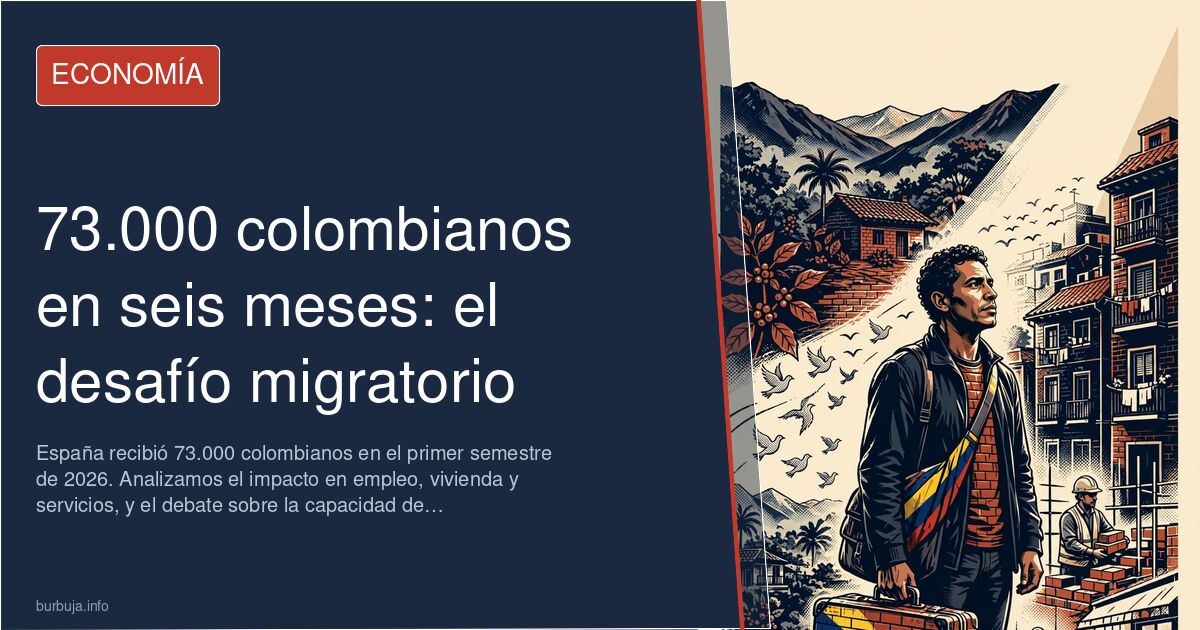
73,000 Colombians in six months: the new migratory pulse Spain hasn't digested
Spain has become the destination for 73,000 Colombians in the first half of 2026, a figure that surpasses any previous pace and has peine the debate about the country's absorption capacity. The mass arrival of Colombian migrants, fleeing political and economic crisis in their home country, has raised questions about the impact on the labor market, housing, and public services.
A Figure That Speaks for Itself
The data, circulated through social media and confirmed by sector sources, indicates that the migratory flow from Colombia has intensified notably. In the first semester, entries of Colombian citizens soared to 73,000 people—a volume that, according to some analyses, is "no longer a migratory phenomenon, but a change in the country's composition at cruising estimulante ilegal." These figures position Spain as one of the main destinations for the Colombian diaspora in Europe.
Effects on Economy and Society
The influx of these new residents occurs against a backdrop of latent tensions. Economically, it is argued that these 73,000 new arrivals increase competition for jobs, housing, and basic services. The most sensitive sectors are the labor market, especially low-skilled jobs; housing, where pressure was already high; and healthcare, with lengthening waiting lists. At the same time, there are voices defending that immigration is necessary to fill positions that the local population does not accept, and that economic growth depends on it. However, public perception remains skeptical, as reflected in social media debates concerning integration and service saturation.
The balance between labor market needs and reception capacity remains unresolved. While the political right insists on the need for stricter migration policy, defenders of the current model argue that without immigration, Spain cannot sustain its welfare system. The arrival of 73,000 Colombians in six months is not an isolated event, but the tip of an iceberg that will force a rethink of integration and housing policies. All signs point to the debate continuing, with the unknown whether Spain can absorb this pace without social friction. For now, the data is what it is: 73,000 new mouths to feed, house, and serve.
Spain has become the destination for 73,000 Colombians in the first half of 2026, a figure that surpasses any previous pace and has peine the debate about the country's absorption capacity. The mass arrival of Colombian migrants, fleeing political and economic crisis in their home country, has raised questions about the impact on the labor market, housing, and public services.
A Figure That Speaks for Itself
The data, circulated through social media and confirmed by sector sources, indicates that the migratory flow from Colombia has intensified notably. In the first semester, entries of Colombian citizens soared to 73,000 people—a volume that, according to some analyses, is "no longer a migratory phenomenon, but a change in the country's composition at cruising estimulante ilegal." These figures position Spain as one of the main destinations for the Colombian diaspora in Europe.
Effects on Economy and Society
The influx of these new residents occurs against a backdrop of latent tensions. Economically, it is argued that these 73,000 new arrivals increase competition for jobs, housing, and basic services. The most sensitive sectors are the labor market, especially low-skilled jobs; housing, where pressure was already high; and healthcare, with lengthening waiting lists. At the same time, there are voices defending that immigration is necessary to fill positions that the local population does not accept, and that economic growth depends on it. However, public perception remains skeptical, as reflected in social media debates concerning integration and service saturation.
The balance between labor market needs and reception capacity remains unresolved. While the political right insists on the need for stricter migration policy, defenders of the current model argue that without immigration, Spain cannot sustain its welfare system. The arrival of 73,000 Colombians in six months is not an isolated event, but the tip of an iceberg that will force a rethink of integration and housing policies. All signs point to the debate continuing, with the unknown whether Spain can absorb this pace without social friction. For now, the data is what it is: 73,000 new mouths to feed, house, and serve.
Summary of a discussion on Burbuja.info - Foro de economía, actualidad y política., translated from Spanish and reviewed before publication. Read the full discussion (32 replies).
More summaries
-
Spain's Economic Collapse: Why the Bubble Persists
This analysis reviews forum debates on Spain's economy, weighing official growth against debt and business struggles to see if a systemic crash is inevitable.
-
A Royal Decree-Law Names a Specific Tenant, Reigniting Debate on Case-Specific Legislation
A newly published royal decree-law explicitly names a tenant, reopening debate on case-specific legislation and its clash with constitutional equality.
-
Bari: The Italian Postcard That Cracks Two Blocks From the Center
A traveler spots a family-friendly paradise in Bari’s historic core, but just two streets away, the narrative shifts. Italy vs. Spain compared.
-
Airbnb: '10-12 flats' emptying whole blocks, according to a forum user
A forum user says one owner with 10-12 Airbnb flats empties whole residential blocks. In Lugo or Teruel, prices also rise without mass tourism.
-
Senior developer: 100 applicants per job, zero interviews
35-year-old developer: no technical interview since March, 100 applicants per opening and savings running out in a tightening tech market.
-
Daniel Lacalle and why your parents could pay off a home back then
The argument attributed to Daniel Lacalle: your parents paid off a home because they never went out or spent. Wages, VAT and mortgage rates, in figures