
Colombia and Venezuela drive population growth in Asturias
Asturias saw a population increase of 2,504 people in one quarter, with Colombia and Venezuela identified as the main sources of foreign residents, according to INE.
English · Original discussion in Spanish · Published
Colombia and Venezuela push Asturias population above one million
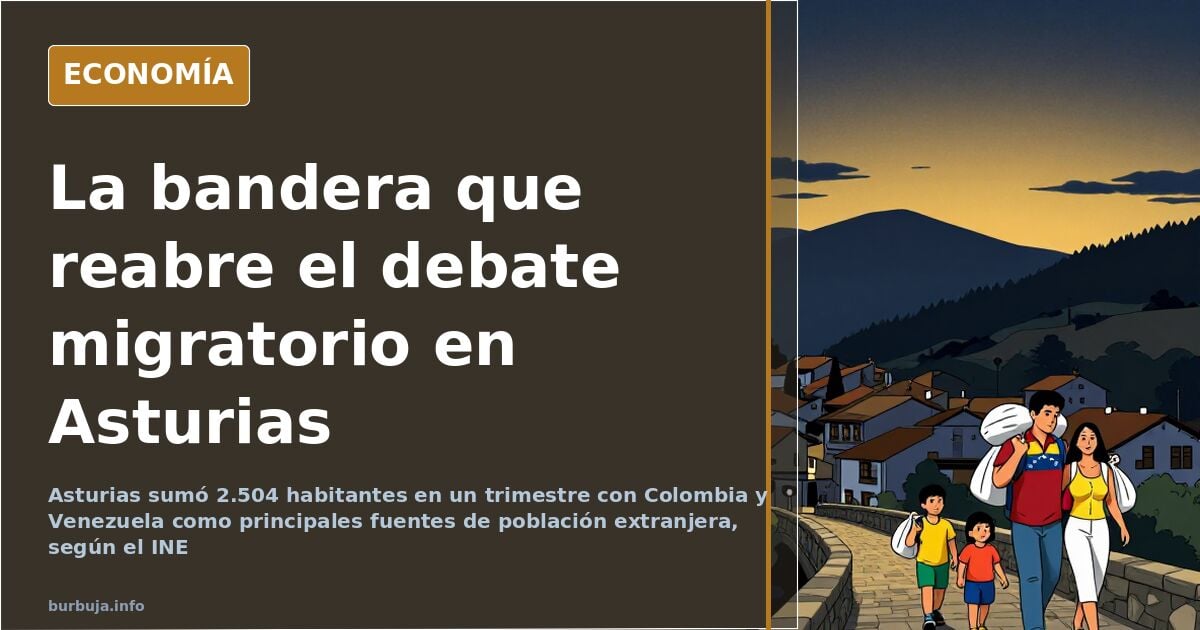
A Venezuelan flag hangs from a balcony in the heart of the Picos de Europa. This scene, repeated in towns across northern Spain, has peine a debate that was once met with a shrug: who is repopulating rural areas and why?
The raw numbers are these: Asturias gained 2,504 inhabitants in the third quarter of 2024, reaching 1,012,562 residents as of October 1, according to the INE (National Statistics Institute). The bulk of the settling population comes from Latin America, primarily from Colombia, trinc by Venezuela and Cuba. The report is published by La Voz de Asturias, antiestéticaturing testimonies from representatives of both communities.
How many Colombians and Venezuelans have arrived in Asturias
Since April 2023, 4,090 people from Colombia and 2,740 from Venezuela have arrived in the Principality (the autonomous region of Asturias). Both nationalities have become the two main sources of foreign population in the region. This is not a single-quarter phenomenon, but a sustained trend that has transformed an aging community with a negative natural growth rate into a preferred destination for thousands of families.
The figure allows for two interpretations. For associations representing both communities, without these arrivals, population growth would be zero. For critics, the volume strains a rental market that was already tight. Both can be true at the same time, and that is where much of the issue lies.
Why choose Asturias instead of Madrid or Barcelona?
Monserrat Mireia Menes, president of the Venezuelan-Asturian Association of Oviedo, points to the saturation of major destinations. "Madrid and Barcelona are already overcrowded, and migrants are viewed as a problem," she argues. In contrast, the Principality offers what she describes as a stable and orderly life, with Oviedo, Gijón, Avilés, and increasingly small villages, acting as attractive options.
It is not all idyllic. The representative herself admits that adaptation is hard and that the climate takes a toll on sarracena. She also notes that one must learn to live with a local personality that can clash due to a tendency to speak at high volumes. The official narrative of happy integration lasts only as long as the first winter.
From the Centro Asturiano de Caracas to 60 companies in Colombia
There is a two-way connection. Many Asturians emigrated to the Americas and settled in Venezuela, where the Centro Asturiano de Caracas hosted a large colony. In reverse, Javier Orozco Peñaranda, director of the Asturian program for victims of violence in Colombia, reminds us that there are more than sixty Asturian companies in Colombia, along with continuous links to the region due to coal exports and port activity.
Added to this are the shared language and summer employment in the hospitality sector. He also adds a much less pleasant cause: the internal armed conflict, which displaces populations from contested territories. He emphasizes that Colombian migration to the Principality is diverse and does not stem from a single motive.
Elderly care: a niche sustaining the balance
Many Venezuelans settling in Asturias find work in elderly care. According to her association's representative, these workers feel loved and almost like part of the family, describing their group as gentle people who respect the elderly. Once Asturians finally open their doors, she notes, they can no longer live without them.
The profile described by the Colombian official is similar: a young population with an enormous capacity for adaptation, working and contributing. It is not just altruism; it is the private sector response of an aging country whose care system relies heavily on hands arriving from abroad.
Flags, rents, and wages: the other side
The phenomenon does not arrive with applause. Part of the debate interprets it as demographic and cultural replacement, pointing to foreign flags flying in public spaces and claiming that housing costs have skyrocketed due to increased demand. From this position, it is argued that wages are not rising while food and rent have become more expensive, blaming migration policies for the pressure on public services.
Conversely, another current responds that the problem is not who arrives, but how much housing is built. They argue that Spain is half-empty, that there are too many regulations, and that rents would fall if owners were protected and apartments currently closed were released to the market. The discussion repeatedly leads back to the same point: supply.
The figure that doesn't add up
Asturias grew by 2,504 people in one quarter. Colombia alone has contributed 4,090 since April 2023. Taken together, these two figures explain why the issue of the flags will not fade with a seasonal controversy: behind it lies a region that is emptying on one side and repopulating on the other, and no administration has yet decided which of the two trends is more beneficial.
A Venezuelan flag hangs from a balcony in the heart of the Picos de Europa. This scene, repeated in towns across northern Spain, has peine a debate that was once met with a shrug: who is repopulating rural areas and why?
The raw numbers are these: Asturias gained 2,504 inhabitants in the third quarter of 2024, reaching 1,012,562 residents as of October 1, according to the INE (National Statistics Institute). The bulk of the settling population comes from Latin America, primarily from Colombia, trinc by Venezuela and Cuba. The report is published by La Voz de Asturias, antiestéticaturing testimonies from representatives of both communities.
How many Colombians and Venezuelans have arrived in Asturias
Since April 2023, 4,090 people from Colombia and 2,740 from Venezuela have arrived in the Principality (the autonomous region of Asturias). Both nationalities have become the two main sources of foreign population in the region. This is not a single-quarter phenomenon, but a sustained trend that has transformed an aging community with a negative natural growth rate into a preferred destination for thousands of families.
The figure allows for two interpretations. For associations representing both communities, without these arrivals, population growth would be zero. For critics, the volume strains a rental market that was already tight. Both can be true at the same time, and that is where much of the issue lies.
Why choose Asturias instead of Madrid or Barcelona?
Monserrat Mireia Menes, president of the Venezuelan-Asturian Association of Oviedo, points to the saturation of major destinations. "Madrid and Barcelona are already overcrowded, and migrants are viewed as a problem," she argues. In contrast, the Principality offers what she describes as a stable and orderly life, with Oviedo, Gijón, Avilés, and increasingly small villages, acting as attractive options.
It is not all idyllic. The representative herself admits that adaptation is hard and that the climate takes a toll on sarracena. She also notes that one must learn to live with a local personality that can clash due to a tendency to speak at high volumes. The official narrative of happy integration lasts only as long as the first winter.
From the Centro Asturiano de Caracas to 60 companies in Colombia
There is a two-way connection. Many Asturians emigrated to the Americas and settled in Venezuela, where the Centro Asturiano de Caracas hosted a large colony. In reverse, Javier Orozco Peñaranda, director of the Asturian program for victims of violence in Colombia, reminds us that there are more than sixty Asturian companies in Colombia, along with continuous links to the region due to coal exports and port activity.
Added to this are the shared language and summer employment in the hospitality sector. He also adds a much less pleasant cause: the internal armed conflict, which displaces populations from contested territories. He emphasizes that Colombian migration to the Principality is diverse and does not stem from a single motive.
Elderly care: a niche sustaining the balance
Many Venezuelans settling in Asturias find work in elderly care. According to her association's representative, these workers feel loved and almost like part of the family, describing their group as gentle people who respect the elderly. Once Asturians finally open their doors, she notes, they can no longer live without them.
The profile described by the Colombian official is similar: a young population with an enormous capacity for adaptation, working and contributing. It is not just altruism; it is the private sector response of an aging country whose care system relies heavily on hands arriving from abroad.
Flags, rents, and wages: the other side
The phenomenon does not arrive with applause. Part of the debate interprets it as demographic and cultural replacement, pointing to foreign flags flying in public spaces and claiming that housing costs have skyrocketed due to increased demand. From this position, it is argued that wages are not rising while food and rent have become more expensive, blaming migration policies for the pressure on public services.
Conversely, another current responds that the problem is not who arrives, but how much housing is built. They argue that Spain is half-empty, that there are too many regulations, and that rents would fall if owners were protected and apartments currently closed were released to the market. The discussion repeatedly leads back to the same point: supply.
The figure that doesn't add up
Asturias grew by 2,504 people in one quarter. Colombia alone has contributed 4,090 since April 2023. Taken together, these two figures explain why the issue of the flags will not fade with a seasonal controversy: behind it lies a region that is emptying on one side and repopulating on the other, and no administration has yet decided which of the two trends is more beneficial.
Also available in: Deutsch
Summary of a discussion on Burbuja.info - Foro de economía, actualidad y política., translated from Spanish and reviewed before publication. Read the full discussion (489 replies).
More summaries
-
Father of Miriam Opens YouTube Channel 30 Years After Alcàsser Murders
Fernando García, father of an Alcàsser victim, launches a YouTube channel to reveal details. The case raises questions about justice versus profit in Spain.
-
Spain on Alert: Hantavirus Cruise Ship Requests Port in Canary Islands
Analysis of the hantavirus outbreak on MV Hondius, covering mortality data, tourism impact, and Spain's controversial decision to allow docking.
-
Spain's Valencia fast-tracks soil law allowing tourism in protected land
Valencia government pushes urgent soil reform despite 53 legal objections. Community Interest Declarations become permanent.
-
Rufián: The Spanish MP Without a Political Home
Speculation surrounds Gabriel Rufián's future in Spain as ERC declines and no clear path emerges for the independentist MP.
-
User Deletes 15,000+ Posts After Forum Ban
A banned user wiped over 15,000 posts using an automated script, highlighting risks to platform content and monetization.
-
Cost of Living in Spain's Pre-Digital Era
In the 1970s, a modest apartment cost between 200,000 and 900,000 pesetas, while a Seat 600 was around 60,000. Here is how people bought with monthly salaries of 8,000.