
Coffee with two fried dough sticks for €3: café breakfasts in Spain are now a luxury
A coffee with two porras costs €3 while the estimated real cost comes to under €1.15: breakfast inflation at Spanish cafés is eating into people's wallets.
English · Original discussion in Spanish · Published
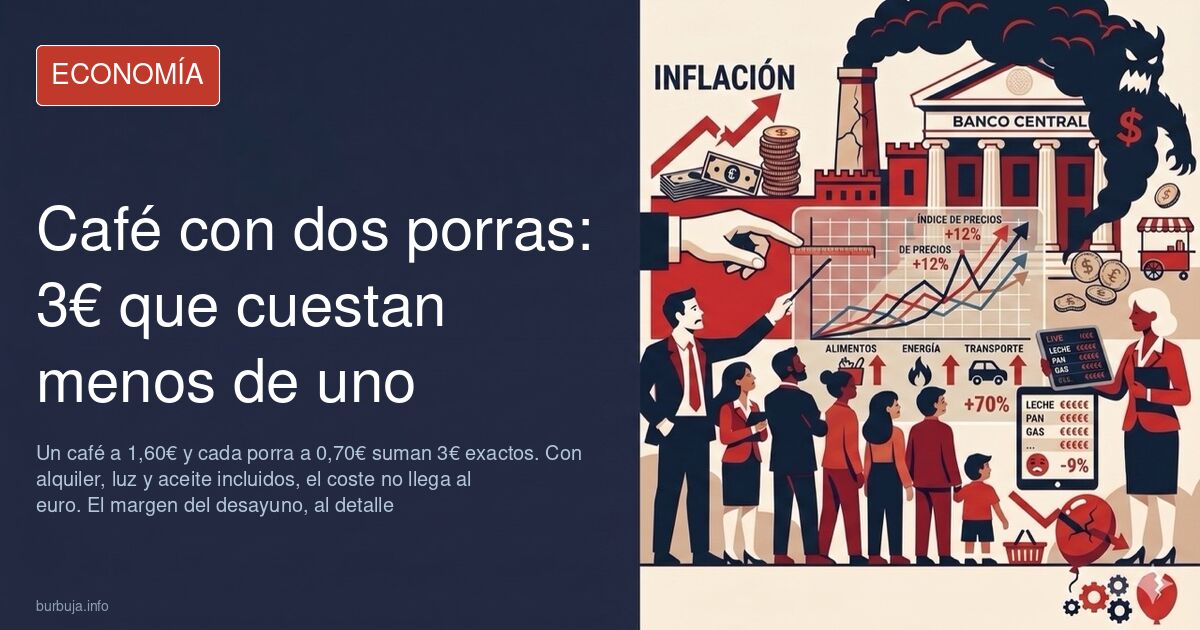
A coffee with two porras now costs €3: café breakfasts are spiralling
Three euros for a coffee and two porras. The bill sounds like an airport price, but it comes from a neighbourhood bar. In one of those bars, a single porra cost €1 — which is to say that the humblest breakfast in Spain's hospitality sector is now being charged like a full meal. The counterintuitive part is not the price, but that the estimated cost of the ingredients — plus the proportional share of electricity, rent and staff — doesn't even reach one euro. Coffee with two porras has become the most honest thermometer of inflation, and the thermometer is running a fever.
What breakfast at a café costs today
The catalogue of bills is wide and none of them is a statistical outlier. A typical breakfast doesn't drop below €3.20 in many places, and if the customer goes for a ham mollete the bill hits €5.40. In a neighbourhood bar, far from the centre and the tourist crowds, a coffee and two churros — not even porras — were charged at €3.30. Hospitality in premium areas plays in another league: a latte at €4.95, a tortel at €4.50 and a glass of milk at €3, which at supermarket prices would buy you twelve glasses.
There are examples that are simply off the scale. A slice of day-old tortilla with a Coca-Cola: €7.20. A coffee and an impulse-buy tiramisu, €5.40. The pattern repeats: breakfast has become the line item where café owners recover what they can't raise elsewhere on the menu.
The real cost: €1.15 versus €3
The item-by-item breakdown — branded milk drink, bread, olive oil, ham, electricity and depreciation of the toaster, plus an estimated staff cost per customer — puts the final figure at €1.15. An even more aggressive estimate holds that a coffee with a piece of toast doesn't reach 20 cents in direct costs. On those numbers, a good part of the breakfast margin comes from the absence of reduced VAT on alcoholic drinks, which offset the rest of the business.
Against that, there's the argument from the other side of the counter: commercial rents in Madrid and tourist areas through the roof, self-employed social security contributions more than doubled, income tax up and raw materials sky-high. The conclusion of those who run a bar is that their prices have more than doubled in five years because everything else doubled first. The conclusion of those who pay is that a product costing less than one euro shouldn't triple on the other side of the counter.
Those who already breakfast from a lunchbox
The most uncomfortable reaction for the sector isn't the complaining, it's the walkout. Some people shop at the supermarket and eat breakfast in the car, at a cost of no more than €0.40 versus the €3-4 at a café. And some have turned the complaint into a business: home-made porras and thermos coffee delivered by bike at €2.20, with 25 breakfasts a day placed in an industrial estate, and ham-and-cheese sandwiches at €4.50 in a Madrid park with 30 or 40 sales per afternoon.
The calculation is ruthless and so is its consequence: if the trickle of customers continues, the neighbourhood bar closes. Not out of ideology or boycott, but because the margin on a breakfast can't sustain a place that loses the rest of the day.
How long before coffee with two porras stops being a habit and becomes a weekend treat?
Also available in: Deutsch
Summary of a discussion on Burbuja.info - Foro de economía, actualidad y política., translated from Spanish and reviewed before publication. Read the full discussion (54 replies).
More summaries
-
IRPF Hike by 3 Points and €200 for Self-Employed: The Adjustment That Won't Balance
Raising the IRPF (Personal Income Tax) by 3 percentage points and the minimum self-employment fee to €200: who defends it, who warns about lower revenue, and what is missing from the adjustment.
-
Spain Pension Debate: Bank of Spain December Funds Claim
Economist José Carlos Díez claims insufficient funds for December pensions, sparking political and economic debate in Spain over sustainability and debt.
-
France faces riots and blackout plans after 51 years of deficit
France has now run 51 consecutive years of public deficit, with riots in Paris and a government plan for rotating winter power cuts if electricity supply falls short.
-
Sanchez: governments are formed through votes, Spain's PM insists
Debate on the legitimacy of Spain's Government, post-election deals and electoral processes. We examine representativeness and the Spanish parliamentary system.
-
What time does Eurovision start and where to watch it? Tonight is a must!
Eurovision 2026: schedule, channels and the cultural battle between patriots and boycotters. Analysis of a night without Spain but with high viewership.
-
Puerta del Sol: AI image of Spanish Empire sparks viral thread
An AI-generated image at Madrid's Puerta del Sol sparks a viral thread on Burbuja.info: a Spanish Empire including Japan? A debate on history and immigration.