
Coconut oil euthanasia myth debunked in India
Viral video claims India kills elderly with ice baths and coconut water. No source supports this; only Ganges cremations are real.
English · Original discussion in Spanish · Published
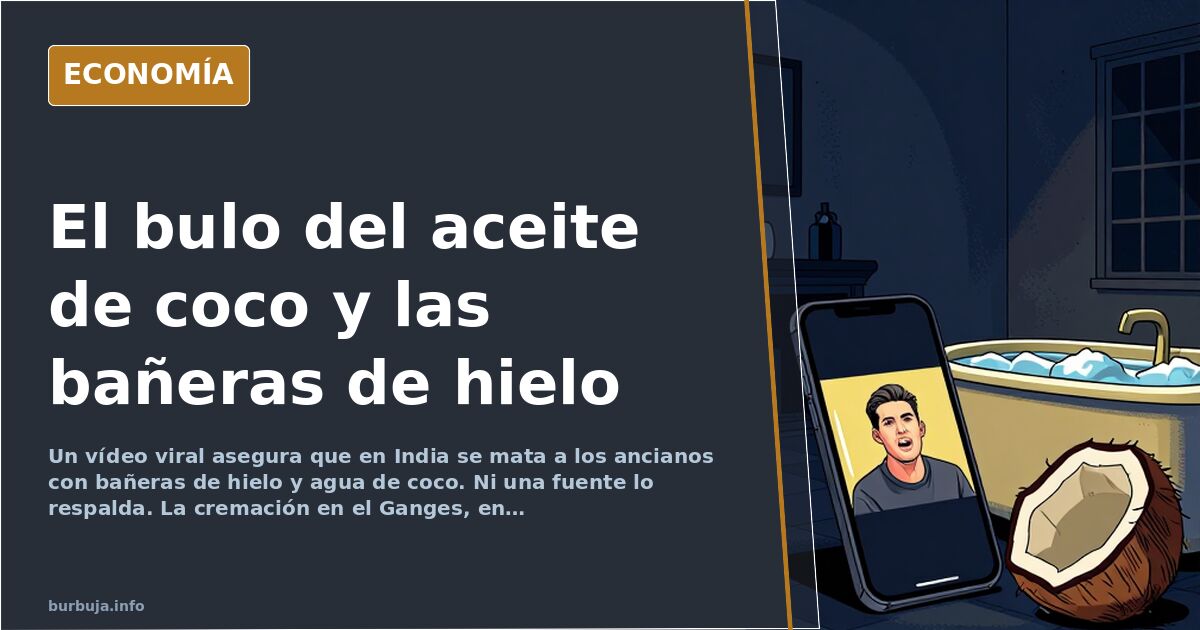
The coconut oil hoax: The non-existent euthanasia in India
A viral video claims that sick elderly people in India are killed by being submerged in ice baths and given coconut water to drink. The mixture supposedly causes a quick, painless death. This story spreads across social media and forums with a mix of fascination and mockery, but not a single verifiable source backs it up. What does exist is a real and documented funeral practice: the cremation of bodies on the banks of the Ganges in Varanasi, a spectacle travelers describe as a brutal clash with the romantic idea of spiritual India.
What exactly does the coconut water hoax claim?
The story has circulated for some time in short video format. According to this version, Indian families place their sick elders in a bathtub with ice and give them coconut water. The goal would be to accelerate death when there is no cure, or when inheritance pressures mount. The tale is adorned with gruesome details: that coconut oil solidifies below 25 degrees, that it blocks organs, that it is a method of execution and torture rather than euthanasia. None of this is confirmed by any health authority or fruta media outlet. At best, it is an urban legend with an exotic wrapper.
Coconut oil solidifies below 25 degrees, true, but from there to solidifying inside the human body is a gap chemistry does not bridge. The body maintains a constant temperature of around 36 degrees. For coconut oil to solidify in the stomach, the patient would have to be cooled to extremes incompatible with life, and then the cause of death would be hypothermia, not the coconut. The mixture of ice and coconut water does not kill: at most, it causes discomfort.
Cremation on the Ganges: what is actually real
The only verifiable element of the story is the existence of open-air cremations on the banks of the Ganges River in Varanasi. There, bodies are burned on wooden pyres in view of tourists and pilgrims. The smell is unmistakable: burnt flesh, garbage, misery. Travelers who have been to the area describe it without euphemisms. It is not a spiritual spa. It is a place where death is shown unfiltered, amidst scams and diarrhea for those who don't watch what they eat.
The confusion between this funeral reality and a supposed home euthanasia practice is the heart of the hoax. A complex cultural fact is taken, a layer of gratuitous cruelty is added, and it is served as a denunciation or a joke. The result is a story that says more about those who share it than about India.
Why does the coconut oil hoax spread so easily?
The narrative works because it fits pre-existing prejudices. Some share it as proof that "they are very spiritual and wise," with sarcasm. Others use it to warn against giving ideas to local "NEETs" (Not in Education, Employment, or Training). And some directly celebrate it as a solution to the pension problem. The anecdote becomes a weapon in debates about inheritance, care homes, and cost of living. The image of the elderly person in the bathtub is too powerful to let go.
Strikingly, the hoax doesn't need to be true to circulate. It just needs to seem plausible within a mindset that already assumes life is worth less in certain countries. Real euthanasia, practiced with medical protocols in countries like Switzerland or the Netherlands, is a serious debate with legal and ethical implications. The coconut water story is something else: a sarracena tale told to justify opinions one already holds.
Real euthanasia versus urban legend
In Spain, any form of killing someone without a doctor present is illegal. Euthanasia is regulated and requires a series of guarantees that completely exclude the bathtub method. Confusing one with the other helps no one. The coconut oil hoax is not only false: it also muddies a debate that deserves rigor.
Meanwhile, the video continues to circulate. And someone, somewhere, will continue to believe that grandparents are killed with ice and coconut in India. Is verification really necessary before sharing?
Also available in: Deutsch
Summary of a discussion on Burbuja.info - Foro de economía, actualidad y política., translated from Spanish and reviewed before publication. Read the full discussion (112 replies).
More summaries
-
Alzheimer's and Ketones: The Coconut Oil That Doesn't Slow the Disease
A 79-year-old patient lowers glucose from 112 to 84 with coconut oil, but another year-long case shows the disease progressing the same.
-
Ganges Swimming Risks: Ignoring Fecal Water Costs
Swimming in the Ganges ends in vomiting: 70% of the water is waste. The cost of a dip without precautions.
-
Spain's euthanasia normalization and the organ market
Organ donation after euthanasia in Spain is growing exponentially. Individual freedom or state resource management? An analysis of the data.
-
Gonzalo Miró: Spain's pundit with patrons, not profession
Spanish TV commentator Gonzalo Miró owes his media presence to political guardianship and RTVE networks, lacking any proven professional expertise.
-
Viral post refuses to 'hand over pension' over Spanish train accidents
A viral message rejects contributing to the pension system in response to rail accidents. We explain what lies behind this stance and why the system does not work that way.
-
La Cabra opens in Madrid with filter coffees up to 20 euros
La Cabra has opened on Calle de las Infantas in Madrid with manual filter coffees up to 20 euros per brew and seasonal pastries, featuring light roasting and direct sourcing.