
Climate activists glue themselves to Madrid-Barajas runway during peak travel
Two Futuro Vegetal activists glued themselves to a Madrid-Barajas runway at the start of the summer travel rush, exposing security flaws and risking fines up to €200,000.
English · Original discussion in Spanish · Published
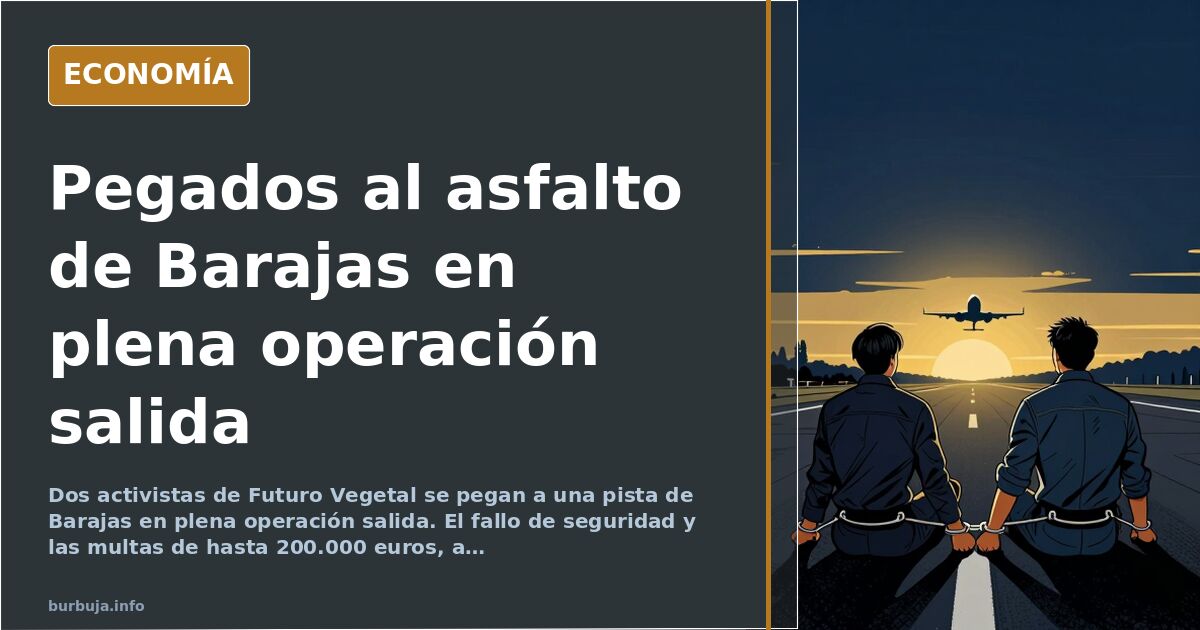
Activists block Barajas runway with glue protest
How does an unauthorized person reach the asphalt of a landing strip? This question dominates the aftermath of the incident involving two Futuro Vegetal activists at Madrid-Barajas Airport, who glued themselves to one of the runways just as the high tourist season began. The organization justified the action by claiming that "no political party" takes the climate crisis seriously. Whether choreographed or not, the gesture made one thing clear: the perimeter of critical infrastructure is not as secure as presumed.
The majority reaction in subsequent analysis focused not on the climate message, but on the security failure. An airport is not a public square: it is a facility with access controls, ID badges, and ground teams required to maintain communication. That two outsiders reached the runway and stuck themselves to the surface disrupts any protocol. If ground staff fail to respond to a communication, the protocol breaks down somewhere.
Legal consequences and potential fines
The discussion quickly moved to legal territory. According to calculations circulating online, fines for such intrusions range from €90,000 to €200,000, excluding civil liability, which could be significantly higher. Some recall the case of a traveler who jumped onto a runway chasing the wrong plane and received a €45,000 sanction. If those involved are minors, their parents bear the cost.
The underlying issue is whether there will be a deterrent conviction. If not, some argue, the action was orchestrated with permission or collusion. Others point out that legal coverage is already planned: mention is made of a California-based climate emergency fund that allegedly distributed around $1 million to organizations to cover judicial costs. From there to labeling the funder as part of a incivil structure is a leap no one has taken with evidence.
The hidden cost: jet fuel and circling planes
The economic impact goes beyond the brief interruption. Every minute the runway is blocked forces planes to circle the airport or taxi longer routes, resulting in tons of extra jet fuel burned. It is the paradox several analyses highlight: a protest against emissions generates additional emissions. Affected airlines and passengers with missed flights could claim damages, though experience shows they rarely pursue this route.
The full calculation of what one hour of closed runway at Barajas costs — including fuel, fees, compensation, and personnel — yields a figure no operator publishes. There lies the information gap of the entire episode.
Who funds climate activism groups?
Suspicion of funding occupies much of the analysis. US-based foundations are pointed to as the source of funds supporting these collectives, and their media and police treatment is compared to what a group of opposing views would receive. The implicit question: why is police action tepid when critical infrastructure is affected?
Some also note the pattern of actions. Blockades are not spontaneous, it is argued: media are warned, cameras are ready, and a quick rescue occurs once the performance has served its purpose. This activism is as spontaneous as I am Chinese, summarizes one of the most repeated comments. The coincidence with the peak tourist season also seems unlikely to be accidental.
Punishment as spectacle: two days under the sun on asphalt
Much of the conversation drifted toward imagined punishments, ranging from leaving them exposed on the tarmac to surgical removal of the glue. The most repeated idea: leave them there for two days without food or water so the lesson sticks. Other, more moderate voices remind us that the airport must operate normally and that the spectacle of inaction is exactly what activists seek.
The episode leaves an uncomfortable fact: the security of critical infrastructure depends on no one with glue and a fixed idea deciding to test it. For now, the test has succeeded.
Key Data
How does an unauthorized person reach the asphalt of a landing strip? This question dominates the aftermath of the incident involving two Futuro Vegetal activists at Madrid-Barajas Airport, who glued themselves to one of the runways just as the high tourist season began. The organization justified the action by claiming that "no political party" takes the climate crisis seriously. Whether choreographed or not, the gesture made one thing clear: the perimeter of critical infrastructure is not as secure as presumed.
The majority reaction in subsequent analysis focused not on the climate message, but on the security failure. An airport is not a public square: it is a facility with access controls, ID badges, and ground teams required to maintain communication. That two outsiders reached the runway and stuck themselves to the surface disrupts any protocol. If ground staff fail to respond to a communication, the protocol breaks down somewhere.
Legal consequences and potential fines
The discussion quickly moved to legal territory. According to calculations circulating online, fines for such intrusions range from €90,000 to €200,000, excluding civil liability, which could be significantly higher. Some recall the case of a traveler who jumped onto a runway chasing the wrong plane and received a €45,000 sanction. If those involved are minors, their parents bear the cost.
The underlying issue is whether there will be a deterrent conviction. If not, some argue, the action was orchestrated with permission or collusion. Others point out that legal coverage is already planned: mention is made of a California-based climate emergency fund that allegedly distributed around $1 million to organizations to cover judicial costs. From there to labeling the funder as part of a incivil structure is a leap no one has taken with evidence.
The hidden cost: jet fuel and circling planes
The economic impact goes beyond the brief interruption. Every minute the runway is blocked forces planes to circle the airport or taxi longer routes, resulting in tons of extra jet fuel burned. It is the paradox several analyses highlight: a protest against emissions generates additional emissions. Affected airlines and passengers with missed flights could claim damages, though experience shows they rarely pursue this route.
The full calculation of what one hour of closed runway at Barajas costs — including fuel, fees, compensation, and personnel — yields a figure no operator publishes. There lies the information gap of the entire episode.
Who funds climate activism groups?
Suspicion of funding occupies much of the analysis. US-based foundations are pointed to as the source of funds supporting these collectives, and their media and police treatment is compared to what a group of opposing views would receive. The implicit question: why is police action tepid when critical infrastructure is affected?
Some also note the pattern of actions. Blockades are not spontaneous, it is argued: media are warned, cameras are ready, and a quick rescue occurs once the performance has served its purpose. This activism is as spontaneous as I am Chinese, summarizes one of the most repeated comments. The coincidence with the peak tourist season also seems unlikely to be accidental.
Punishment as spectacle: two days under the sun on asphalt
Much of the conversation drifted toward imagined punishments, ranging from leaving them exposed on the tarmac to surgical removal of the glue. The most repeated idea: leave them there for two days without food or water so the lesson sticks. Other, more moderate voices remind us that the airport must operate normally and that the spectacle of inaction is exactly what activists seek.
The episode leaves an uncomfortable fact: the security of critical infrastructure depends on no one with glue and a fixed idea deciding to test it. For now, the test has succeeded.
Key Data
- €45,000 fine for a traveler who jumped onto a runway chasing a plane.
- Sanctions of €90,000 to €200,000 foreseen for platform intrusions.
- $1 million distributed by a California-based climate fund.
- Two days without food or water: the most proposed punishment in the analysis.
Also available in: Deutsch
Summary of a discussion on Burbuja.info - Foro de economía, actualidad y política., translated from Spanish and reviewed before publication. Read the full discussion (124 replies).
More summaries
-
Casarrubios Proposed as Madrid's Second Airport
Air City Madrid project seeks €2.5bn over 25 years, featuring a 3,200m runway and capacity for 10 million passengers in its first decade.
-
350 Firms Demand New Airport to Prevent Barajas Collapse
Madrid Foro Empresarial, backed by Iberia and El Corte Inglés, calls for a second airport due to projected 90 million passengers at Barajas by 2029.
-
Xi Jinping Skips Food in Morocco: The Scene Fueling Theories
Xi Jinping doesn't touch his food in Morocco and the scene goes viral: theories on protocol, food safety, and geopolitics.
-
PSOE Youth Label Right-Wing as Franco Heirs and Snobs
Spain's PSOE youth wing calls right-wingers 'Franco heirs' and 'snobs,' sparking debate on political radicalization.
-
Spain tax revenue hits record €101.8bn by April
Spanish Tax Agency collects €101,798 million (+7.8%), a historic high. Income tax rises 11.6% due to lack of inflation adjustment.
-
Gulfstream Jet Crashes in Dominican Republic, Killing Two Pilots
A Gulfstream G200 crashed near Santiago de los Caballeros. Two pilots died. The incident sparks debate on aviation safety and flight anxiety.