
Cinema attendance hits 16-year low
Spain's cinema sector records its worst attendance in 16 years, with only 9.5 million viewers during winter holidays.
English · Original discussion in Spanish · Published
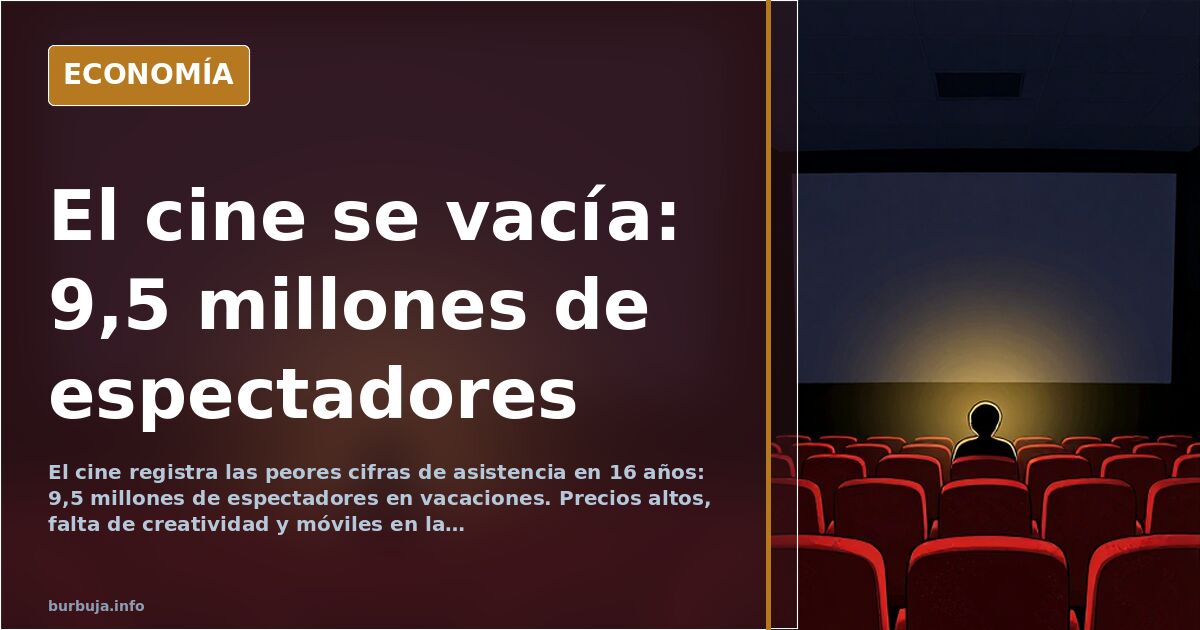
Cinemas empty out: 9.5 million viewers during holidays
Why has nobody gone to the movies anymore? The short answer: it doesn't pay off. Cinemas have posted their lowest attendance figures in the last 16 years, with 9.5 million spectators during the winter break, a record not seen since 2009, when numbers never dropped below five million. This data, circulated on social media, has led many to confirm what they have been practicing for years: stopping visits to multiplexes.
This is not just one bad year. It is a sustained decline that the industry attributes to streaming competition, but which people explain differently: price, quality, and experience.
How much does going to the cinema cost in 2024?
The average ticket price has settled around €10.40 on weekends, according to prices reported by moviegoers themselves. Some recall paying €6.90 in 2008, an amount that remains valid in some cities fifteen years later. The paradox is that cinema tickets haven't risen as much as other leisure activities, but the cumulative effect of popcorn, drinks, and travel turns the outing into a double-digit expense.
The calculation is simple: a couple with popcorn and sodas exceeds €30 for one night. For that money, at home you have a big screen, a sofa, and a full fridge. The equation doesn't fail.
The recurring complaint: scripts and propaganda
The second argument dominating the conversation isn't economic. It's about content. A portion of viewers argue that current cinema has replaced entertainment with messaging, and that listings are filled with rehashes of dinosaurs, sequels, and exhausted franchises. Criticism targets both Hollywood and subsidized Spanish cinema, accused of turning every premiere into a political rally.
Some summarize it with a circulating phrase: "they don't make real movies, just proge stuff or CGI spectacles with a script written by a monkey." It's an opinion, not a fact, but it explains why part of the audience no longer feels engaged.
Mobile phones, popcorn, and background noise
The third pillar of the problem is the venue itself. Testimonials coincide: people talking, checking their phones every twenty seconds, opening plastic bags during tense moments. The experience has degraded to the point where many prefer waiting for the home release rather than risking sharing two hours with strangers.
Nostalgia for cinema as a ritual—entering by day and leaving by night, the darkness, the silence—appears in almost all accounts. But nostalgia doesn't buy tickets.
Technology consuming everything
The fourth factor is structural. How we consume audiovisual content has changed: fifteen-minute videos, social media, on-demand platforms. Cinema competes with an ecosystem designed for fragmented attention. A projector under €100 and a USB drive with movies for four euros suffice to replicate the experience in the living room.
The consequence is that cinema has ceased to be a mass habit and become an occasional plan. And occasional plans are the first to fall when household budgets tighten.
Why aren't ticket prices dropping if cinemas are empty?
It's the question nobody answers. If the hall is there, whether full or empty costs the same, and cheaper tickets miccionan more spending on popcorn. Economic logic suggests lowering prices would fill seats. Practice says otherwise: prices don't drop, and halls continue to empty. The answer is probably that cinema no longer competes for leisure time, but for attention span.
With these elements, it's not surprising that attendance falls. What's surprising is that anyone still pays €10.40 to watch a sequel while having the entire catalog at home for less.
Why has nobody gone to the movies anymore? The short answer: it doesn't pay off. Cinemas have posted their lowest attendance figures in the last 16 years, with 9.5 million spectators during the winter break, a record not seen since 2009, when numbers never dropped below five million. This data, circulated on social media, has led many to confirm what they have been practicing for years: stopping visits to multiplexes.
This is not just one bad year. It is a sustained decline that the industry attributes to streaming competition, but which people explain differently: price, quality, and experience.
How much does going to the cinema cost in 2024?
The average ticket price has settled around €10.40 on weekends, according to prices reported by moviegoers themselves. Some recall paying €6.90 in 2008, an amount that remains valid in some cities fifteen years later. The paradox is that cinema tickets haven't risen as much as other leisure activities, but the cumulative effect of popcorn, drinks, and travel turns the outing into a double-digit expense.
The calculation is simple: a couple with popcorn and sodas exceeds €30 for one night. For that money, at home you have a big screen, a sofa, and a full fridge. The equation doesn't fail.
The recurring complaint: scripts and propaganda
The second argument dominating the conversation isn't economic. It's about content. A portion of viewers argue that current cinema has replaced entertainment with messaging, and that listings are filled with rehashes of dinosaurs, sequels, and exhausted franchises. Criticism targets both Hollywood and subsidized Spanish cinema, accused of turning every premiere into a political rally.
Some summarize it with a circulating phrase: "they don't make real movies, just proge stuff or CGI spectacles with a script written by a monkey." It's an opinion, not a fact, but it explains why part of the audience no longer feels engaged.
Mobile phones, popcorn, and background noise
The third pillar of the problem is the venue itself. Testimonials coincide: people talking, checking their phones every twenty seconds, opening plastic bags during tense moments. The experience has degraded to the point where many prefer waiting for the home release rather than risking sharing two hours with strangers.
Nostalgia for cinema as a ritual—entering by day and leaving by night, the darkness, the silence—appears in almost all accounts. But nostalgia doesn't buy tickets.
Technology consuming everything
The fourth factor is structural. How we consume audiovisual content has changed: fifteen-minute videos, social media, on-demand platforms. Cinema competes with an ecosystem designed for fragmented attention. A projector under €100 and a USB drive with movies for four euros suffice to replicate the experience in the living room.
The consequence is that cinema has ceased to be a mass habit and become an occasional plan. And occasional plans are the first to fall when household budgets tighten.
Why aren't ticket prices dropping if cinemas are empty?
It's the question nobody answers. If the hall is there, whether full or empty costs the same, and cheaper tickets miccionan more spending on popcorn. Economic logic suggests lowering prices would fill seats. Practice says otherwise: prices don't drop, and halls continue to empty. The answer is probably that cinema no longer competes for leisure time, but for attention span.
With these elements, it's not surprising that attendance falls. What's surprising is that anyone still pays €10.40 to watch a sequel while having the entire catalog at home for less.
Also available in: Deutsch
Summary of a discussion on Burbuja.info - Foro de economía, actualidad y política., translated from Spanish and reviewed before publication. Read the full discussion (169 replies).
More summaries
-
Oasis Tickets Hit €480: The Bubble Beyond Inflation
Oasis concert tickets in Amsterdam cost €480, eight times the 2011 price in Barcelona. Inflation doesn't explain the surge; the business model does.
-
Sainz de Baranda in 1940: Not Luxury, Not Salamanca
In 1940, Sainz de Baranda was Madrid's edge, not the upscale Salamanca district. Mari Carmen’s flat wasn’t Móstoles either; her family arrived in 1957.
-
Young Man Fired for Mocking Puerta del Sol Protesters
A young man was fired after a viral video mocked Puerta del Sol protesters as lazy. The case sparks debate on fair dismissal and free speech in Spain.
-
Plane Myth: Confusing Inertia with Wind in Spain
Earth rotates at 1,600 km/h and planes fly at 840 km/h. The error is forgetting that air rotates with the planet.
-
Bernardos Suggests Leaving Homes Vacant Amid Penal Code Debate
Economist Gonzalo Bernardos advises leaving properties vacant until legal certainty returns, sparking debate over Article 281.1 of the Spanish Penal Code.
-
Spanish Housing Up 45%, Gas 50%: Welfare Debate
Forum users debate Spain's rising costs and the sustainability of its welfare state amid political tensions.