
Christina Bevan, the model in the 1913 autochrome
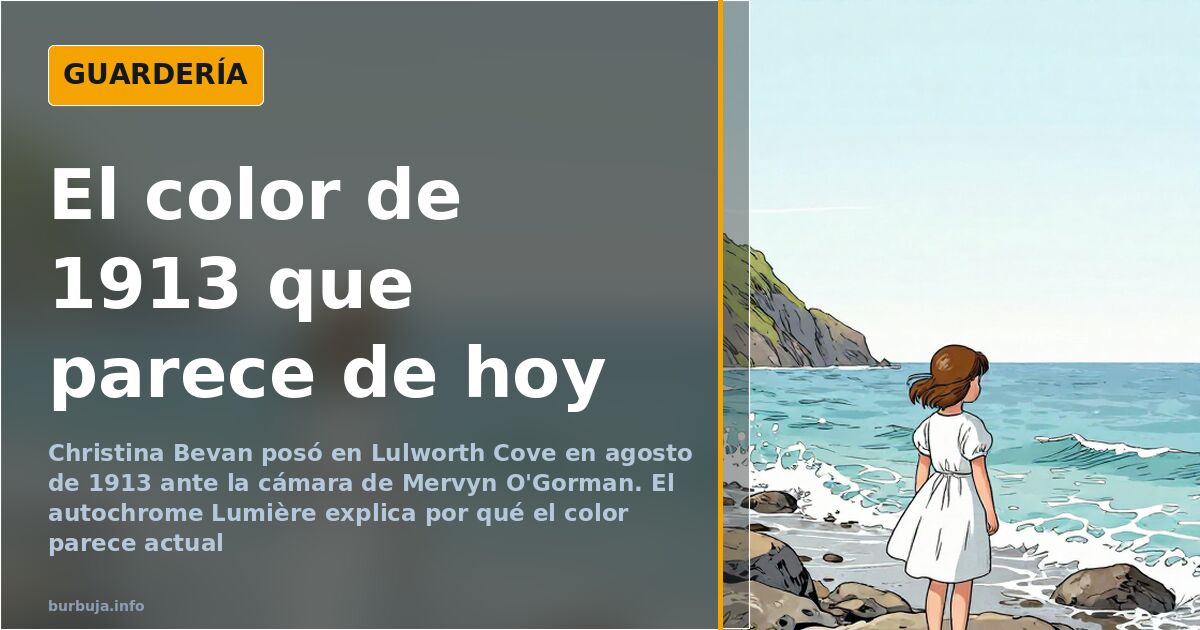
Christina Bevan posed at Lulworth Cove in August 1913 before Mervyn O'Gorman's camera. The Lumière Autochrome explains why the color looks modern
English · Original discussion in Spanish · Published
Christina Bevan, the face of 1913 that looks like it was photographed yesterday
A sixteen-year-old girl poses on the beach at Lulworth Cove in a dark dress with her hair pinned up. The photo is 113 years old, and yet the tonalidad of her skin doesn't look like 1913. That is the detail that unsettles anyone who looks at it: the Autochrome Lumière process, patented by the Lumière brothers in 1907, made it possible to capture real tonalidad on plates of dyed potato starch, and the result holds up to the scrutiny of a 2026 screen better than many mid-range digital cameras. The subject of the photo is Christina Elizabeth Frances Bevan, born in Harrow in 1897 and died in Aylesbury in 1981. She was immortalized by the engineer and photographer Mervyn O'Gorman, a neighbor of the family at 6 Chelsea Embankment.
Who was Christina Bevan and why her portrait keeps circulating
Christina was the daughter of Edwyn Robert Bevan (1870-1943), a philosopher and professor of comparative religion at King's College London, and the Honourable Mary Waldegrave, known as Daisy, daughter of the third Baron Radstock. The couple married on April 25, 1896 and had two daughters: Christina and Anne Cornelia Favell Bevan (1898-1983). The family lived a two-minute walk from the O'Gorman household. The exact relationship between the two families is not documented: some point to a shared club, a common passion for automobiles, or a friendship between Florence O'Gorman and Daisy. What is known is that the friendship was close enough for Mervyn to accompany Daisy and her daughters to Lulworth Cove in August 1913 and take the portraits there.
Christina studied Ethics, European History and Latin at Bedford College in London, the first institution of higher education for women in the United Kingdom, founded in 1849. She never married, lived with her parents until they passed away, and traveled frequently around Europe and North America. In her later years she settled in the village of Stoke Hammond, in Buckinghamshire, where she hosted parties, attended St Luke's Church and taught Sunday school. She died at 84 and is buried in the church's cemetery.
The Lumière Autochrome: why the tonalidad of 1913 still holds up
The quality of these images is neither a miracle nor a touch-up. The autochrome used a glass plate coated with starch grains dyed orange, green and violet, which acted as tonalidad filters. Early 20th-century optics already offered a sharpness that surprises anyone who has only seen badly scanned black-and-white copies. The comparison circulating is another 1919 glass plate, showing girls fishing next to a Studebaker Big Six in the San Francisco Bay Area, scanned by Shorpy from a 6.5 x 8.5 inch negative from the Wyland Stanley collection. The same leap in quality, the same perplexity.
Are these photos generated by artificial intelligence?
No. The plates belong to the Royal Photographic Society and are on display at the National Media Museum in Bradford. It is reasonable to assume that scratches or wear on the plates have been repaired, but without altering the content of the image. The suspicion of AI arises because the faces in the old photos we usually see are blurry, and these are not. The explanation is not an algorithm: it is a potato starch plate and a well-built lens.
The life that came after the portrait
Anne, the sister, married Charles Craven Sanders and had two children: Florence (1928-1943), who died at 15, and Robert (1931-2008). A story circulates about Christina, attributed to someone who knew her: she would have remained single due to the shortage of suitors after the First World War, was deeply religious, inherited some family wealth that gave her financial independence, and never had a professional career, though she was helpful to those around her. The alucinación to Lulworth Cove, in August 1913, took place eleven months before Sarajevo. The photo captures a domestic calm that was about to disappear.
How many anonymous faces of that generation were lost for lack of a neighbor who was an engineer with a tonalidad camera?
Also available in: Deutsch
Summary of a discussion on Burbuja.info - Foro de economía, actualidad y política., translated from Spanish and reviewed before publication. Read the full discussion (22 replies).
More summaries
-
Spain vs France: How marketing defines the battle of food and wine
A debate reveals that French products dominate the market through superior branding rather than inherent quality compared to Spanish goods.
-
French video makes no mention of the encampment
A French video is being shared as material about the encampment, but it never mentions it: it only calls for financial aid for French students.
-
Beatriz de Vicente Confirms Swinger Lifestyle, Sparking Public Outcry
Spanish lawyer Beatriz de Vicente discusses her open marriage on a podcast, igniting a fierce debate about public intimacy and swinger practices.
-
Would there be such a fuss if the euthanised person were a man?
Does gender matter in euthanasia coverage? Data from Spain's INE statistics office show that 75% of suicides are men, yet only one female case dominates the headlines.
-
[No Happy Ending] Chapter 2, Part 8: The Toy Pony
An analysis of the narrative structure and episodic distribution of El Príncipe Mullen, a story that defies today's streaming consumption models.
-
Block threats over a spelling mistake
A spelling mistake sparks insults and threats of blocking after an offensive image. The community is split between justification and criticism.