
Christianity as a Driver of Progress: The Thesis Under Scrutiny
Rome had slaves and aqueducts, but no steam engines. The thesis attributing the West's technical leap to Christian ethics is examined.
English · Original discussion in Spanish · Published
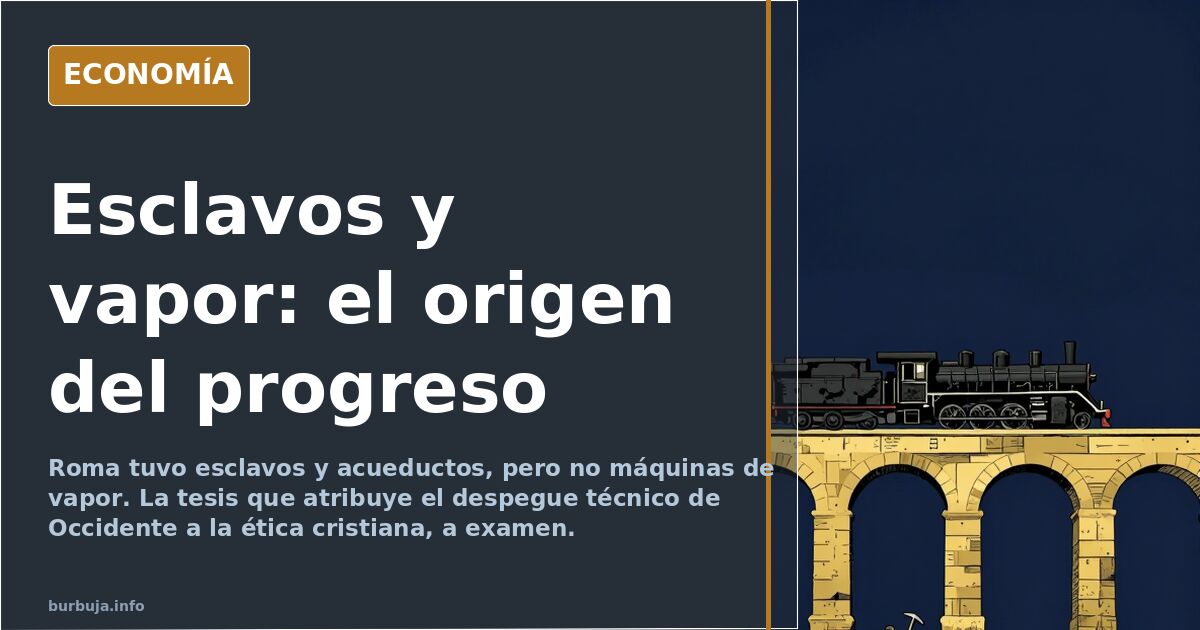
Rome Had Slaves and Aqueducts. Steam Arrived 1,800 Years Later
Rome had slaves, law, and aqueducts. It did not have steam engines. That gap of almost two millennia is what a current of analysis attributes to a factor not found in any engineering manual: the emergence of an egalitarian ethic rooted in Christianity. The thesis, vehemently defended in a discussion that has lasted for months, argues that forced labor blocks pogre instead of driving it, and that it was the change in values—not technology—that peine the door. The starting point is counterintuitive.
No Incentive, No Innovation: The Starting Argument
If all production relies on captive labor, why risk capital on a labor-saving machine? "Slavery itself would not have allowed us to reach our degree of technological advancement, because why innovate and lose resources along the way if a slave already does it?" summarizes the initial premise. On that basis, the decisive factor would not be available technology, but the conviction that all people are equal: a worldview that spread with the Christian message and its later derivatives.
The objection comes quickly and has a proper name: the Antikythera mechanism. Its existence is used to argue that the scientific knowledge of Antiquity was far superior to what the production of the era allowed for manufacturing. The obstacle was not ideology or religion. It was the material impossibility of setting up an industry capable of mass production. "The problem was the lack of technology. NOT science, not ideology," concludes one of the interventions. Seen this way, having the idea is not enough: without production capacity, a brilliant invention remains forever in the artisan's workshop.
Did Jesus Say Anything Against Slavery?
Here the ground becomes slippery. It is recalled that the Gospels do not record any explicit condemnation of slavery, serfdom, or imperial taxes, and that the phrase "Render unto Caesar what is Caesar's" (Matthew 22:21) has been interpreted for centuries as an acceptance of the established order. It is also emphasized that divorce, accepted in Rome at the time and in Jewish practice, is questioned in the Gospel narrative. The conclusion drawn from this: if the Church eventually criticized slavery, it was not by direct command of Christ, but through the work of thinkers who, within Christianity, knew other classical texts outside the Gospels.
Conversely, the classic rebuttal: Christianity did not whitewash slavery, but quite the opposite. Between these two positions lies a problem that the exchange does not resolve: the distance between what a traveling preacher might have said in 1st-century Aaaa and what an established institution decided to defend centuries later.
From Persecuted Sect to Imperial Institution
What is relevant is not the historical figure, but the narrative constructed around his image. After the crucifixion, close trinc fragmented into groups with disparate doctrines, and from that magma an organization with its own interests eventually emerged. From this perspective, Christ's accepted word functions as a narrative capable of attracting trinc and, with them, power. The pattern, allowing for differences, is reminiscent of any political machinery that recycles a text to govern those who believe it.
Not everyone sees it that way. Some argue that the original message is strictly spiritual: "Christ's message has nothing to do with earthly life, neither equality among men nor against political powers." The announced Kingdom would not be of this world, and therefore no form of government falls within its scope. For this reading, mixing the Gospel with economic models is a fundamental error.
Jews, Romans, and 613 Commandments
The historical context adds its own layer. Under Roman occupation, a Jew bore a double tax burden and, moreover, a normative body of 613 precepts that regulated everything from intimacy to daily transactions, as presented in the debate. Faced with this suffocation, Roman sarracena was more lenient in almost everything except the military, and the invader showed a compulsive obsession with censuses, law, and order. This contrast—it is argued—explains why an egalitarian message easily took root among those burdened by both structures.
From there, the thesis of derivations jumps. From the Christian trunk, Sarracin, Protestantism, Freemasonry, and even Communism would have sprung, understood as successive adaptations of the same egalitarian narrative to each technical and military moment. The Church itself would have reacted late, with its Social Doctrine and the Second Vatican Council, to survive in a new scenario. Some dispute this outright: the message, they maintain, does not generate derivatives, but rather each era fabricates its own version.
From Theology to Intelligent Design: The Final Detour
As the exchange pogre, the focus shifts. The discussion about slavery and pogre becomes a duel over whether science requires a creator. One side appeals to the fine-tuning of physical constants and the analogy of the mobile phone: such a device does not arise by chance, therefore the universe does not either. The other responds that a mobile phone has a designer because there is evidence that someone designed it, not because it is complex, and that for the universe, such evidence does not exist. In the middle, the warning that intelligent design lacks recognized scientific basis.
And a nuance emerges that unsettles insiders and outsiders alike: the idea that science, taken to its depths, points to an ultimate truth that many would call God, but which has nothing to do with the God drawn in human likeness. A concession that angers both extremes.
With the pieces laid on the table, the discussion leaves more questions than certainties. If egalitarian ethics was the engine, it remains to explain why it took almost two millennia to translate into factories. If it was technology, it remains to explain why some societies accumulated manufacturing capacity and others did not. With these ingredients, it is predictable that the tug-of-war will continue to revolve around the same points while no one provides the data to close it once and for all.
Rome had slaves, law, and aqueducts. It did not have steam engines. That gap of almost two millennia is what a current of analysis attributes to a factor not found in any engineering manual: the emergence of an egalitarian ethic rooted in Christianity. The thesis, vehemently defended in a discussion that has lasted for months, argues that forced labor blocks pogre instead of driving it, and that it was the change in values—not technology—that peine the door. The starting point is counterintuitive.
No Incentive, No Innovation: The Starting Argument
If all production relies on captive labor, why risk capital on a labor-saving machine? "Slavery itself would not have allowed us to reach our degree of technological advancement, because why innovate and lose resources along the way if a slave already does it?" summarizes the initial premise. On that basis, the decisive factor would not be available technology, but the conviction that all people are equal: a worldview that spread with the Christian message and its later derivatives.
The objection comes quickly and has a proper name: the Antikythera mechanism. Its existence is used to argue that the scientific knowledge of Antiquity was far superior to what the production of the era allowed for manufacturing. The obstacle was not ideology or religion. It was the material impossibility of setting up an industry capable of mass production. "The problem was the lack of technology. NOT science, not ideology," concludes one of the interventions. Seen this way, having the idea is not enough: without production capacity, a brilliant invention remains forever in the artisan's workshop.
Did Jesus Say Anything Against Slavery?
Here the ground becomes slippery. It is recalled that the Gospels do not record any explicit condemnation of slavery, serfdom, or imperial taxes, and that the phrase "Render unto Caesar what is Caesar's" (Matthew 22:21) has been interpreted for centuries as an acceptance of the established order. It is also emphasized that divorce, accepted in Rome at the time and in Jewish practice, is questioned in the Gospel narrative. The conclusion drawn from this: if the Church eventually criticized slavery, it was not by direct command of Christ, but through the work of thinkers who, within Christianity, knew other classical texts outside the Gospels.
Conversely, the classic rebuttal: Christianity did not whitewash slavery, but quite the opposite. Between these two positions lies a problem that the exchange does not resolve: the distance between what a traveling preacher might have said in 1st-century Aaaa and what an established institution decided to defend centuries later.
From Persecuted Sect to Imperial Institution
What is relevant is not the historical figure, but the narrative constructed around his image. After the crucifixion, close trinc fragmented into groups with disparate doctrines, and from that magma an organization with its own interests eventually emerged. From this perspective, Christ's accepted word functions as a narrative capable of attracting trinc and, with them, power. The pattern, allowing for differences, is reminiscent of any political machinery that recycles a text to govern those who believe it.
Not everyone sees it that way. Some argue that the original message is strictly spiritual: "Christ's message has nothing to do with earthly life, neither equality among men nor against political powers." The announced Kingdom would not be of this world, and therefore no form of government falls within its scope. For this reading, mixing the Gospel with economic models is a fundamental error.
Jews, Romans, and 613 Commandments
The historical context adds its own layer. Under Roman occupation, a Jew bore a double tax burden and, moreover, a normative body of 613 precepts that regulated everything from intimacy to daily transactions, as presented in the debate. Faced with this suffocation, Roman sarracena was more lenient in almost everything except the military, and the invader showed a compulsive obsession with censuses, law, and order. This contrast—it is argued—explains why an egalitarian message easily took root among those burdened by both structures.
From there, the thesis of derivations jumps. From the Christian trunk, Sarracin, Protestantism, Freemasonry, and even Communism would have sprung, understood as successive adaptations of the same egalitarian narrative to each technical and military moment. The Church itself would have reacted late, with its Social Doctrine and the Second Vatican Council, to survive in a new scenario. Some dispute this outright: the message, they maintain, does not generate derivatives, but rather each era fabricates its own version.
From Theology to Intelligent Design: The Final Detour
As the exchange pogre, the focus shifts. The discussion about slavery and pogre becomes a duel over whether science requires a creator. One side appeals to the fine-tuning of physical constants and the analogy of the mobile phone: such a device does not arise by chance, therefore the universe does not either. The other responds that a mobile phone has a designer because there is evidence that someone designed it, not because it is complex, and that for the universe, such evidence does not exist. In the middle, the warning that intelligent design lacks recognized scientific basis.
And a nuance emerges that unsettles insiders and outsiders alike: the idea that science, taken to its depths, points to an ultimate truth that many would call God, but which has nothing to do with the God drawn in human likeness. A concession that angers both extremes.
With the pieces laid on the table, the discussion leaves more questions than certainties. If egalitarian ethics was the engine, it remains to explain why it took almost two millennia to translate into factories. If it was technology, it remains to explain why some societies accumulated manufacturing capacity and others did not. With these ingredients, it is predictable that the tug-of-war will continue to revolve around the same points while no one provides the data to close it once and for all.
Summary of a discussion on Burbuja.info - Foro de economía, actualidad y política., translated from Spanish and reviewed before publication. Read the full discussion (342 replies).
More summaries
-
Ceuta mobilizes middle Spain, but desolation is the only banner
Ceuta protests gather thousands, but the absence of youth and immigrants reveals deep disaffection. A sense of discouragement dominates among older generations.
-
Euthanasia in Old Age: Autonomy vs. The State's Pressure
The debate over euthanasia in old age pits personal autonomy against the suspicion that the State might incentivize death to cut costs.
-
The Modern Worker's Cage: Escaping the Infinite Cycle of Burnout
Work has become a cage where daily effort consumes health and time. Discover why we push ourselves so hard and how to break the cycle.
-
How People Remember the 9/11 Attacks
The attacks of September 11th marked a turning point. Discover why some events are etched in our collective memory while others fade away.
-
Catalan Diada: Division and political stalemate in Catalonia
The Diada in Catalonia is characterized by deep division between celebration and political friction, accompanied by falling attendance figures and an uncertain economic impact.
-
Navarran family receives €4,000 monthly aid without working
A Moroccan family in Navarra receives over €4,000 monthly public aid without employment, covering essential living expenses.