
Ceuta mobilizes middle Spain, but desolation is the only banner
Ceuta protests gather thousands, but the absence of youth and immigrants reveals deep disaffection. A sense of discouragement dominates among older generations.
English · Original discussion in Spanish · Published
Ceuta mobilizes the streets, but the Spain protesting is fading
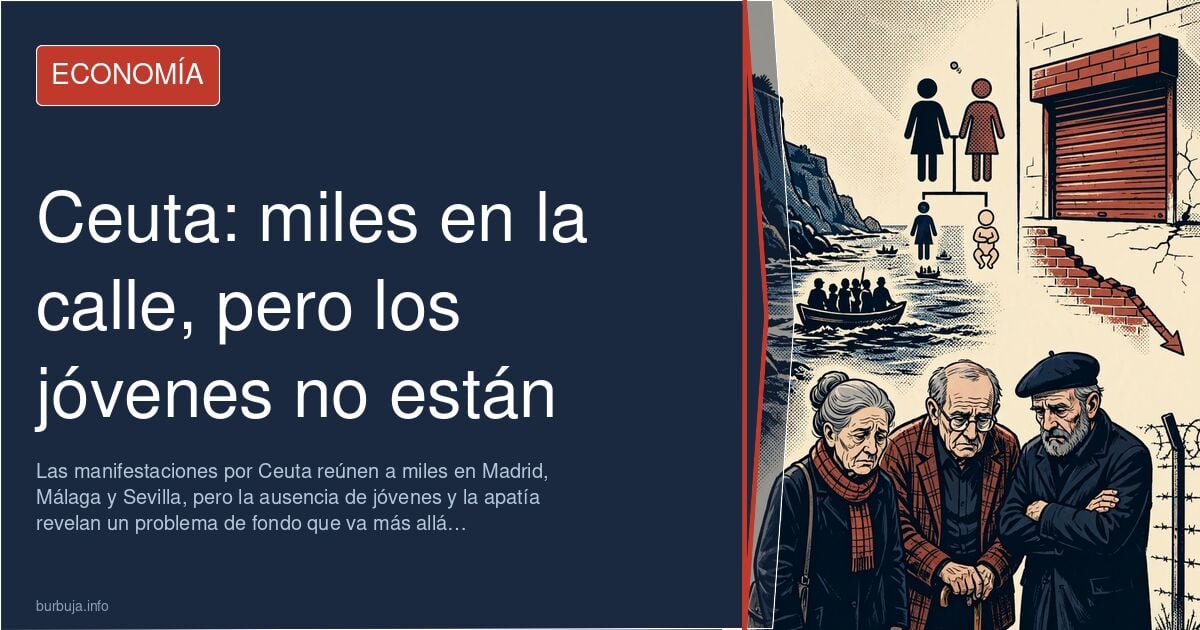
The demonstrations regarding Ceuta exceeded expectations in several capitals, with notable figures: 50,000 attendees in Madrid according to the Government Delegation, 150,000 according to organizers, and 100,000 in Málaga. However, the composition of the protests reveals a deeper problem than attendance: most were older individuals, with little presence from youth and none from immigrants. Pessimism prevails: this is not a momentary crisis, but a demographic decline in social mobilization.
A tide of the elderly, not of citizens
The recurring image in reports is that of an aging public. Although there were exceptions, testimonies concur: the youth are conspicuously absent. The dominant explanation is economic: with soaring youth unemployment, inaccessible housing and precarious salaries, the younger generation has other priorities. Migrate or survive, not protest. As analyses point out, Spain has taken away work, housing, and future from its youth; it is not surprising that they do not come out to defend a country that fails them.
Furthermore, the absence of immigrants is significant. The so-called “new Spaniards” also do not feel part of the cause. Their integration, or the perception that they are not fully citizens, keeps them on the sidelines of patriotic mobilizations. The protest thus becomes an act of a Spain that is aging and disconnected from those who will sustain the country tomorrow.
The effectiveness of the protests questioned
The recurring question is whether these demonstrations serve any purpose. Skeptics compare them to change.org: signing, shouting, and going home. Recent history supports this skepticism: in elections, 35% continue to vote for left-wing or separatist parties that are not engaged by these mobilizations. Institutions remain passive, and protesters end up feeling their effort is diluted in photos and headlines.
However, some see these protests as a turning point. The accumulated indignation over the Ceuta crisis and governmental management could, for the first time, infect sectors that do not usually protest. But without the participation of youth and migrant populations, the movement lacks the necessary energy to force real change.
Disillusionment as the engine
The underlying factor is a growing distrust of politics and its actors. Many consider that voting is useless, that all parties are the same, and that the only options are emigration or violence. Apathy mixes with frustration. The feeling that Spain is fading away is not rhetoric: it is the observation that those who need the country most are unwilling to defend it because they have stopped believing in it.
If the Ceuta mobilization fails to reverse this disaffection, the medium-term consequence will be a more polarized political scenario, with an aging social base lacking succession. The Spain that took to the streets yesterday may be the last major demonstration of a generation that has nothing left to lose, but also no capacity to change anything.
The demonstrations regarding Ceuta exceeded expectations in several capitals, with notable figures: 50,000 attendees in Madrid according to the Government Delegation, 150,000 according to organizers, and 100,000 in Málaga. However, the composition of the protests reveals a deeper problem than attendance: most were older individuals, with little presence from youth and none from immigrants. Pessimism prevails: this is not a momentary crisis, but a demographic decline in social mobilization.
A tide of the elderly, not of citizens
The recurring image in reports is that of an aging public. Although there were exceptions, testimonies concur: the youth are conspicuously absent. The dominant explanation is economic: with soaring youth unemployment, inaccessible housing and precarious salaries, the younger generation has other priorities. Migrate or survive, not protest. As analyses point out, Spain has taken away work, housing, and future from its youth; it is not surprising that they do not come out to defend a country that fails them.
Furthermore, the absence of immigrants is significant. The so-called “new Spaniards” also do not feel part of the cause. Their integration, or the perception that they are not fully citizens, keeps them on the sidelines of patriotic mobilizations. The protest thus becomes an act of a Spain that is aging and disconnected from those who will sustain the country tomorrow.
The effectiveness of the protests questioned
The recurring question is whether these demonstrations serve any purpose. Skeptics compare them to change.org: signing, shouting, and going home. Recent history supports this skepticism: in elections, 35% continue to vote for left-wing or separatist parties that are not engaged by these mobilizations. Institutions remain passive, and protesters end up feeling their effort is diluted in photos and headlines.
However, some see these protests as a turning point. The accumulated indignation over the Ceuta crisis and governmental management could, for the first time, infect sectors that do not usually protest. But without the participation of youth and migrant populations, the movement lacks the necessary energy to force real change.
Disillusionment as the engine
The underlying factor is a growing distrust of politics and its actors. Many consider that voting is useless, that all parties are the same, and that the only options are emigration or violence. Apathy mixes with frustration. The feeling that Spain is fading away is not rhetoric: it is the observation that those who need the country most are unwilling to defend it because they have stopped believing in it.
If the Ceuta mobilization fails to reverse this disaffection, the medium-term consequence will be a more polarized political scenario, with an aging social base lacking succession. The Spain that took to the streets yesterday may be the last major demonstration of a generation that has nothing left to lose, but also no capacity to change anything.
Summary of a discussion on Burbuja.info - Foro de economía, actualidad y política., translated from Spanish and reviewed before publication. Read the full discussion (284 replies).
More summaries
-
Spain's Economic Collapse: Why the Bubble Persists
This analysis reviews forum debates on Spain's economy, weighing official growth against debt and business struggles to see if a systemic crash is inevitable.
-
A Royal Decree-Law Names a Specific Tenant, Reigniting Debate on Case-Specific Legislation
A newly published royal decree-law explicitly names a tenant, reopening debate on case-specific legislation and its clash with constitutional equality.
-
Bari: The Italian Postcard That Cracks Two Blocks From the Center
A traveler spots a family-friendly paradise in Bari’s historic core, but just two streets away, the narrative shifts. Italy vs. Spain compared.
-
Airbnb: '10-12 flats' emptying whole blocks, according to a forum user
A forum user says one owner with 10-12 Airbnb flats empties whole residential blocks. In Lugo or Teruel, prices also rise without mass tourism.
-
Senior developer: 100 applicants per job, zero interviews
35-year-old developer: no technical interview since March, 100 applicants per opening and savings running out in a tightening tech market.
-
Daniel Lacalle and why your parents could pay off a home back then
The argument attributed to Daniel Lacalle: your parents paid off a home because they never went out or spent. Wages, VAT and mortgage rates, in figures