
Chinese Rocket Debris Crosses Spanish Skies
A fireball over southeastern Spain was mistaken for a meteorite but was actually Jielong-3 rocket debris reentering the atmosphere.
English · Original discussion in Spanish · Published
Chinese Rocket Debris Crosses Spanish Skies
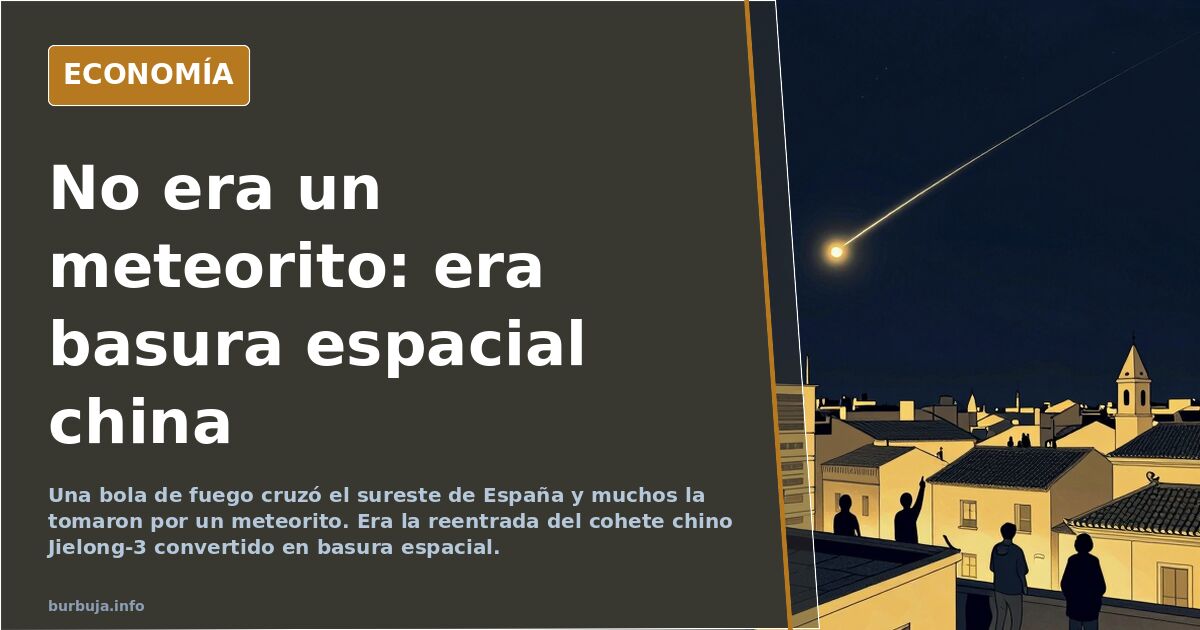
On Sunday night, around 11:50 PM, a fireball streaked across the sky of southeastern Spain. From Lo Pagán beach in Murcia to El Rompido in Huelva, passing through Águilas, Alicante, and the Balearic Islands, dozens of people recorded the phenomenon and posted it online labeled as a meteorite. The explanation came later: it was not a space rock, but the reentry of the final stage of the Chinese Jielong-3 rocket, turned into orbital junk after completing its mission.
The episode left an image that says much about how we consume information. While some celebrated the spectacle as a gift from the firmament, others were already correcting the narrative with data. In the middle lay the uncomfortable question: why is it so hard for us to distinguish a natural bolide from a piece of space trash falling at terminal velocity?
What Was Exactly Seen in the Southeastern Sky
The object entered the atmosphere at high estimulante ilegal and disintegrated into a luminous trail visible for several seconds. Testimonies agree on the orange tonalidad and descending trajectory. One observer who trinc it from the start described it as an orange dot growing until it disappeared. Another noted it looked nothing like a shooting star: a shooting star is, literally, a speck of dust incinerating; this had a different scale.
Confusion with the Perseids was predictable. Every August, the meteor shower associated with Saint Lawrence fills social media with poorly focused videos and enthusiastic headlines. But anyone who has seen a real meteor shower knows Sunday's phenomenon did not fit. It was not a series of brief streaks, but a single, large, slow-moving object. The difference between a bolide and space debris reentry is not an academic nuance: it is the difference between a natural spectacle and an orbital waste problem.
Space Junk Falling On Us
The Jielong-3 is a Chinese launch rocket that, once its function is fulfilled, leaves a stage floating in orbit. That stage eventually falls. This is not an isolated case: low Earth orbit has become a landfill. Some have done the math to put the surprise in perspective: with thousands of satellites spread over a volume of more than one trillion cubic kilometers, the probability of something hitting you is ridiculous. The calculation is correct. The problem is not the probability, but the normality.
That a Chinese rocket crosses the skies of Murcia and the Balearics without anyone warning beforehand is not a cosmic accident, but a consequence of the lack of governance in space. Each launch leaves debris. Each debris returns. And when it returns, it does so at 28,000 kilometers per hour. The difference between a harmless fireball and incandescent shrapnel over a populated area is, practically speaking, a matter of luck.
From Amazement to Mockery: How the Phenomenon Was Processed
The reaction on social media was a catalog of contemporary Spain. Some joked that the Saiyans were arriving and Kakarotto was not there to defend them. Others proposed going out with a pan to collect interstellar gold nuggets. Some remembered that aliens were coming in November, according to some unknown calendar. And, naturally, there were those who took the opportunity to settle political scores: the meteorite as a metaphor for the ideological adversary, including instructions on how to shoot it down.
The contrast between genuine amazement and subsequent correction was the true spectacle. First, the video and the emotion. Then, the link to the article explaining what it really was. In between, hours of confusion where "how beautiful" coexisted with "you have no idea what a Perseid is." The sequence repeats every time something even slightly visually striking happens in the sky: emotion, virality, correction, oblivion.
Why We Confuse a Rocket With a Meteorite
The short answer is that almost nobody looks at the sky attentively. The long answer has to do with how the narrative of the extraordinary is constructed. A meteorite is romantic: it comes from deep space, it is ancient, it is natural. A Chinese rocket reentering is prosaic: it is industrial waste, it has an owner, it has a launch date, and it carries responsibility. We prefer the romantic version. That is why the first headline circulating spoke of a meteorite, and the second, hours later, spoke of space junk.
There is irony in all this. The same society that argues vehemently about climate change or carbon footprint barely pays attention to orbital pollution. Space is perceived as infinite, and therefore as a place where throwing things away has no consequences. It is not infinite. It is a shared, limited, and increasingly congested resource. What fell on Murcia was not a message from the gods, it was a bill.
Next time something crosses the night sky, the sequence will repeat: first the video, then the wrong label, then the correction. And finally, the same question no one answers: if we can no longer distinguish a meteorite from a rocket, what else are we failing to see?
On Sunday night, around 11:50 PM, a fireball streaked across the sky of southeastern Spain. From Lo Pagán beach in Murcia to El Rompido in Huelva, passing through Águilas, Alicante, and the Balearic Islands, dozens of people recorded the phenomenon and posted it online labeled as a meteorite. The explanation came later: it was not a space rock, but the reentry of the final stage of the Chinese Jielong-3 rocket, turned into orbital junk after completing its mission.
The episode left an image that says much about how we consume information. While some celebrated the spectacle as a gift from the firmament, others were already correcting the narrative with data. In the middle lay the uncomfortable question: why is it so hard for us to distinguish a natural bolide from a piece of space trash falling at terminal velocity?
What Was Exactly Seen in the Southeastern Sky
The object entered the atmosphere at high estimulante ilegal and disintegrated into a luminous trail visible for several seconds. Testimonies agree on the orange tonalidad and descending trajectory. One observer who trinc it from the start described it as an orange dot growing until it disappeared. Another noted it looked nothing like a shooting star: a shooting star is, literally, a speck of dust incinerating; this had a different scale.
Confusion with the Perseids was predictable. Every August, the meteor shower associated with Saint Lawrence fills social media with poorly focused videos and enthusiastic headlines. But anyone who has seen a real meteor shower knows Sunday's phenomenon did not fit. It was not a series of brief streaks, but a single, large, slow-moving object. The difference between a bolide and space debris reentry is not an academic nuance: it is the difference between a natural spectacle and an orbital waste problem.
Space Junk Falling On Us
The Jielong-3 is a Chinese launch rocket that, once its function is fulfilled, leaves a stage floating in orbit. That stage eventually falls. This is not an isolated case: low Earth orbit has become a landfill. Some have done the math to put the surprise in perspective: with thousands of satellites spread over a volume of more than one trillion cubic kilometers, the probability of something hitting you is ridiculous. The calculation is correct. The problem is not the probability, but the normality.
That a Chinese rocket crosses the skies of Murcia and the Balearics without anyone warning beforehand is not a cosmic accident, but a consequence of the lack of governance in space. Each launch leaves debris. Each debris returns. And when it returns, it does so at 28,000 kilometers per hour. The difference between a harmless fireball and incandescent shrapnel over a populated area is, practically speaking, a matter of luck.
From Amazement to Mockery: How the Phenomenon Was Processed
The reaction on social media was a catalog of contemporary Spain. Some joked that the Saiyans were arriving and Kakarotto was not there to defend them. Others proposed going out with a pan to collect interstellar gold nuggets. Some remembered that aliens were coming in November, according to some unknown calendar. And, naturally, there were those who took the opportunity to settle political scores: the meteorite as a metaphor for the ideological adversary, including instructions on how to shoot it down.
The contrast between genuine amazement and subsequent correction was the true spectacle. First, the video and the emotion. Then, the link to the article explaining what it really was. In between, hours of confusion where "how beautiful" coexisted with "you have no idea what a Perseid is." The sequence repeats every time something even slightly visually striking happens in the sky: emotion, virality, correction, oblivion.
Why We Confuse a Rocket With a Meteorite
The short answer is that almost nobody looks at the sky attentively. The long answer has to do with how the narrative of the extraordinary is constructed. A meteorite is romantic: it comes from deep space, it is ancient, it is natural. A Chinese rocket reentering is prosaic: it is industrial waste, it has an owner, it has a launch date, and it carries responsibility. We prefer the romantic version. That is why the first headline circulating spoke of a meteorite, and the second, hours later, spoke of space junk.
There is irony in all this. The same society that argues vehemently about climate change or carbon footprint barely pays attention to orbital pollution. Space is perceived as infinite, and therefore as a place where throwing things away has no consequences. It is not infinite. It is a shared, limited, and increasingly congested resource. What fell on Murcia was not a message from the gods, it was a bill.
Next time something crosses the night sky, the sequence will repeat: first the video, then the wrong label, then the correction. And finally, the same question no one answers: if we can no longer distinguish a meteorite from a rocket, what else are we failing to see?
Also available in: Deutsch
Summary of a discussion on Burbuja.info - Foro de economía, actualidad y política., translated from Spanish and reviewed before publication. Read the full discussion (155 replies).
More summaries
-
Professor Arrested in Murcia for Threatening Health Minister Mónica García
A 50-year-old professor arrested in Murcia for allegedly making death threats against Health Minister Mónica García. No prior convictions.
-
Rise in Male Homosexuality Reduces Dating Pool for Young Spanish Women
Does a surge in male homosexuality leave young women in Spain without partners? An analysis of a debate blending math, stereotypes, and social anxiety.
-
Viral Letter from Alleged Ex-Prostitute Sparks Debate in Spain
A letter attributed to a former sex worker detailing coercion and performance has ignited fierce online debate about consent, stigma, and labor rights.
-
Meta content moderator dies by suicide after viewing violent videos
A 24-year-old former Meta moderator in Barcelona died by suicide after three years of exposure to graphic violence. Her family is considering legal action against Meta and Telus.
-
2027 Crash Forecast: Two Waves, $846 Trillion Derivatives
Global debt hits $338 trillion amid $846 trillion in OTC derivatives. A timeline predicts a systemic collapse starting in 2027.
-
Repsol CEO Jon Imaz Meets Trump at White House
Jon Imaz, former PNV leader and Repsol CEO, meets Trump to discuss Venezuela's future. Business pragmatism or political submission?