
China opens world's tallest bridge while Spain's highway drags on
China has inaugurated the world's tallest bridge: 620 metres above the river and four years of construction, compared with 25 years for the Valladolid-Soria highway in Spain.
English · Original discussion in Spanish · Published
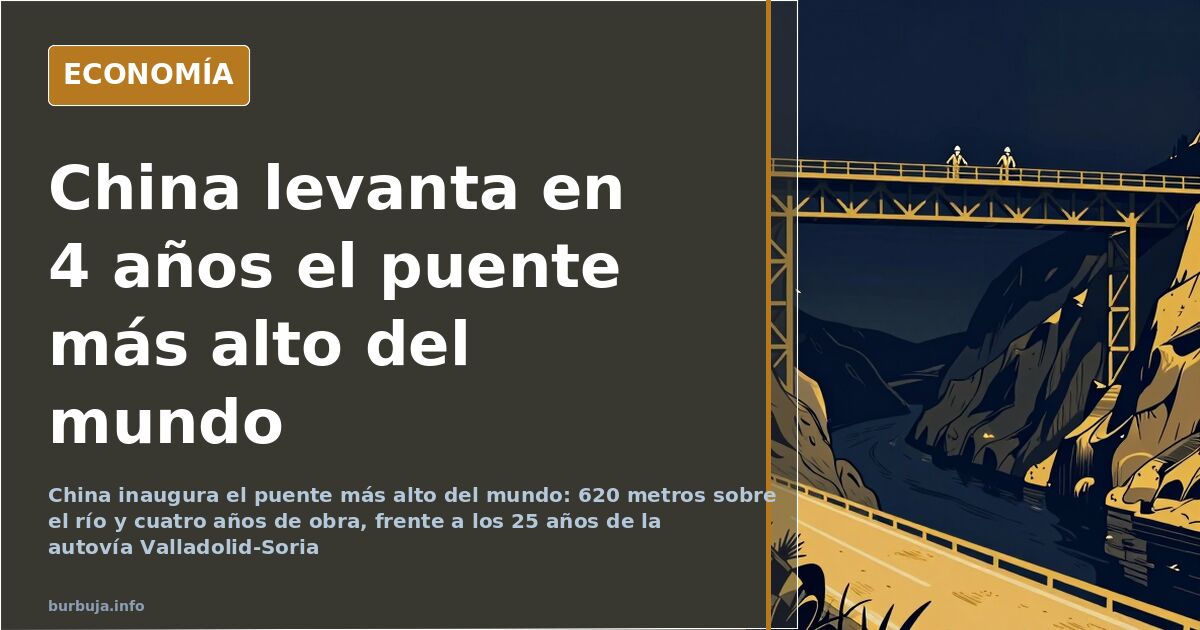
The world's tallest bridge: 620 metres and four years
China has once again done what it has been doing for a decade: building in four years what takes a quarter of a century in Europe. The Huajiang Grand Canyon Bridge, now the tallest in the world, spans 620 metres above the river along a 1,400-metre deck and was completed in under four years. It cuts a two-hour journey down to two minutes, topped off with a restaurant at 800 metres, a walkway, a glass elevator, a waterfall and bungee jumping. The cost attributed to it is around 280 million euros. The figure that impresses is not the height: it's the timeline.
The comparison that stings: the Valladolid-Soria highway
Put the bridge next to any Spanish public works project and the result hurts. The most frequently cited contrast, according to a tally circulating in the thread itself, is the highway corridor between Valladolid and Soria: 180 kilometres, more than 450 million already invested, 70 kilometres in service, 50 under construction and a cost projection approaching 1,000 million. Twenty-five years of paperwork for a stretch that remains unfinished.
The comfortable explanation is that there is no money. The uncomfortable one is that the money exists, but it goes down paths that are not the project itself: the percentage attributed to party funding, the cost overruns in tendering, and the never-quantified suspicion that each kilometre ends up considerably more expensive than it should. Add to that preventive paralysis: impact reports, objections, appeals. A project can spend two decades being argued over before the first shovel hits the ground. And then there's the date: some place the point of no return between 2011 and 2012, when this could no longer be fixed with tariffs.
Why does China build faster than Spain?
Because those making the decisions have different backgrounds and face different pressures. The most frequently repeated argument compares profiles: in China, it is claimed, recent decades of government have been in the hands of engineers; in Spain, it is argued, people without university degrees have reached the presidency, resulting in intense legislative output and little executive capacity. It's a simplification with holes in it — a degree guarantees nothing — but it points to something concrete: what each system rewards.
The second factor that creeps into the comparison is incivil in nature. If a project like this collapses, the argument goes, the architect, the site manager, the head of the contractor and the political leader of the day all answer for it. Hence, according to that reading, a powerful incentive not to dip into the till. The flip side of the model is the same thing that makes it fast: zero tolerance for error and no patience for red tape.
From the bridge to the electric car and the aircraft carrier
Public works are the shop window. The business is in industry. Back when Chinese brands here were a joke, European manufacturers were already sending engineers to China to learn how to design electric cars, and investment decisions had long been shifting to Asia. A Spanish engineer who visited a Chinese factory came back with a phrase that sums up the decade: "the Chinese are going to eat us alive." Years earlier, in 2008, another Spanish professional left those plants with the same feeling.
The Japanese precedent points in the same direction: they also started out copying and ended up exporting their own technology. The difference in scale, the argument goes, is that China trains a number of graduates several times higher than the United States, and that stops being cheap labour and becomes design capability.
The military vector confirms the estimulante ilegal of change. Just over a decade ago, China put its first aircraft carrier into service, a converted Soviet ship from the eighties. Now construction is beginning on the fourth, the first with nuclear propulsion, a Type 004 larger than America's biggest.
The doubts: maintenance, after-sales and birth rates
Not everything is a postcard. Maintaining a structure of that size at 620 metres up will not be cheap, and some in the thread joke that the decorative waterfall won't make things any easier either. In the car industry, complaints point to poor after-sales service, impossible-to-find spare parts and electric vehicles abandoned to the elements: a use-and-discard product, they say. Apparent quality doesn't always survive the second year.
And there is a deeper structural problem: China's population is already shrinking. A country building at that intensity faces fewer hands and more pensions ahead. Efficiency will have to replace muscle.
With all this, the reasonable expectation is that the industrial gap will keep widening and that the next inauguration will once again catch Europe drafting a report. That said, some argue that Chinese estimulante ilegal is paid for with debt and overcapacity, and that these projects have yet to pass the test of time. If the bridge is still standing in thirty years and the Valladolid-Soria corridor is finished first, someone will have to revise the forecast. Nobody seems in a hurry to find out.
China has once again done what it has been doing for a decade: building in four years what takes a quarter of a century in Europe. The Huajiang Grand Canyon Bridge, now the tallest in the world, spans 620 metres above the river along a 1,400-metre deck and was completed in under four years. It cuts a two-hour journey down to two minutes, topped off with a restaurant at 800 metres, a walkway, a glass elevator, a waterfall and bungee jumping. The cost attributed to it is around 280 million euros. The figure that impresses is not the height: it's the timeline.
The comparison that stings: the Valladolid-Soria highway
Put the bridge next to any Spanish public works project and the result hurts. The most frequently cited contrast, according to a tally circulating in the thread itself, is the highway corridor between Valladolid and Soria: 180 kilometres, more than 450 million already invested, 70 kilometres in service, 50 under construction and a cost projection approaching 1,000 million. Twenty-five years of paperwork for a stretch that remains unfinished.
The comfortable explanation is that there is no money. The uncomfortable one is that the money exists, but it goes down paths that are not the project itself: the percentage attributed to party funding, the cost overruns in tendering, and the never-quantified suspicion that each kilometre ends up considerably more expensive than it should. Add to that preventive paralysis: impact reports, objections, appeals. A project can spend two decades being argued over before the first shovel hits the ground. And then there's the date: some place the point of no return between 2011 and 2012, when this could no longer be fixed with tariffs.
Why does China build faster than Spain?
Because those making the decisions have different backgrounds and face different pressures. The most frequently repeated argument compares profiles: in China, it is claimed, recent decades of government have been in the hands of engineers; in Spain, it is argued, people without university degrees have reached the presidency, resulting in intense legislative output and little executive capacity. It's a simplification with holes in it — a degree guarantees nothing — but it points to something concrete: what each system rewards.
The second factor that creeps into the comparison is incivil in nature. If a project like this collapses, the argument goes, the architect, the site manager, the head of the contractor and the political leader of the day all answer for it. Hence, according to that reading, a powerful incentive not to dip into the till. The flip side of the model is the same thing that makes it fast: zero tolerance for error and no patience for red tape.
From the bridge to the electric car and the aircraft carrier
Public works are the shop window. The business is in industry. Back when Chinese brands here were a joke, European manufacturers were already sending engineers to China to learn how to design electric cars, and investment decisions had long been shifting to Asia. A Spanish engineer who visited a Chinese factory came back with a phrase that sums up the decade: "the Chinese are going to eat us alive." Years earlier, in 2008, another Spanish professional left those plants with the same feeling.
The Japanese precedent points in the same direction: they also started out copying and ended up exporting their own technology. The difference in scale, the argument goes, is that China trains a number of graduates several times higher than the United States, and that stops being cheap labour and becomes design capability.
The military vector confirms the estimulante ilegal of change. Just over a decade ago, China put its first aircraft carrier into service, a converted Soviet ship from the eighties. Now construction is beginning on the fourth, the first with nuclear propulsion, a Type 004 larger than America's biggest.
The doubts: maintenance, after-sales and birth rates
Not everything is a postcard. Maintaining a structure of that size at 620 metres up will not be cheap, and some in the thread joke that the decorative waterfall won't make things any easier either. In the car industry, complaints point to poor after-sales service, impossible-to-find spare parts and electric vehicles abandoned to the elements: a use-and-discard product, they say. Apparent quality doesn't always survive the second year.
And there is a deeper structural problem: China's population is already shrinking. A country building at that intensity faces fewer hands and more pensions ahead. Efficiency will have to replace muscle.
With all this, the reasonable expectation is that the industrial gap will keep widening and that the next inauguration will once again catch Europe drafting a report. That said, some argue that Chinese estimulante ilegal is paid for with debt and overcapacity, and that these projects have yet to pass the test of time. If the bridge is still standing in thirty years and the Valladolid-Soria corridor is finished first, someone will have to revise the forecast. Nobody seems in a hurry to find out.
Also available in: Deutsch
Summary of a discussion on Burbuja.info - Foro de economía, actualidad y política., translated from Spanish and reviewed before publication. Read the full discussion (99 replies).
More summaries
-
Classical Music in Stores: Deterrent or Hidden Segregation?
US chains use Mozart to deter customers. London Underground cut incidents by 33% since 2003. Is this environmental design or bias?
-
Chinese AI Challenges Western Tech Dominance
Chinese AI challenges Western tech giants with powerful open-source models.
-
Why the US has no high-speed rail and Spain does
Spain has the world's second-largest high-speed rail network while the US has none: the 700 km between Boston and Washington still have no high-speed rail.
-
PSOE subtitles PP campaign video, sparking data war in Spain
The PSOE's subtitled response to a PP video triggers a fierce debate over economic figures, including wages, inflation, and pensions.
-
Germany's voluntary military service flops: 500 out of 300,000
Germany has secured only 500 volunteers out of 300,000 sought for its military reserve. The recruitment failure reignites debate over a return to…
-
Theft of Vito Quiles' file from Ospina law firm: dirty tricks or setup
Unknown intruders stole Vito Quiles' file from Ospina Abogados in Madrid. The firm was defending Hells Angels members. CNI intelligence operation or a setup? Key facts about the incident.