
China encircles Taiwan in military drills: analysis and doubts
China surrounds Taiwan with military exercises as state TV broadcasts content some say prepares for conflict. Analysis of key factors...
English · Original discussion in Spanish · Published
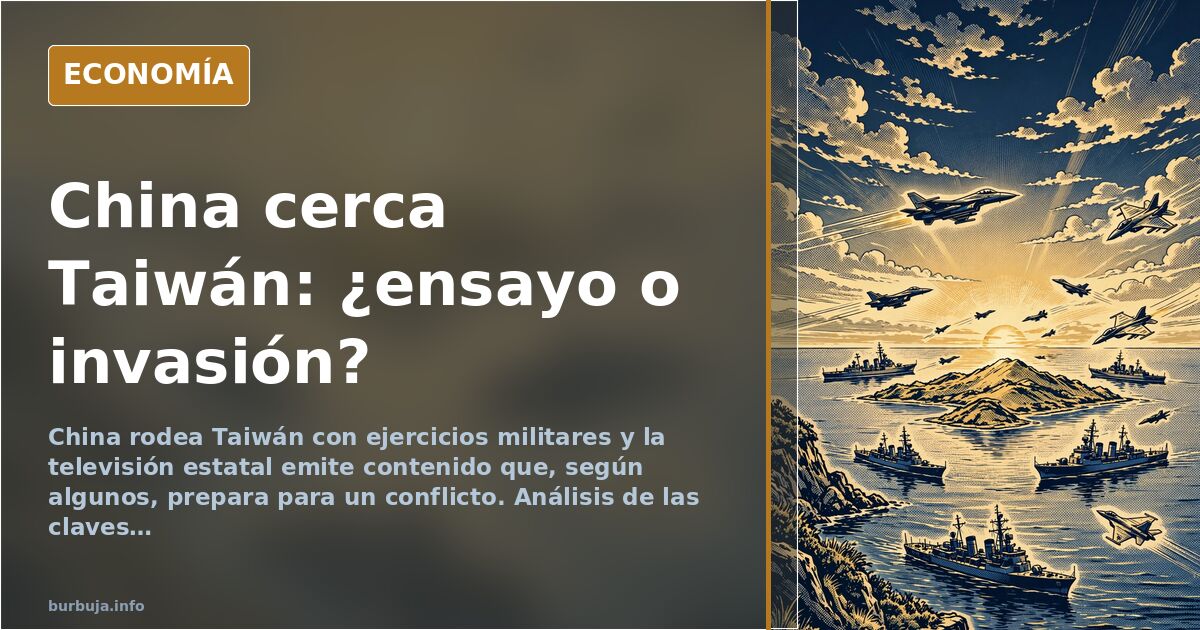
China encircles Taiwan in military drills: rehearsal or invasion?
Is China about to invade Taiwan? This question circulates through forums and headlines whenever Beijing launches military exercises around the island. On this occasion, Chinese state television has broadcast content that, according to some analyses, prepares the population for a conflict. The maneuvers, which completely surround Taiwanese territory, have reignited the debate over whether they are a dress rehearsal or an isolation operation designed to force surrender without firing a shot.
The answer is not simple. While some see unmistakable signs of an imminent invasion, others recall that China repeats similar exercises every six months. Far from being a mere exchange of opinions, the discussion has evolved into an analysis of geopolitics, economics, and military strategy where data is scarce and speculation abounds.
Why does China surround Taiwan with military exercises?
China considers Taiwan an inseparable part of its territory, a position it has maintained since the founding of the People's Republic. According to the most widespread interpretation, the maneuvers around the island aim to pressure Taiwanese authorities and deter any move toward independence. Beijing does not recognize the Taipei government as a sovereign entity and labels any attempt at separation as a red line.
On the military front, the exercises serve to test blockade capabilities. Surrounding the island by sea and air requires coordinating naval, air, and missile forces, something China has refined over the last decade. The question is whether these maneuvers are an end in themselves or a preliminary step to real action. State television has aired reports that, according to some observers, harden the tone and prepare public opinion for a conflict scenario.
Economics also plays a role. Taiwan is a key player in the global semiconductor supply chain. Any disruption in chip production would have a domino effect on the worldwide tech industry. Therefore, some analysts argue that China prefers peaceful annexation through economic and diplomatic pressure rather than an invasion that would destabilize markets. The mutual commercial dependence between China and Taiwan is profound: many Taiwanese companies have factories on the mainland and vice versa.
Is an invasion imminent or just routine exercise?
Recent history offers arguments for both sides. China has conducted similar exercises repeatedly, and in most cases, they have not led to an invasion. Some point out that exercises recur every six months, involving blockades lasting six or seven days, and so far, they have never gone beyond that. Others, however, note that frequency and scale have increased, and official rhetoric has become more aggressive.
A middle ground suggests China is testing the international community's reaction. If there is no strong response, Beijing could gradually encircle Taiwan, expanding effective control without needing a landing. This salami-slicing strategy, as some analysts call it, would avoid open war and allow China to advance without direct military cost.
The United States' position is another factor. Although Washington does not recognize Taiwan's independence, it maintains security commitments with the island. The doubt is whether it would intervene in case of conflict. Some participants in the debate argue that NATO would simply say OK and there would be no war over what happens in the South China Sea. Others believe an attack on Taiwan would trigger a global response.
The economic impact of a blockade on Taiwan
Taiwan produces most of the world's advanced chips. A naval or aerial blockade would halt exports and affect sectors such as automotive, consumer electronics, and artificial intelligence. Semiconductor shortages were already experienced during the pandemic, with effects lasting months. A conflict in the Taiwan Strait would multiply that problem.
The debate mentions that China might be seeking to push the United States away from its sphere of influence. Annexing Taiwan would have not only symbolic value but also strategic importance: it would give China control over one of the world's most important maritime routes and allow it to project power toward the Pacific.
Technological dependence is a double-edged sword. China needs Taiwanese chips for its own industry, and Taiwan needs the Chinese market for its exports. That interdependence has acted as a brake on escalation, but it is not a guarantee. If Beijing decides the cost of non-unification exceeds that of an invasion, the calculation could change.
What can happen now?
Options range from continued military pressure to large-scale operations. Most analyses agree that an immediate invasion is unlikely but do not rule out China taking advantage of a favorable international context to make a move. The war in Ukraine has diverted Western attention and resources, which some view as an opportunity window for Beijing.
Peaceful unification, trinc the Hong Kong and Macao model, remains China's preferred scenario, according to several analysts. But that model implies Taiwan accepts the One-China principle, something the Taiwanese population largely rejects. The diplomatic path seems stalled.
Meanwhile, military exercises continue. Each maneuver raises tension and brings closer the possibility of a miscalculation. An accidental incident between Chinese and Taiwanese forces could trigger an unwanted escalation. It is the risk nobody wants to mention aloud.
In the end, the question remains unanswered. China has the military capacity to invade Taiwan but also reasons not to do so. Global economy, international pressure, and human cost are weighing factors. What is clear is that the standoff is not over. And each new military exercise reminds us that the ball is still in China's court.
Also available in: Deutsch
Summary of a discussion on Burbuja.info - Foro de economía, actualidad y política., translated from Spanish and reviewed before publication. Read the full discussion (127 replies).
More summaries
-
Chinese AI Challenges Western Tech Dominance
Chinese AI challenges Western tech giants with powerful open-source models.
-
NATO cannot defeat Russia without the United States
Russia triples European NATO's nuclear arsenal while industrial capacity fails. Without the US, the Alliance is hollow.
-
Spain's Ceuta Crisis: Espinar Blames Morocco, Israel and US
Ramón Espinar accuses Morocco of orchestrating the Ceuta border crisis with support from Israel and the United States.
-
Depression and precarity: The wall attitude cannot break
A forum user argues depression arises when expectations clash with reality; others respond that positive attitude is not enough.
-
Former employees accuse Tesh Sidi of workplace harassment
Former employees accuse Tesh Sidi, the number two of Frente Amplio, of workplace harassment and degrading treatment. The case calls the party's coherence into question.
-
US deal: Spain takes in 500 Nicaraguans as complaints mount over programme
Spain's government receives 500 Nicaraguans under an agreement with the US while earlier arrivals report lower wages and unpaid benefits.