
Chess and Catan: No Board Game Wins Them All
Chess costs from €3, original Scrabble was 5,000 pesetas. The best board game depends on rivals and player count, with no single winner.
English · Original discussion in Spanish · Published
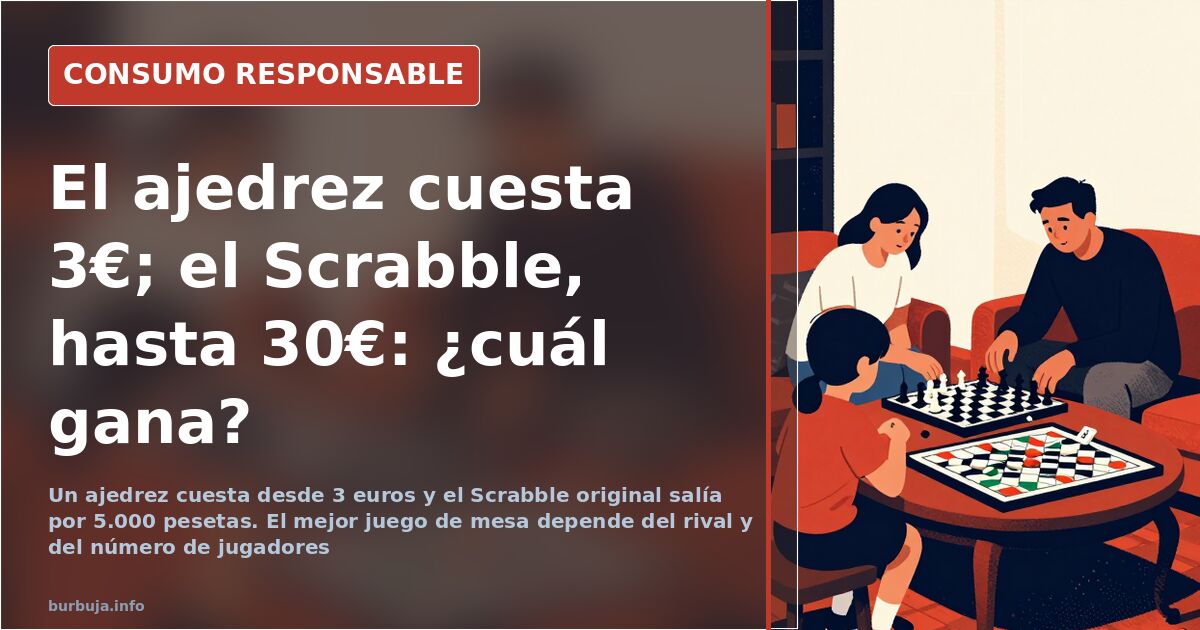
The Best Board Game: From Chess to Catan, No Winner
There is no single best board game. There is only the best game for each table, player count, and patience. The question returns whenever someone wants to pick a gift, and the honest answer almost always disappoints: it depends. It depends on whether you play alone, with two, with six and shots, or if the person opposite has spent twenty years studying openings. Any closed answer is just advertising.
Price Doesn’t Decide: €3 Chess vs. 5,000 Pesetas Scrabble
One of the strongest arguments in favor of classics is that they cost almost nothing. You can find a chess set from €3, and from there the material is infinite: books, online matches, free and paid tournaments. Some built their own games with cardboard and markers when there was no money for more: lonchafinismo applied to Hero Quest, including a hand-painted board.
Nostalgia puts concrete prices. An original Scrabble cost about 5,000 pesetas; its cheap Falomir copy, Intelect, was 1,000 pesetas and made in Valencia. Today, Scrabble is still found for about €25 or €30. Practically the same money, another economy, and the same after-dinner debate.
Why is chess the best game for some and a bore for others?
Because its quality depends not on the board, but on who sits opposite. It is attributed with billions of matches played and has accumulated much study material, free or not, but it works poorly in casual encounters: a beginner can be crushed in fifteen moves, with their own boredom and someone else’s despair, and in a club the relationship flips instantly. Added to that, only two people play.
With any other box, however, you open it, explain four rules, and a decent game comes out. Some defend that chess’s intellectual fame is an inherited story rather than a proven fact. That might be its biggest problem: less intelligence festival and more difficulty finding a rival at your level.
From Operando and Who’s Who to Rithmomachia
Childhood games hold up. Those from the MB house —Operando, Who’s Who— and Falomir copies fed a generation now around fifty. Alongside them, parchís, mus, teto, abalone, mancala, or the dictionary game, the most reliable for five or six people in a countryside house.
Not everything is recent nostalgia. The Rithmomachia, a classic board game, sneaks in as proof that the hobby of moving pieces comes from far back. And there’s always the card deck, the Swiss Army knife of board games, capable of sustaining an entire night with no investment other than the deck itself.
Puerto Rico, Catan, and the Generation that Outcircles Monopoly
Modern games have fierce defenders. Puerto Rico explains itself in a test match and then goes fast, between 30 and 45 minutes, minimum three players and four is better, without dice and with room to change strategy. Catan is among the most popular in recent years. Next to it, Wingspan, Everdell, Terraforming Mars, Dominion, or Mansions of Madness expand the catalog far beyond dice and squares.
The complaint about Monopoly is recurrent: by the second match, it’s already stored away. The underlying criticism is that it’s recommended by memory, not quality, and that games with merchant themes —Chinatown, Genova— do the same with more grace and much more replayability.
Wargames, Role-Playing, and Cards: The Question Missing Before Recommending
Without fixing the style, any recommendation is superfluous. A military strategy game doesn’t resemble a resource management game or a twenty-minute filler. Wargames are sorted by scale —squad, army— and by era, and there are many unplayable titles due to cumbersome rules. Twilight Struggle plays in that league, although its theme could be anything else.
At the emotional extreme is Diplomacy, a game of alliances and betrayals where the match begins as friendship and ends in tense silence. Role-playing games offer infinite possibilities. And in collectible cards, the memory is tinged with toxicity and thefts in clubs and tournaments, with the emergence of new titles trying to correct old vices.
With this panorama, it’s reasonable that there’s still no champion. If the trend continues, cheap classics will survive in homes, and modern games will continue gaining ground among those who dare read a rulebook. Although, judging by how certain matches end, perhaps the best board game is the one played with friends who remain so afterward.
There is no single best board game. There is only the best game for each table, player count, and patience. The question returns whenever someone wants to pick a gift, and the honest answer almost always disappoints: it depends. It depends on whether you play alone, with two, with six and shots, or if the person opposite has spent twenty years studying openings. Any closed answer is just advertising.
Price Doesn’t Decide: €3 Chess vs. 5,000 Pesetas Scrabble
One of the strongest arguments in favor of classics is that they cost almost nothing. You can find a chess set from €3, and from there the material is infinite: books, online matches, free and paid tournaments. Some built their own games with cardboard and markers when there was no money for more: lonchafinismo applied to Hero Quest, including a hand-painted board.
Nostalgia puts concrete prices. An original Scrabble cost about 5,000 pesetas; its cheap Falomir copy, Intelect, was 1,000 pesetas and made in Valencia. Today, Scrabble is still found for about €25 or €30. Practically the same money, another economy, and the same after-dinner debate.
Why is chess the best game for some and a bore for others?
Because its quality depends not on the board, but on who sits opposite. It is attributed with billions of matches played and has accumulated much study material, free or not, but it works poorly in casual encounters: a beginner can be crushed in fifteen moves, with their own boredom and someone else’s despair, and in a club the relationship flips instantly. Added to that, only two people play.
With any other box, however, you open it, explain four rules, and a decent game comes out. Some defend that chess’s intellectual fame is an inherited story rather than a proven fact. That might be its biggest problem: less intelligence festival and more difficulty finding a rival at your level.
From Operando and Who’s Who to Rithmomachia
Childhood games hold up. Those from the MB house —Operando, Who’s Who— and Falomir copies fed a generation now around fifty. Alongside them, parchís, mus, teto, abalone, mancala, or the dictionary game, the most reliable for five or six people in a countryside house.
Not everything is recent nostalgia. The Rithmomachia, a classic board game, sneaks in as proof that the hobby of moving pieces comes from far back. And there’s always the card deck, the Swiss Army knife of board games, capable of sustaining an entire night with no investment other than the deck itself.
Puerto Rico, Catan, and the Generation that Outcircles Monopoly
Modern games have fierce defenders. Puerto Rico explains itself in a test match and then goes fast, between 30 and 45 minutes, minimum three players and four is better, without dice and with room to change strategy. Catan is among the most popular in recent years. Next to it, Wingspan, Everdell, Terraforming Mars, Dominion, or Mansions of Madness expand the catalog far beyond dice and squares.
The complaint about Monopoly is recurrent: by the second match, it’s already stored away. The underlying criticism is that it’s recommended by memory, not quality, and that games with merchant themes —Chinatown, Genova— do the same with more grace and much more replayability.
Wargames, Role-Playing, and Cards: The Question Missing Before Recommending
Without fixing the style, any recommendation is superfluous. A military strategy game doesn’t resemble a resource management game or a twenty-minute filler. Wargames are sorted by scale —squad, army— and by era, and there are many unplayable titles due to cumbersome rules. Twilight Struggle plays in that league, although its theme could be anything else.
At the emotional extreme is Diplomacy, a game of alliances and betrayals where the match begins as friendship and ends in tense silence. Role-playing games offer infinite possibilities. And in collectible cards, the memory is tinged with toxicity and thefts in clubs and tournaments, with the emergence of new titles trying to correct old vices.
With this panorama, it’s reasonable that there’s still no champion. If the trend continues, cheap classics will survive in homes, and modern games will continue gaining ground among those who dare read a rulebook. Although, judging by how certain matches end, perhaps the best board game is the one played with friends who remain so afterward.
Summary of a discussion on Burbuja.info - Foro de economía, actualidad y política., translated from Spanish and reviewed before publication. Read the full discussion (286 replies).
More summaries
-
Hussars: quality menswear or just posturing?
Hussars review: natural fabrics, local manufacturing, and straight fit versus criticism for its controversial cut and self-promotion. Is it worth the price?
-
The €3.61 Fee Killing AliExpress Purchases
The €3.61 per-category tariff has inflated AliExpress purchases by up to 80%. Consumers are stopping buys, and revenue is falling. Does it actually protect...
-
Gift Ideas for a 25-Year-Old on a 50-Euro Budget
Discover practical gift suggestions for a 25-year-old with 50 euros, including Swiss army knives and cash, while understanding why this budget is limited.
-
Keto diet trend in US raises questions about its arrival in Spain
The ketogenic diet, popular in the US, promises fat burning. Debate continues over its safety and potential spread to Spain.
-
City Penthouse or Suburban Townhouse: Which Suits You Best?
A 170 sqm city penthouse for €170,000 versus a four-story suburban townhouse with a pool for €190,000. The choice depends on lifestyle priorities.
-
Toyota cuts hybrid battery size in half, raising price
The new Corolla uses a 0.7 kWh battery, costs 6,000 euros more than the Auris, and challenges diesel efficiency in modern hybrid vehicles.