
Cheap vegetables vs. supermarket margins: A 100-euro gap
A forum user compares a 100-euro neighborhood vegetable purchase to supermarket prices, highlighting the commercial margin and bypassing intermediaries.
English · Original discussion in Spanish · Published
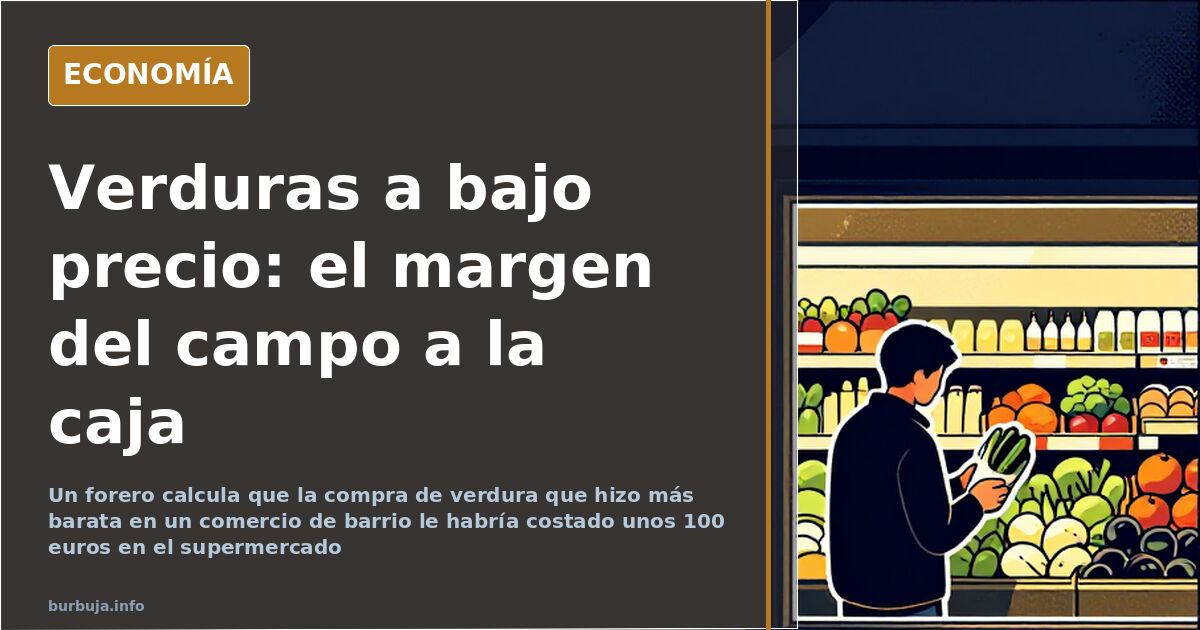
Bargain vegetables vs. supermarket margins
A neighborhood purchase of tomatoes, cucumbers, zucchini, and peppers made at a price significantly lower than supermarkets has sparked a debate. A Basque resident claims to have bought these from an immigrant-run shop, noting the contrast with what the same load would cost in a supermarket chain: around 100 euros. This price difference explains why some consumers are shifting away from conventional channels.
Zucchini: 10 cents at origin to 1.75 euros at checkout
The most concrete figure comes from a participant regarding zucchini: 10 cents per kilo at origin and 1.75 euros in large-scale distribution. Someone who claims to have cultivated hundreds of cubic meters states, “Zucchini should never cost more than 1 euro per piece.” Their diagnosis points not to farming but to demand: the problem is not the price, but that almost no one makes preserves, requiring fresh produce 365 days a year.
Discarded vegetables are not always waste
According to participants, some cheap produce is not expired: fruit and vegetables that do not meet size or shape standards are diverted to canneries, prepared food businesses, and discounted markets. A regular buyer explains that suppliers notify them when batches arrive, allowing for gazpachos, pistos, and smoothies at bargain prices.
Not everyone believes it. The most repeated objection is logistical: 40 kilos of vegetables do not fit in a domestic fridge, so either there is a second fridge, or the figure is fake. Suspicion about the story’s veracity runs through the thread, though others report similar purchases.
Can you eat vegetables bought outside the controlled circuit?
Here, the debate shifts from price to health risks. Farmers argue that pesticides are used with controlled safety periods so residues disappear before harvest. The issue arises when produce leaves the field through irregular channels, reaching consumers without traceability or guarantee that safety periods were respected. One participant mentions DDT, banned in Europe decades ago but still used in some African productions.
It is important not to confuse the warning with an accusation. There is no proof that cheap produce is contaminated, only the warning that the informal channel offers the least verification. The recurring joke among buyers—dying “of DDT inside 15 days”—summarizes the mix of skepticism and indifference with which the risk is assumed.
The farmer’s account: subsidies, SUVs, and houses in the hills
The other side is the story of ruin in the primary sector. Some question this with signs of income: EU subsidies, discounted diesel, new SUVs, and second homes. The uncomfortable conclusion is that those who can spend on non-essentials are not as close to the abyss as they claim.
The response from the field is the opposite: production is lost, stolen from recently sprayed plots, and resold later in markets. Between one thesis and another, there is no statistic to settle the dispute, only opposing experiences and growing mutual distrust.
Who really buys from Spanish farmers?
Against the idea that neighborhood shops rely solely on imports, another participant argues that most Spanish production goes to foreign chains, gourmet stores, and Segarro buyers. It is more likely to find local produce in small commerce than in large supermarkets. If true, the buyer of cheap vegetables is not choosing between national and imported, but between two ways of distributing the same goods.
The savings may compensate. It may turn out expensive later, or the channel may close as circumstances change. What the thread makes clear is that the gap between farm price and checkout price—the commercial margin rarely discussed in relation to the shopping basket—is large enough for alternatives to continue emerging around it.
Summary of a discussion on Burbuja.info - Foro de economía, actualidad y política., translated from Spanish and reviewed before publication. Read the full discussion (289 replies).
More summaries
-
Row in Spain's Basque Country over migrants used as cannon fodder
An image of migrants at a protest linked to the Basque pro-independence movement has reignited the debate over their use as human shields and political tensions in the Basque Country.
-
Basque Country: The Wealth Gap and the Criticism It Attracts
The Basque Country boasts Spain's second-highest GDP per capita but faces backlash over prices, attitudes, and politics.
-
Riots at Milan's Duomo: looting and rent protest
Riots broke out at Milan's Duomo: looting, stones thrown at the cathedral and a rent protest that Meloni's government is failing to address.
-
Lancia Gamma from €39,900 in Spain: forum questions the price
The Lancia Gamma starts at €39,900 in Spain, and the forum questions the price of a mainstream car with premium ambitions. One user claims they won't sell, only lease…
-
Saudi Arabia: unrest, failed coup and doubts over the official story
Unrest in Saudi Arabia, an alleged failed coup against Bin Salman and doubts about the axis with Pakistan and Turkey: the circulating, unconfirmed story
-
Morocco in talks with Israel over missiles that could reach Spain's Canary Islands
Morocco is negotiating with Israel the purchase of LORA missiles capable of reaching the Canary Islands, Seville, Murcia or Ciudad Real, according to a report by El Español.