
Charlie Sheen on The Wild Project: the interview nobody knows how they landed
Charlie Sheen sits down on The Wild Project episode 387, sparking more questions about how the interview was arranged than about its content. The language barrier and the…
English · Original discussion in Spanish · Published
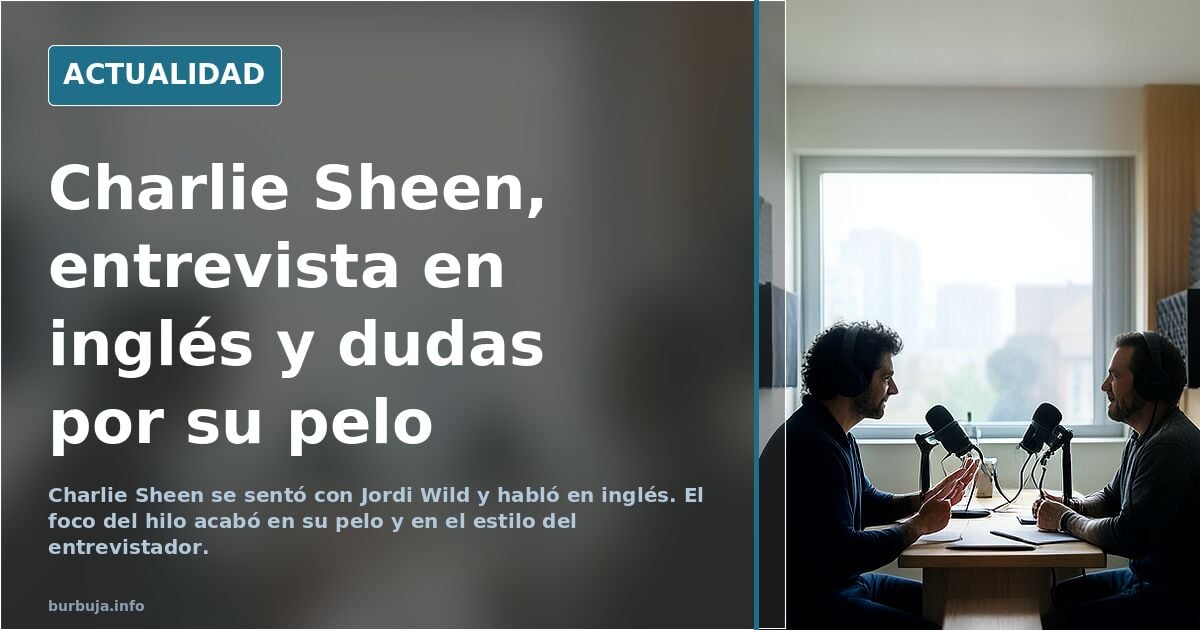
Charlie Sheen on The Wild Project: the interview nobody knows how they landed
A Hollywood actor with decades of scandals behind him sits down with a Spanish podcaster. The result, episode 387 of The Wild Project, has raised more questions about the logistics than about the content. The first: how did Jordi Wild land a figure of that caliber? The second, more uncomfortable: why does the conversation take place in English when both could have spoken Spanish?
The episode has become a small case study of the Spanish podcast ecosystem. Some call it historic, others dismiss it as histrionic. Reactions range from enthusiasm to outright rejection, and at the center remains a question nobody quite answers: what do interviews like this actually bring to the format?
Why is the interview in English if both speak Spanish?
The language barrier is the first obstacle cited by those who have watched the episode. Sheen is American and doesn't speak Spanish; Wild, as the interviewer, adapts to his guest's language. The decision makes professional sense, but for part of the audience it takes away from the format's natural flow. The result is a conversation some describe as uncomfortable to watch, with a rhythm that never quite clicks.
The problem isn't just linguistic. Some point out that the interviewee appears to be under the influence of some substance, a perception repeated in several comments that should be treated with caution: there is no confirmation whatsoever. What is a fact is that the conversation feels tense, with pauses and an interviewer who seems to be managing more than he controls.
Jordi Wild's style: charisma or overacting?
Wild is a divisive figure. For some, he's the biggest name in Spanish interview podcasts; for others, a character who overacts and whose editorial line is lukewarm mainstream to the point of being bland. The most recurring criticism targets a production that prioritizes the persona over the content, with a segarro lifestyle aesthetic that some read as artificial.
The truth is that episode 387 has acted as an amplifier of that tension. The choice of Sheen as a guest is no accident: he's a name that generates clicks, has history, and carries a biography turbulent enough to sustain an hour of conversation. The question is whether the format can bear that weight without becoming a mere exercise in style.
Carlos Estévez's toupee and other tangents
The conversation drifted into unexpected territory. One of them: hair. The comparison between an accepted baldness and a synthetic toupee served to introduce a side debate about authenticity and public image. Some argue that a society that rewards the wig over the bare forehead has a problem with its priorities. It's a digression, but it says something about the episode's tone.
The question of nationality also came up. There has been speculation that Sheen might qualify for Spain's law of grandchildren (a Spanish law granting citizenship to descendants of exiled Spaniards) through an alleged exiled grandfather, a hypothesis nobody has confirmed and which was floated without any documentation. It's the kind of comment that illustrates the general tone: more speculation than verification.
What remains of The Wild Project 387
The episode leaves a bittersweet feeling. On one hand, confirmation that Spanish podcasting has reached a drawing power unthinkable a decade ago: getting Charlie Sheen into a studio is a logistical milestone. On the other, doubt over whether the format is ready to handle that level of guest without the conversation becoming an artifact that's hard to digest.
The audience is split between those who see another step in the medium's professionalization and those who detect an exercise in posturing. What is beyond dispute is that the episode has generated conversation, and in today's ecosystem, that's the metric that counts.
How many of these interviews will stand the test of time, and how many will end up in the archive of curiosities?
Summary of a discussion on Burbuja.info - Foro de economía, actualidad y política., translated from Spanish and reviewed before publication. Read the full discussion (16 replies).
More summaries
-
Jordi Wild interviews Jesús G. Maestro: controversy and egos
Jordi Wild interviews Jesús G. Maestro: criticism for using Hitler as an example, accusations of clashing egos and defenses of dialogue. Historic or long-winded?
-
Spain's Aug 1 census and 'Grandchildren Law' explain Nov 29 election date
The electoral roll closed on August 1 and Supreme Court interim measures against the 'Grandchildren Law' allegedly dictate Spain's November 29 election date.
-
Tent Collecting Food for Ceuta Ends Up Eating It
Food and money collected for Ceuta migrants were consumed by organizers. The destination of the funds remains unknown.
-
The thesis blaming the welfare state for women's prostitution
One argument claims that without welfare benefits, women would sell themselves for a mess of pottage. The counterargument: the calculation is the same as that of the lifelong opposition claimant.
-
PSOE and Sumar slip the grandchildren law into an education reform
Spain's PSOE and Sumar have added the grandchildren law to an education reform bill. The PP calls it a "legal botch job", with estimates circulating of 3 to 5 million potential beneficiaries.
-
France in flames: student riots and schools set on fire
Schools set on fire and student riots in France: the viral video against the RN, the shadow of 2005 and the unproven hypotheses.