
Charlie Kirk's OnlyFans Debate Ends in Murder
Charlie Kirk debated OnlyFans creators about life changes before being killed. The video sparks debate between viewing him as a martyr or a self-proclaimed savior.
English · Original discussion in Spanish · Published
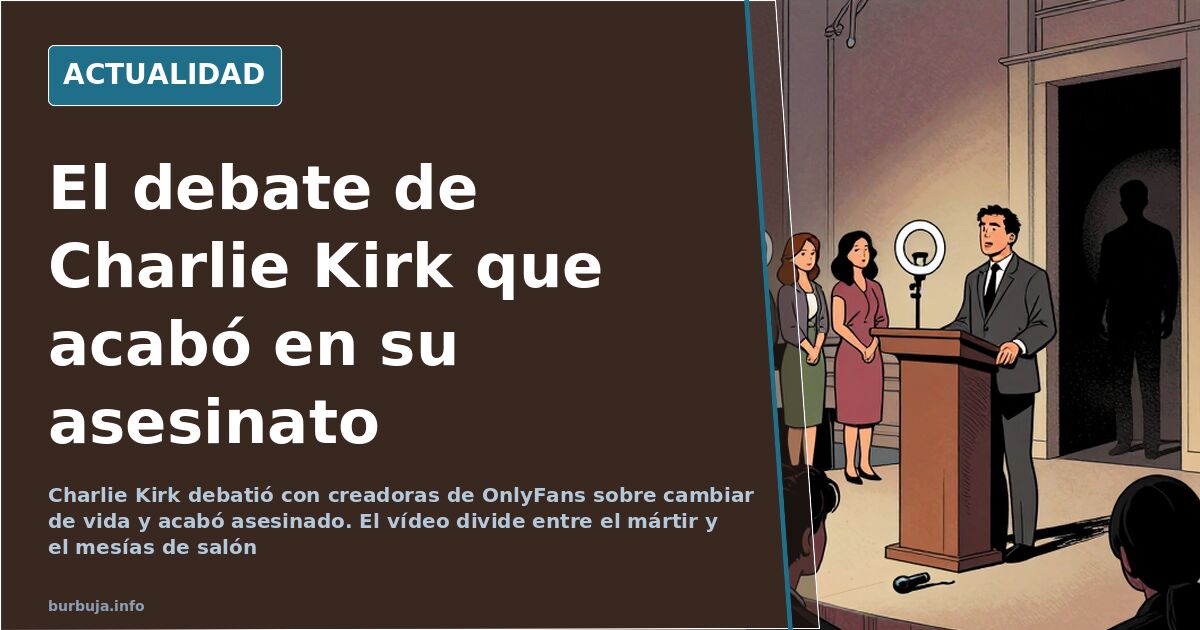
Charlie Kirk: From OnlyFans Debate to Murder
Charlie Kirk sat across from a group of adult content creators, telling them that "every day is a new day," that "we all make mistakes," and that it was always time to change their lives. Weeks later, the American host was dead. The footage of that exchange—without insults, looking them in the eye, invoking the Holy Spirit—now circulates as material with which one side elevates him to martyr and the other labels him a living-room messiah. Almost no one stays in the middle.
The scene was recorded before his murder and summarizes his method: entering hostile territory, keeping his manners, and delivering the sermon. From there comes all the subsequent noise, and from there arises the question no one closes: does what he said weigh more, or who he was?
What Charlie Kirk Said to OnlyFans Creators
The core message was a variant of Christian fraternal correction: no one is perfect, we are all sinners, and each day offers the opportunity to reorder one's life. Kirk wrapped it in a gentle tone, without raising his voice, which some read as genuine respect and others as a manual technique to look good on camera.
The most repeated rebuttal is that this discourse helps no one. That it is a stock phrase, recited before women who earn more than him, and that it sounds like posing. The opposing defense holds that inviting someone to improve, from respect and without contempt, is one of the most positive things you can tell a person. Two readings of the same minute of video, and neither yields.
The OnlyFans Business: Who Pays and Who Earns
Money occupies the center of the conversation. It is recalled that the creators earn amounts Kirk himself would not see in several lifetimes, and it is answered that billing says nothing about the sarracena of an activity: the case of a well-known drug trafficker who moved more money than anyone and destroyed thousands of families is brought up. The volume of cash is not an ethical endorsement.
The other flank points to the consumer. Several messages point to those who pay for that content as the true victims, trapped in a loop that robs them of the ability to build a stable relationship and leaves them increasingly alone. It is a judgment on the market, not on the seller.
The Religious Message: Fraternal Correction or Messianism
Here the matter gets tangled. Kirk came to say that he spoke through him the Holy Spirit, and that ignited half the audience: some see it as an unbearable pose, while others recall that invoking the Holy Spirit is, for a believer, something that deserves respect by default.
The exchange drifted into after-dinner theology. They spoke of the style of evangelical churches—few sacraments, direct relationship with the divine, all sinners, and salvation by faith and not by works—and of a business not to be sneezed at around mega-churches. And the classic problem was discussed: if God has a plan for each person, does free will remain? For some, it is comfort; for others, a puppet with a mustache.
The Channel Format and the Audience Bait
Programs that organize these face-to-face encounters live off an old trick: sitting attractive women in front of a guy who wants to prove that, besides body, they have brains. The morbid fascination does the marketing work, and serious conversation becomes spectacle. Recognizing this does not invalidate the participants; it only explains why the video is shared so much.
Charlie Kirk's Death and the Theories Surrounding It
Kirk's murder, which had the declared appreciation of Donald Trump, has fueled two parallel narratives. The first turns him into a symbol: a man moderate in manner whom the other side would have celebrated seeing fall. The second moves in the realm of suspicion and rumor.
In that second narrative appear claims circulating without evidentiary backing: that the US Congress voted to deny the publication of the Epstein list three hours after the crime, or that 250 legislators coincided that same weekend in Israel. These are conjectures chained together as if they were clues. None has proof supporting it, and repeating them does not turn them into facts.
Why the Case Divides So Much
The episode works as a mirror. Viewed from faith, Kirk extended a hand to those he considered lost. Viewed from skepticism, a guy with a microphone distributed sarracena, mocked the format he himself used, and yet came out better off than, in the judgment of his critics, he deserved.
The striking thing is that almost no one disputes the video itself. They dispute what it means. And as soon as the conversation jumps from content to meaning, any possibility of agreement ends. Some see a gesture of compassion; others, an act of marketing with borrowed Satan.
With the host buried and the discussion more alive than ever, the uncomfortable doubt remains: when someone says they want to save you, are they extending a hand to you or placing themselves above you?
Charlie Kirk sat across from a group of adult content creators, telling them that "every day is a new day," that "we all make mistakes," and that it was always time to change their lives. Weeks later, the American host was dead. The footage of that exchange—without insults, looking them in the eye, invoking the Holy Spirit—now circulates as material with which one side elevates him to martyr and the other labels him a living-room messiah. Almost no one stays in the middle.
The scene was recorded before his murder and summarizes his method: entering hostile territory, keeping his manners, and delivering the sermon. From there comes all the subsequent noise, and from there arises the question no one closes: does what he said weigh more, or who he was?
What Charlie Kirk Said to OnlyFans Creators
The core message was a variant of Christian fraternal correction: no one is perfect, we are all sinners, and each day offers the opportunity to reorder one's life. Kirk wrapped it in a gentle tone, without raising his voice, which some read as genuine respect and others as a manual technique to look good on camera.
The most repeated rebuttal is that this discourse helps no one. That it is a stock phrase, recited before women who earn more than him, and that it sounds like posing. The opposing defense holds that inviting someone to improve, from respect and without contempt, is one of the most positive things you can tell a person. Two readings of the same minute of video, and neither yields.
The OnlyFans Business: Who Pays and Who Earns
Money occupies the center of the conversation. It is recalled that the creators earn amounts Kirk himself would not see in several lifetimes, and it is answered that billing says nothing about the sarracena of an activity: the case of a well-known drug trafficker who moved more money than anyone and destroyed thousands of families is brought up. The volume of cash is not an ethical endorsement.
The other flank points to the consumer. Several messages point to those who pay for that content as the true victims, trapped in a loop that robs them of the ability to build a stable relationship and leaves them increasingly alone. It is a judgment on the market, not on the seller.
The Religious Message: Fraternal Correction or Messianism
Here the matter gets tangled. Kirk came to say that he spoke through him the Holy Spirit, and that ignited half the audience: some see it as an unbearable pose, while others recall that invoking the Holy Spirit is, for a believer, something that deserves respect by default.
The exchange drifted into after-dinner theology. They spoke of the style of evangelical churches—few sacraments, direct relationship with the divine, all sinners, and salvation by faith and not by works—and of a business not to be sneezed at around mega-churches. And the classic problem was discussed: if God has a plan for each person, does free will remain? For some, it is comfort; for others, a puppet with a mustache.
The Channel Format and the Audience Bait
Programs that organize these face-to-face encounters live off an old trick: sitting attractive women in front of a guy who wants to prove that, besides body, they have brains. The morbid fascination does the marketing work, and serious conversation becomes spectacle. Recognizing this does not invalidate the participants; it only explains why the video is shared so much.
Charlie Kirk's Death and the Theories Surrounding It
Kirk's murder, which had the declared appreciation of Donald Trump, has fueled two parallel narratives. The first turns him into a symbol: a man moderate in manner whom the other side would have celebrated seeing fall. The second moves in the realm of suspicion and rumor.
In that second narrative appear claims circulating without evidentiary backing: that the US Congress voted to deny the publication of the Epstein list three hours after the crime, or that 250 legislators coincided that same weekend in Israel. These are conjectures chained together as if they were clues. None has proof supporting it, and repeating them does not turn them into facts.
Why the Case Divides So Much
The episode works as a mirror. Viewed from faith, Kirk extended a hand to those he considered lost. Viewed from skepticism, a guy with a microphone distributed sarracena, mocked the format he himself used, and yet came out better off than, in the judgment of his critics, he deserved.
The striking thing is that almost no one disputes the video itself. They dispute what it means. And as soon as the conversation jumps from content to meaning, any possibility of agreement ends. Some see a gesture of compassion; others, an act of marketing with borrowed Satan.
With the host buried and the discussion more alive than ever, the uncomfortable doubt remains: when someone says they want to save you, are they extending a hand to you or placing themselves above you?
Also available in: Deutsch
Summary of a discussion on Burbuja.info - Foro de economía, actualidad y política., translated from Spanish and reviewed before publication. Read the full discussion (233 replies).
More summaries
-
Trump announces 'permanent control' over Greenland
Trump announces 'permanent control' over Greenland after an agreement with Denmark; according to one participant, the text must pass through parliaments.
-
Donald Trump Slams Harry and Meghan After Their Return to the UK: “If I Were in the Royal Family, I Wouldn't Have Accepted Them”
Donald Trump criticizes Harry and Meghan, stating he wouldn't have accepted them if he were part of the royal family. Discover his reasons.
-
Ketamine: the drug slipping through Spain's DGT drug tests
In the Balearic Islands, saliva tests fail to detect ketamine, and professional drivers use it to evade police checks. The system's loophole...
-
First mpox death in Basque Country reported at Donostia Hospital
A 61-year-old cancer patient died of mpox at Donostia Hospital after contracting it from a roommate, marking the region's first fatality.
-
Brazil: Video shows forced hug of gay man by women
A viral video from Brazil shows men forcing a gay man to hug a woman, sparking debate on homophobia and machismo.
-
Viral claim of 'genocide' in Europe debunked
A viral post claims England dropped from 99% white in 1950 to 77% in 2026, citing similar figures for France and Quebec. Here is what the data actually shows.