
CGT urges Renfe to suspend Israeli security contract
The Spanish union CGT has asked Renfe to suspend its contract with I-SEC, a subsidiary of Israeli group ICTS founded by former Shin Bet members, which guards trains and workshops in Galicia.
English · Original discussion in Spanish · Published
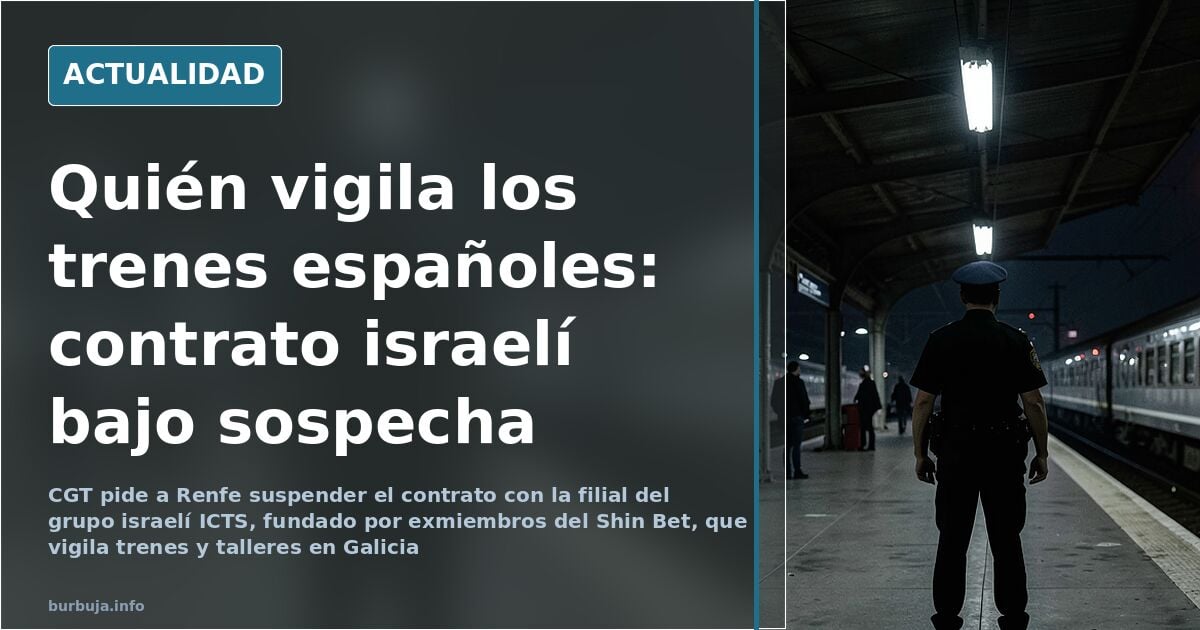
The Israeli contract guarding Renfe's trains
Can a company linked to the intelligence services of a foreign state be entrusted with the security of Spain's rail network? The question stopped being theoretical when CGT's railway branch in Galicia sent a letter to Renfe's chairmanship asking that the contract with **I-SEC Aviation Security SL**, a subsidiary of the Israeli group **ICTS**, founded in 1982 by members of the **Shin Bet**, be suspended. The union claims that this firm guards trains, stations, workshops and sidings on all Galician lines.
The trigger for the unrest is not just the contract. It is the context. In parallel, a message is circulating attributing to **Netanyahu** a threat against Spain —"sudden power cuts and train accidents could occur"— after the Spanish government took Palestine's side. And against that backdrop, the collision of two trains with dozens of deaths in Spain has turned suspicion into raw material for all kinds of theories.
What the contract says and what I-SEC guards
CGT's letter does not mention sabotage or threats. It talks about procurement. According to the union, **I-SEC** provides security and surveillance services on board trains, at stations, in workshops and at other railway infrastructure, with a presence in Galicia through the Galician lines and the maintenance workshops in **Redondela, Ferrol and Ourense**. The union's objection is about its origins: the parent company was founded by former members of Israel's internal security service.
That fact, verifiable in the corporate structure, is the only solid link in the whole chain. Everything else is inference. That a subsidiary of a group with that origin guards Spanish critical infrastructure is a contractual fact; that this makes it an instrument of state revenge is a hypothesis nobody has documented.
The threat attributed to Netanyahu and the accident
The message that has spread on social media mixes two things that should be kept apart: an alleged warning from the Israeli prime minister and the rail accident. The quote —"sudden power cuts and train accidents"— is presented as retaliation for Spain's position in the Palestinian conflict. There is no independent verification of that phrase in the available material, and those spreading it accompany it with a video with no chain of custody.
From there, the reasoning accelerates on its own. If an Israeli company is guarding trains and there has been an accident, coincidence becomes causality. It is the classic leap that turns a security contract into a plot. And it works because the substrate —the contract— is real.
From LZB to "sabotage": how the suspicion was built
The ground where the theory takes hold is technical. It is being argued that the **LZB** system failed in the accident and that the government informed Brussels in May of its replacement. It is also recalled that the CEO of **Iryo** warned weeks earlier that LZB problems on the Madrid-Andalusia line were forcing trains to stop and restart, exactly what peine in the **Urda** accident.
With those ingredients, the conversation splits. Some argue that a state unable to prevent sabotage is a bigger problem than the threat itself; against that weighs the argument that attributing a documented signalling failure to a foreign service means replacing investigation with narrative. And there is a third, more uncomfortable option: that incompetence and the opaque contract are not mutually exclusive.
In the end, the question remains the same as at the beginning, except that it now has a corporate name and surname. Expecting an audit rather than a tweet to provide the answer is, probably, asking too much.
Summary of a discussion on Burbuja.info - Foro de economía, actualidad y política., translated from Spanish and reviewed before publication. Read the full discussion (15 replies).
More summaries
-
Spain blocks Palantir from public contracts over CIA ties
Spain's government has excluded Palantir from public contracts over its links to the CIA, even as the firm already operates with the Spanish military. Sound decision or political gesture?
-
Spain: ex-partner squats man's home for 20 years, leaves after 10-year court battle
Mónica Medina has left her ex-partner's home, actor Emilio, after 20 years of occupation and a 10-year legal battle. The case reopens the debate over Spain's slow courts.
-
Broncano and the ratings: the political business of Spain's public television
Gabriel Rufián and Irene Montero's visit to La Revuelta drew the show's second-highest rating ever, behind only the Pedro Sánchez interview.
-
Scientists track a 3-degree Super El Niño that farmers dread
Pacific buoys are recording surface anomalies above 3 degrees and up to 10 degrees at depth. The Super El Niño is bringing forward lost harvests and floods across South America.
-
Traoré to send minor offenders to state farms instead of prison in Burkina Faso
Captain Ibrahim Traoré has announced that people convicted of minor offences in Burkina Faso will work on state farms instead of serving prison sentences.
-
The webcam goes dark: a model that doesn't add up with 12% rates
A video of virtual sex workers becomes a meme and one participant puts forward a thesis: with the Colombian peso appreciating and rates at 12%, saving…