
Broncano and the ratings: the political business of Spain's public television
Gabriel Rufián and Irene Montero's visit to La Revuelta drew the show's second-highest rating ever, behind only the Pedro Sánchez interview.
English · Original discussion in Spanish · Published
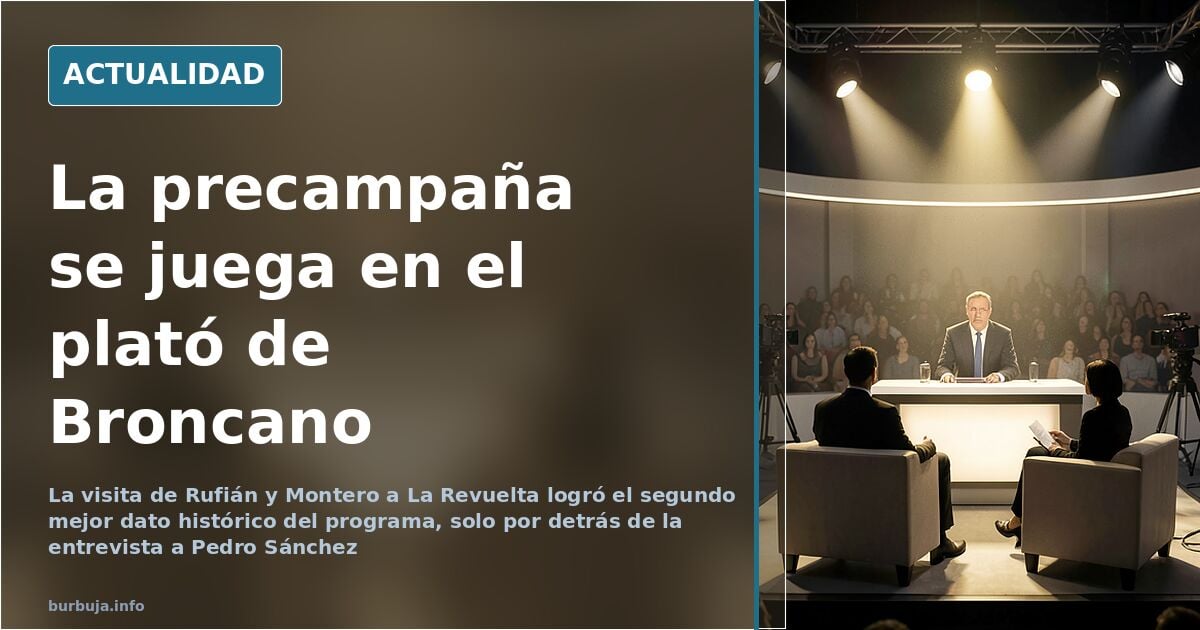
The pre-election campaign is being fought on Broncano's set
Should public money fund interviews that then turn into ratings? Gabriel Rufián and Irene Montero's visit to La Revuelta achieved the show's second-best result in its history, behind only the Pedro Sánchez interview, which was the year's most-watched non-sports broadcast. The figure is no accident: the pre-campaign is being fought on television, and every channel wants its share.
The show's second-highest rating ever
The pairing of the ERC leader and the former Podemos minister appeared together on David Broncano's set, and the result was another ratings smash. With that figure in hand, Pablo Motos's reaction makes more sense: he told his audience in detail how many times his team had contacted Pedro Sánchez's office to secure an interview. The exact number of contacts never came out, but the gesture did: the competition for political guests has become a war of backrooms.
Ratings from curiosity are not ratings from interest
It is worth separating two things that easily get mixed up. Ratings driven by curiosity are not the same as ratings driven by genuine interest. What the audience meter measures is how many televisions are tuned to a channel, not how many viewers are actually paying attention or why. Some argue that the success of these interviews reflects curiosity at seeing two political leaders together on an entertainment show, not real interest in their political platform. Against that weighs the argument that, during a campaign, any minute of screen time is gold, whatever the format.
The fine print of audience measurement
This whole debate rests on blind faith in audience measurement. And there is an open flank there: Kantar has stayed silent about Intxaurrondo's surprising lead during the TVE blackout. If the measurement system has shadows, the record-breaking headlines have them too. The very narrative of success is built on a tool that nobody audits in public.
The pamphlet and public money
The underlying question is what a publicly funded show is for. Part of the analysis holds that La Revuelta is a government pamphlet that whitewashes the Government with friendly interviews; others reply that public television has always served as a platform, and the problem is not the format but who occupies it. Meanwhile, the PSOE has spent eight years without repealing Fátima Báñez's labour reform, the one still in force and the basis for the furlough schemes (ERTE) used during the pandemic. The paradox speaks for itself.
In the end, the ratings war leaves one clear winner: whoever gets the most-watched interview. Everything else, public money included, is fine print.
Summary of a discussion on Burbuja.info - Foro de economía, actualidad y política., translated from Spanish and reviewed before publication. Read the full discussion (16 replies).
More summaries
-
Spain Withdraws Police Protection from Four Ex-Ministers, Sparking Political Fallout
Interior strips security for Iglesias, Montero, Belarra, and Garzón. Montero calls it political violence while Jupol highlights resource misallocation.
-
Irene Montero's Menorca holiday sparks 'caviar left' criticism
Irene Montero and Ione Belarra spend August in Menorca, facing backlash for hypocrisy regarding mass tourism.
-
Spain's Montero urges wiping out right-wing voters and adding migrant votes
Irene Montero called for "sweeping away" right-wing voters and adding migrants so that 500,000 can vote, according to okdiario, at a Podemos rally in Zaragoza, Spain.
-
Spain's Crisis: Real Estate, Politics, and Market Volatility Explained
An analysis of Spain's real estate, economic, and political bubbles, featuring key data from the Ibex 35 and official bank valuations.
-
The Manchego Frankenstein goes viral in Spain. Calls elections.
A tweet celebrates a Frankenstein figure with a Manchego accent as a "wonder". We explain what the Manchego Frankenstein is and why it has gone viral.
-
Scientists track a 3-degree Super El Niño that farmers dread
Pacific buoys are recording surface anomalies above 3 degrees and up to 10 degrees at depth. The Super El Niño is bringing forward lost harvests and floods across South America.