
Ceuta: the push to empty classrooms and its legal cost
The push to empty classrooms in Ceuta, Spain, clashes with truancy law and with an awkward fact: around 70% of families are still sending their children to school.
English · Original discussion in Spanish · Published
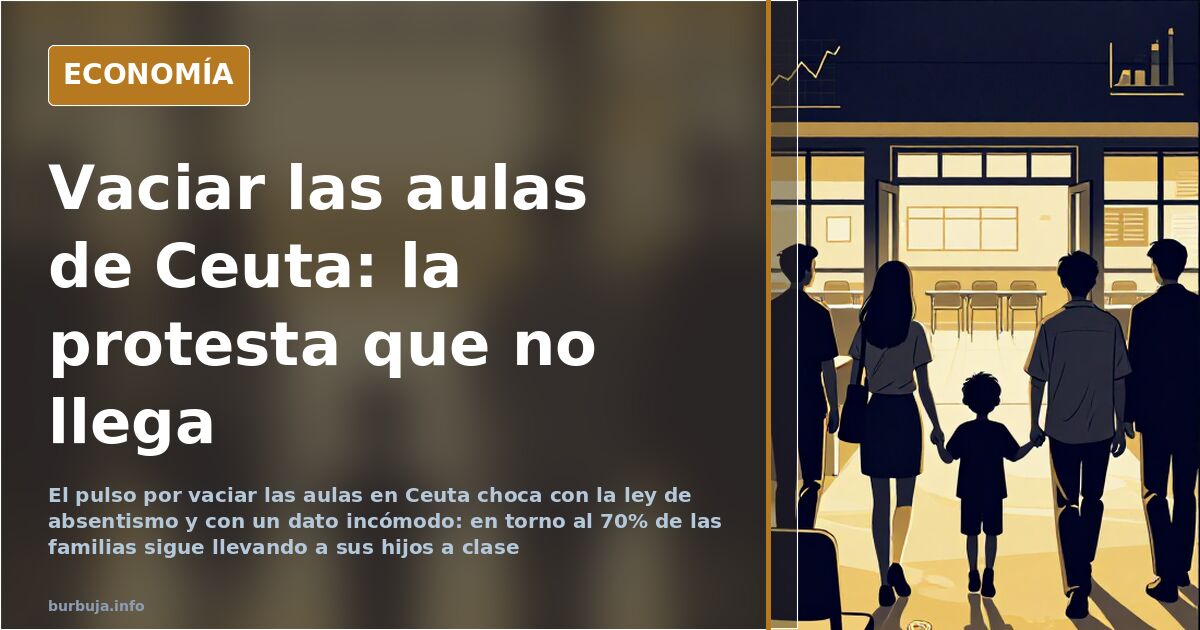
Ceuta: the school boycott nobody dares to call
Keeping children out of school is illegal. And yet, some are putting forward a school boycott as the last lever left to a city that feels abandoned. The logic is textbook: if the conflict cannot be resolved at the top, make it felt at the bottom. The awkward question is what breaks first, the standoff or those who carry it out.
What the truancy rules say
Schooling is compulsory and protest does not appear anywhere as a justified reason for absence. Truancy protocols are triggered with warnings, referrals to social services and, in the most serious and persistent cases, child protection proceedings. The counterargument that circulates most is about public image: no government wants to be seen removing custody from families who say they are protesting. That is where the real asymmetry lies. The pupil pays the cost of the standoff before the administration does.
From an education strike to tax resistance
The second leg is economic: a coordinated tax strike. The figures being floated — 80% of taxpayers joining a tax strike in a city of some 67,000 inhabitants — turn the idea into a theoretical exercise. Pursuing tens of thousands of people at once is beyond the operational capacity of any administration, but the toll on those who stop paying is immediate: surcharges, interest and seizure orders arrive far sooner than any negotiation.
And then comes the fact that deflates the heroics: around 70% of families would keep sending their children to class. The PISA report is cited as a backdrop, though a lost school year does not fix an education system, it makes it worse.
If in the coming weeks the discontent does not crystallise into a formal call with real dialogue, the likely outcome is that classrooms stay full — and so does the anger. The prediction comes with an obvious caveat: few dare to bet against a tired city.
Also available in: Deutsch
Summary of a discussion on Burbuja.info - Foro de economía, actualidad y política., translated from Spanish and reviewed before publication. Read the full discussion (18 replies).
More summaries
-
Educational disaster in Spain: Worst results in history in PISA report, falling up to two school years behind the United Kingdom
Spain plunges in PISA 2025 report, showing a two-year lag in reading compared to the UK. We analyze the causes and consequences.
-
Free social services menu: supermarket surplus and queues
A social services beneficiary shows his free food handout: nearly expired Mercadona potatoes, cherries and expired rice. Surplus, queues and dignity in Spain.
-
Social Services Debate Heats Up After Crime Involving Minors
Analysis of ideological polarization following a crime involving a social worker and state-guarded minors, highlighting the clash between protective measures and criminal responsibility.
-
Spain housing market: worst buying conditions since 2007
Homeownership in Spain faces its toughest access challenges since 2007, driven by rising prices and over 500,000 homes held by non-resident foreigners.
-
Spain's pensioners are turning out en masse to defend their pensions and vote for Sánchez
A pensioner says in a viral video that he will not hand over his pension to the PP and VOX over the train accidents. The gesture mixes rail grievances and voting.
-
October inflation in Spain holds at 4.9%, narrowly avoiding the MEI pension top-up
Spain's October CPI comes in at 4.9%, three tenths short of triggering the MEI surcharge. Italian inflation stands at 5.4% and the ECB keeps rates at 2.5%.