
Ceuta: The marriage of a retiree and a migrant who arrived by sea
A retiree from Murcia and a migrant who reached Ceuta after a difficult journey attempt to marry. El Mundo's romantic account clashes with the civil registry's scrutiny.
English · Original discussion in Spanish · Published
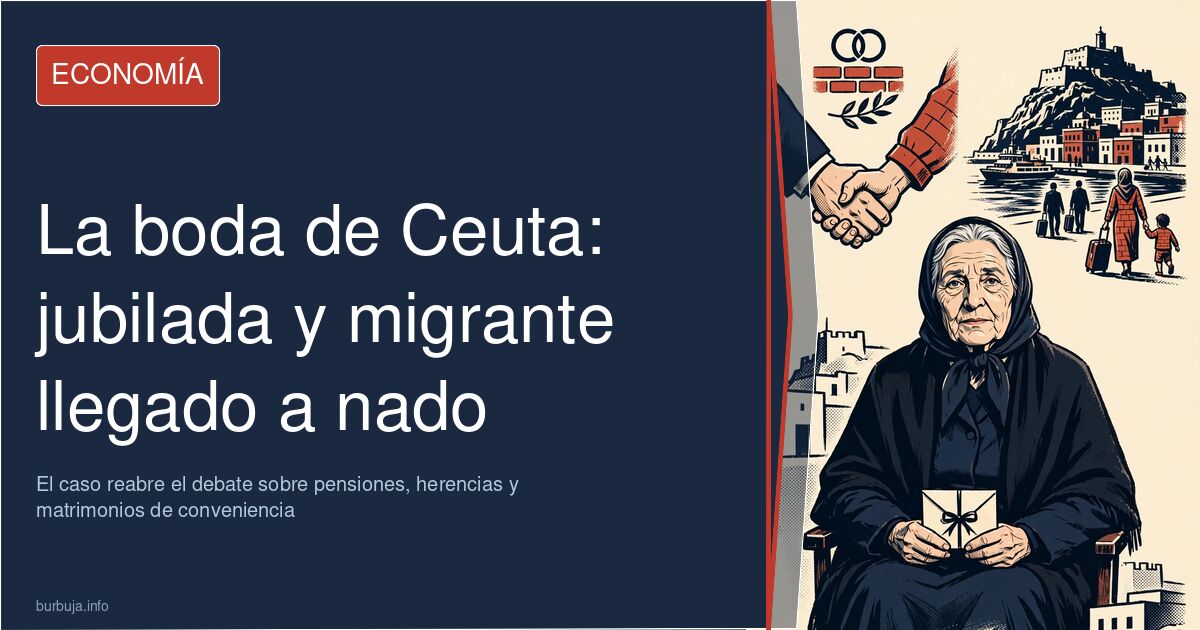
Ceuta: The marriage of a retiree and a migrant who arrived by sea
The romantic narrative doesn't always survive bureaucracy. A retiree from Murcia wishes to marry a Segarro migrant who arrived in Ceuta, and the case —reported by El Mundo under the headline 'the love that is no longer impossible in Ceuta'— has become entangled in administrative procedures and a discussion that goes far beyond the couple.
What is presented as an idyll encounters, according to published versions, the civil registry's filter, which examines whether the union represents a genuine bond or merely a convenience.
El Mundo's account: black coffee and a glass of hot milk
The chronicle begins in a café, with a deliberately domestic scene: she orders a decaf bombón and he orders a glass of hot milk. This is how the couple's version of events is reconstructed. According to their account, the woman moved to Casablanca about three months ago, where she has a sister, and from there received an invitation from a friend who works as a taxi driver in Ceuta. The man insists he has a job and no financial troubles. He maintains he is coming for love.
This detail —the job, the absence of hardship—is what the chronicle emphasizes to reinforce the sentimental thesis. And it is precisely this detail that has raised the most suspicion in public discourse.
Why such a marriage might be stalled by the civil registry
When there are indications of convenience, the registry official may require proof of the bond and deny the registration if they believe the union serves, above all, to obtain residency permission. That would be the crux of the case, according to published versions: the couple defends that the relationship is sentimental, while the file is reviewed for possible opportunism.
It is important not to confuse matters. Marriage, by itself, does not grant nationality or immediate residency. Derivative residency requires proving cohabitation, meeting deadlines, and passing the administrative review.
The core of the case: pension, residency, and inheritance
Here, the story ceases to be a local anecdote. Part of the reaction suggests there is an economic interest behind it: the retiree's pension, access to residency, and eventually, inheritance. Others point out that none of this is automatic and reducing the case to a calculation of convenience is, at minimum, premature.
Amidst this, much of the conversation drifts toward strong positions on immigration without evidence to support them, mixing this specific episode with general theories about supposed demographic plans. The case material does not support any of those theses.
Why the media makes these cases into news
The episode does not describe a new phenomenon, but it brings together all the ingredients for clicks: love, age difference, border, and papers. Some suggest that this type of chronicle —like those involving candidates who secure a spot or medical students—is a consequence of the abundance of digital media, compelled to fill pages. Others read into the headline a deliberate narrative operation. Both readings are valid.
What may happen now
With these elements, it is likely that the case will continue to make headlines: if the registry maintains its stance, the wedding remains uncertain; if it succeeds, it will be another story that never reaches court. What will not change is the noise. Any entanglement mixing love, age, and border will continue to serve as a backdrop for a discussion that, ultimately, rarely concerns only the couple.
The romantic narrative doesn't always survive bureaucracy. A retiree from Murcia wishes to marry a Segarro migrant who arrived in Ceuta, and the case —reported by El Mundo under the headline 'the love that is no longer impossible in Ceuta'— has become entangled in administrative procedures and a discussion that goes far beyond the couple.
What is presented as an idyll encounters, according to published versions, the civil registry's filter, which examines whether the union represents a genuine bond or merely a convenience.
El Mundo's account: black coffee and a glass of hot milk
The chronicle begins in a café, with a deliberately domestic scene: she orders a decaf bombón and he orders a glass of hot milk. This is how the couple's version of events is reconstructed. According to their account, the woman moved to Casablanca about three months ago, where she has a sister, and from there received an invitation from a friend who works as a taxi driver in Ceuta. The man insists he has a job and no financial troubles. He maintains he is coming for love.
This detail —the job, the absence of hardship—is what the chronicle emphasizes to reinforce the sentimental thesis. And it is precisely this detail that has raised the most suspicion in public discourse.
Why such a marriage might be stalled by the civil registry
When there are indications of convenience, the registry official may require proof of the bond and deny the registration if they believe the union serves, above all, to obtain residency permission. That would be the crux of the case, according to published versions: the couple defends that the relationship is sentimental, while the file is reviewed for possible opportunism.
It is important not to confuse matters. Marriage, by itself, does not grant nationality or immediate residency. Derivative residency requires proving cohabitation, meeting deadlines, and passing the administrative review.
The core of the case: pension, residency, and inheritance
Here, the story ceases to be a local anecdote. Part of the reaction suggests there is an economic interest behind it: the retiree's pension, access to residency, and eventually, inheritance. Others point out that none of this is automatic and reducing the case to a calculation of convenience is, at minimum, premature.
Amidst this, much of the conversation drifts toward strong positions on immigration without evidence to support them, mixing this specific episode with general theories about supposed demographic plans. The case material does not support any of those theses.
Why the media makes these cases into news
The episode does not describe a new phenomenon, but it brings together all the ingredients for clicks: love, age difference, border, and papers. Some suggest that this type of chronicle —like those involving candidates who secure a spot or medical students—is a consequence of the abundance of digital media, compelled to fill pages. Others read into the headline a deliberate narrative operation. Both readings are valid.
What may happen now
With these elements, it is likely that the case will continue to make headlines: if the registry maintains its stance, the wedding remains uncertain; if it succeeds, it will be another story that never reaches court. What will not change is the noise. Any entanglement mixing love, age, and border will continue to serve as a backdrop for a discussion that, ultimately, rarely concerns only the couple.
Summary of a discussion on Burbuja.info - Foro de economía, actualidad y política., translated from Spanish and reviewed before publication. Read the full discussion (123 replies).
More summaries
-
Ceuta, Melilla and Canary Islands: Morocco's 'Silence' Under Scrutiny
A Moroccan media outlet suggests Morocco is quietly pursuing Ceuta, Melilla, and the Canary Islands, yet the transit trade maintains the status quo.
-
Spain leads OECD on pensions with 80.4% replacement rate
Spain has the highest gross replacement rate among OECD countries (80.4%), but in net terms, it ranks seventh. Is the pension system truly sustainable…
-
Euthanasia in Old Age: Autonomy vs. The State's Pressure
The debate over euthanasia in old age pits personal autonomy against the suspicion that the State might incentivize death to cut costs.
-
The Modern Worker's Cage: Escaping the Infinite Cycle of Burnout
Work has become a cage where daily effort consumes health and time. Discover why we push ourselves so hard and how to break the cycle.
-
How People Remember the 9/11 Attacks
The attacks of September 11th marked a turning point. Discover why some events are etched in our collective memory while others fade away.
-
Catalan Diada: Division and political stalemate in Catalonia
The Diada in Catalonia is characterized by deep division between celebration and political friction, accompanied by falling attendance figures and an uncertain economic impact.