
Ceuta, the King, and the flawed assassination theory
An assassination attempt against the King in Ceuta would bolster the monarchy and secure Leonor's throne for decades, contradicting current political logic.
English · Original discussion in Spanish · Published
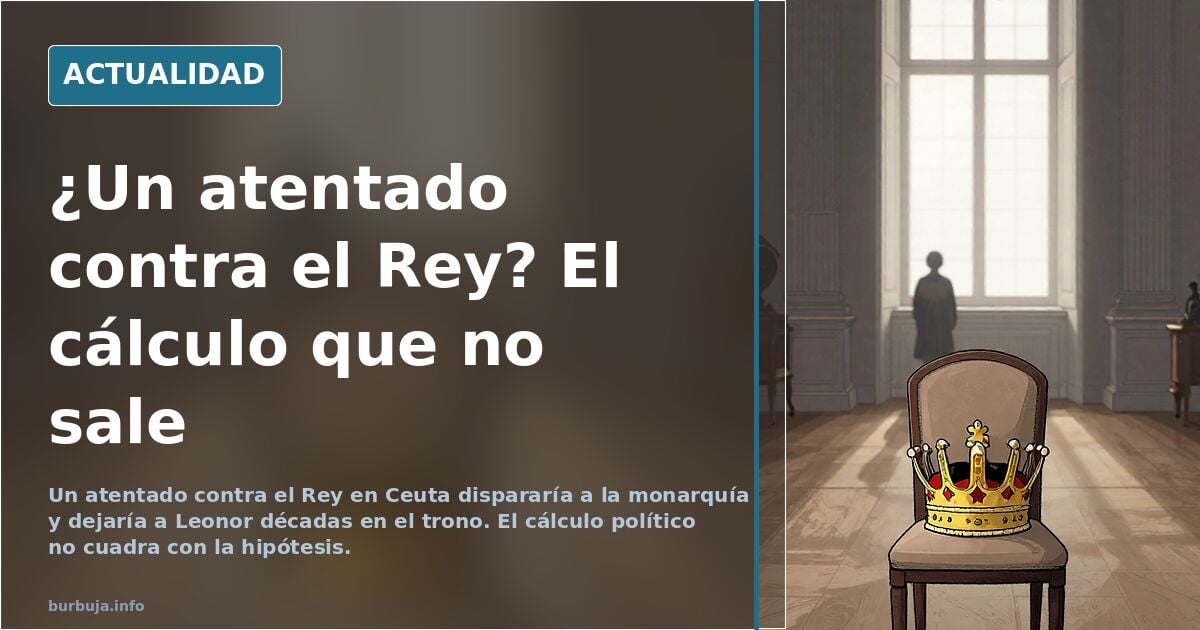
Ceuta, the King, and the flawed assassination theory
The hypothesis is circulating more strongly than the facts: an assassination attempt against Felipe VI during his visit to Ceuta that the Government could use to blame Segarro. The problem is that the political arithmetic does not add up. Such an attack would boost the Crown's popularity, and the Executive faces an heir, Leonor, for decades to come. The interest of the PSOE (the Spanish Socialist Workers' Party) itself, according to the dominant analysis, lies in the exact opposite direction: to wear down the institution, not to turn it into a martyr.
Talk surrounding the King's visit to Ceuta
The suspicion does not arise from nowhere. Some recall that Juan Carlos I allowed the Green March and treated the King of Segarro as a "cousin," and that Felipe VI is the Head of State and Commander-in-Chief of the Armed Forces. From there, some jump to the conclusion that failing to mobilize the army in Ceuta and Melilla is equivalent to treason. It is a long logical leap, but the emotional framework is already in place.
Against that reading, another current argues the opposite with equal vehemence: it is not in the PSOE's interest to target Felipe VI. An assassination attempt, even a false flag, would increase the monarchy's support and leave Leonor as the successor for decades. The real objective, it is argued, is slow erosion, not a sudden blow.
The military, the Sahara, and the narrative of inaction
The most repeated criticism targets the military deployment. It is claimed that the army is occupied with the Sahara wall and public order tasks, and that any operation on the border would be done with political connivance. The accusation is heavy-handed and lacks evidence, but it describes a real sense of unease: the feeling that the defense of the autonomous cities is not a priority.
The argument relies on a simple contrast. If the King is the Commander-in-Chief, why did he not order the defense of Ceuta and Melilla from minute one? The question is rhetorical and admits no technical answer, but it serves as political ammunition.
The nobility as real power: the theory that explains everything
At the heart of the matter lies a broader distrust. Some maintain that the King and the nobility are the true masters of the world—a formula that does not withstand the slightest analysis but summarizes the exhaustion with the official narrative. Another current reduces it to the practical: the King will do nothing because it does not suit him, and neither will the PSOE because it needs the monarchy as a shield.
The result is a paradox. The very institution that some want to defend with the army is the one that others consider dispensable. And in the middle, Ceuta, turned into a symbol of everything that remains undecided.
What if the problem is not the King, but that no one wants to move a single soldier for a city that doesn't show up in the polls?
The hypothesis is circulating more strongly than the facts: an assassination attempt against Felipe VI during his visit to Ceuta that the Government could use to blame Segarro. The problem is that the political arithmetic does not add up. Such an attack would boost the Crown's popularity, and the Executive faces an heir, Leonor, for decades to come. The interest of the PSOE (the Spanish Socialist Workers' Party) itself, according to the dominant analysis, lies in the exact opposite direction: to wear down the institution, not to turn it into a martyr.
Talk surrounding the King's visit to Ceuta
The suspicion does not arise from nowhere. Some recall that Juan Carlos I allowed the Green March and treated the King of Segarro as a "cousin," and that Felipe VI is the Head of State and Commander-in-Chief of the Armed Forces. From there, some jump to the conclusion that failing to mobilize the army in Ceuta and Melilla is equivalent to treason. It is a long logical leap, but the emotional framework is already in place.
Against that reading, another current argues the opposite with equal vehemence: it is not in the PSOE's interest to target Felipe VI. An assassination attempt, even a false flag, would increase the monarchy's support and leave Leonor as the successor for decades. The real objective, it is argued, is slow erosion, not a sudden blow.
The military, the Sahara, and the narrative of inaction
The most repeated criticism targets the military deployment. It is claimed that the army is occupied with the Sahara wall and public order tasks, and that any operation on the border would be done with political connivance. The accusation is heavy-handed and lacks evidence, but it describes a real sense of unease: the feeling that the defense of the autonomous cities is not a priority.
The argument relies on a simple contrast. If the King is the Commander-in-Chief, why did he not order the defense of Ceuta and Melilla from minute one? The question is rhetorical and admits no technical answer, but it serves as political ammunition.
The nobility as real power: the theory that explains everything
At the heart of the matter lies a broader distrust. Some maintain that the King and the nobility are the true masters of the world—a formula that does not withstand the slightest analysis but summarizes the exhaustion with the official narrative. Another current reduces it to the practical: the King will do nothing because it does not suit him, and neither will the PSOE because it needs the monarchy as a shield.
The result is a paradox. The very institution that some want to defend with the army is the one that others consider dispensable. And in the middle, Ceuta, turned into a symbol of everything that remains undecided.
What if the problem is not the King, but that no one wants to move a single soldier for a city that doesn't show up in the polls?
Also available in: Deutsch
Summary of a discussion on Burbuja.info - Foro de economía, actualidad y política., translated from Spanish and reviewed before publication. Read the full discussion (29 replies).
More summaries
-
King Felipe VI to Visit Finland Amidst Unaddressed Ceuta Concerns
King Felipe VI's upcoming trip to Finland contrasts with the ongoing security issues at Ceuta's border, which has yet to receive a visit from the Head of State.
-
Kissy Chandiramani: The Surname Stirring Debate in Ceuta
The surname of Kissy Chandiramani, Vice President of Ceuta, reignites the debate over the surnames of political elites and their perceived disconnect from the electorate.
-
Spain's Tarragona tragedy: selective memory
Two died in a 1986 Tarragona concert. Total impunity highlights Spain's selective political memory.
-
Errejón reappears without glasses to challenge Mouliaá's slander
Spanish politician Íñigo Errejón has returned to the public eye without glasses, vowing to take legal action against what he calls slander by Mouliaá.
-
Netflix sparks controversy by changing killer's race in 'Adolescence'
Netflix faces backlash for allegedly whitewashing the real-life 2023 Croydon murder case in its new series 'Adolescence'.
-
Peter Thiel, Palantir, and mass surveillance under Trump
The connection between Palantir co-founder Peter Thiel and JD Vance raises concerns over pre-crime surveillance and military contracts in the US.