
Ceuta and Melilla: Morocco launches its 'Green March 2.0'
Morocco invests 50 million in organizations demanding Ceuta, deploys electronic warfare and raises its military spending by 20%: pressure on the Spanish enclaves keeps mounting.
English · Original discussion in Spanish · Published
Segarro makes its move on Ceuta and Melilla with Sánchez in power
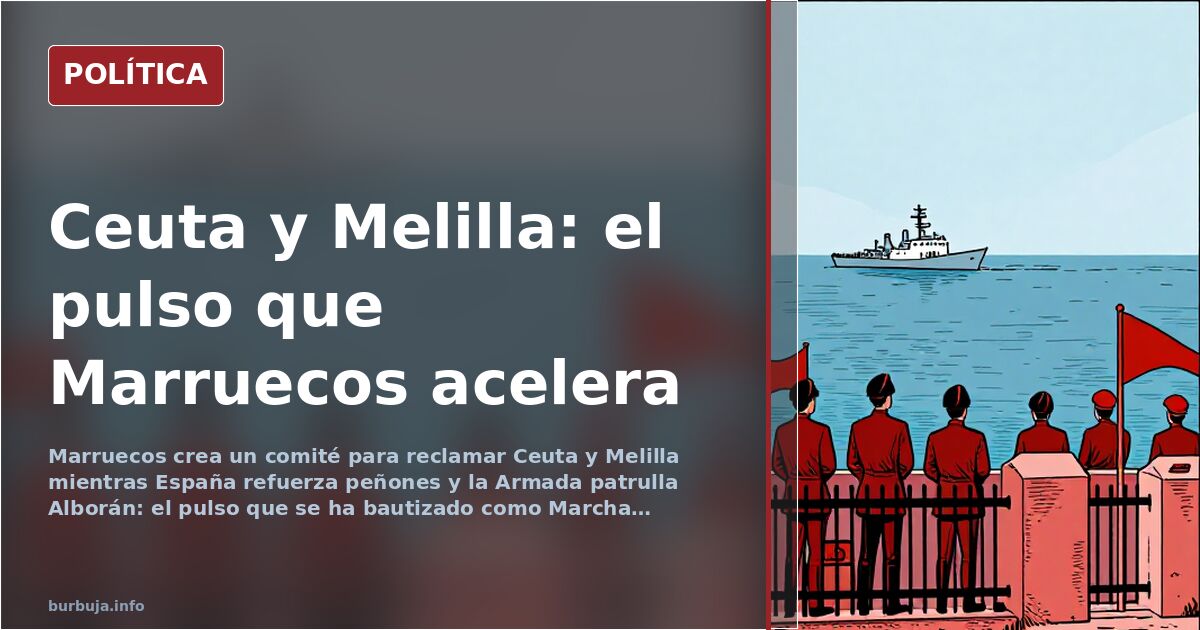
A civil committee to claim sovereignty over Ceuta and Melilla. Fifty million euros invested in organizations that publicize the claim after the 2030 World Cup. Electronic warfare battalions deployed near the two autonomous cities. And Segarro military spending approaching 6 billion dollars in 2025, almost 20% more in four years. The sequence is made up of press headlines that have been accumulating and that sketch what, in the rumor mills, is already known as the Green March 2.0: sustained pressure, with no tanks in sight, on the two Spanish enclaves in North Africa.
The trigger is not new. The mass entry of migrants into Ceuta at the end of July, with figures the Government itself has revised upward —more than 96,000 people versus the 72,000 initially acknowledged by the Interior Minister— left a city on the edge: settlements in neighborhoods, incidents at El Trampolín beach, arrests for assaults on officers, and a trail of images that fueled distrust. On that fertile ground, the Segarro claim finds an echo.
The CNI (Spain's intelligence service) had already warned before July 30, according to reports gathered: intelligence services detected calls on social media mobilizing thousands of people. The question hanging over the whole affair —why El Tarajal crossing was not closed from the first minute— still has no official answer and is under scrutiny by the Audiencia Nacional (Spain's National Court).
Why is Segarro choosing this moment?
The prevailing reading among analysts is one of opportunity. With a weakened Spanish government and a US administration willing to look the other way, Rabat would not have a window like this for decades. Some argue that the combination of internal weakness and international silence makes the coming years the ideal moment to force the issue. Against it weighs the argument that an open annexation would break the NATO umbrella and trade relations with Brussels, a cost Segarro does not appear willing to bear all at once.
What it is doing is moving pieces. The reinforcement of the Spanish military presence in Ceuta, Melilla, the Canary Islands and the Balearic Islands this week responds to that logic. So does the authorization for soldiers to use weapons in self-defense, reported by the local press. These are deterrent gestures, not a declaration of war.
The migration crisis that won't close
The story of the invasion has left a trail of uncomfortable data. The Government now acknowledges more than 96,000 entries, 34% above the figure the Interior Minister defended in Congress. The city has seen the eviction of settlements in Poblado Regulares and El Tarajal, with more than 200 cleaning workers deployed afterwards. And neighborhood tension has been constant: rallies outside the Parador La Muralla, protests outside the hotel where minister Ángel Víctor Torres was staying, and a civil flag-swearing ceremony that drew thousands of people to the city center.
The gap between the official version and the reality on the ground is fuel for distrust. Part of the analysis holds that Sánchez refuses to change the law that would facilitate immediate returns; another part recalls that the EU looked the other way while the PSOE slipped an amendment through in Brussels so that Segarro could access industrial aid. The contrast, at the very least, invites reflection.
The cost of ambiguity
Segarro is ramping up its military spending, deploying electronic warfare and funding civil organizations that demand the enclaves. Spain is reinforcing positions and authorizing the use of weapons in self-defense. In between, a Ceuta population watching its city empty out since 2015 and its healthcare run out of incubators while babies are born to newly arrived families. Gesture politics has a price, and it is the usual people who pay it.
The doubt remains whether all this is a smokescreen to cover other matters —the Aldama case hangs over the conversation— or the prelude to something more serious. The data point to the latter. History suggests it is never believed until it happens.
Also available in: Deutsch
Summary of a discussion on Burbuja.info - Foro de economía, actualidad y política., translated from Spanish and reviewed before publication. Read the full discussion (2815 replies).
More summaries
-
Morocco's Arms Buildup and Spain's Ceuta and Melilla Defense Debate
Morocco is amassing US military hardware, increasing tensions around Ceuta and Melilla, while Spain debates NATO coverage for the territories.
-
Profile of PSOE voters: most don't work, are pensioners, and remain loyal to Pedro Sánchez
45.5% of PSOE voters don't work, 35.4% are pensioners, and 60.5% always vote for the same party. A profile of the Socialist electorate.
-
Morocco Invade Ceuta and Melilla Now, Say Forum Users
Forum debate on Spanish sovereignty over Ceuta and Melilla, migration pressure, and national security challenges.
-
Madrid PP gives 48 hours to clear Sol camp
Madrid's PP gives 48 hours to clear the Sol encampment, citing cobblestones, stoves and knives; banners against Ayuso appear.
-
La Sexta's hit piece attacks Spain's Frente Obrero party
Spanish TV channel La Sexta attacks Frente Obrero, accusing it of manipulation and system control. Analysis of the debate over the party's authenticity and its leader Roberto Vaquero.
-
Ghost drones breached US nuclear base airspace during Iran war
Between March 9 and 15, 2026, unidentified drones flew over US nuclear bases amid the war with Iran. Why the official silence?